Nehmen Sie Kontakt mit DONGHE Company auf


Aktualisiert im Juni 2026. Bewertet vom technischen Team von Shanghai Donghe Science and Technology Co., Ltd
Die Phrase Wafer-Slicing vs. Wafer-Dicing Klingt nach der Wahl zwischen zwei konkurrierenden Schneidmethoden Ist es nicht Wafer-Slicing vs Wafer-Dicing ist wirklich eine Frage über zwei aufeinanderfolgende Produktionsstufen, nicht zwei konkurrierende Werkzeuge Schneiden und Würfen sind zwei verschiedene Arbeiten, die an entgegengesetzten Enden des Lebens eines Wafers ausgeführt werden: Das Schneiden verwandelt einen kristallinen Barren gleich zu Beginn in blanke Wafer, und das Würfeln schneidet einen fertigen, schaltungstragenden Wafer ganz am Ende in einzelne Matrizen durcheinander bringt die beiden Käufer dazu, Maschinen zu vergleichen, die nie Alternativen waren, und zu ignorieren, wo ihre realen Material - und Kostenverluste passieren.
Kurze Antwort: (Front-End)Wafer-Schneiden verwandelt einen kristallinen traditionellen Inyog (oder SiC/Saphir) in einen dünnen Wafer unter Verwendung eines Diamantdrahtsäge. (Back-End) Wafer-Dicing verwandelt einen fertigen Wafer (vollständigt den Produktlebenszyklus) durch Singulation mit einer Lasersäge, Plasma oder Stealth-Prozess-Säge oder Klingensäge (Dicing-Säge) oder Dicing-Technik (z. B. ein Stealth-Prozess) in Hunderte von Matrizen. Dabei handelt es sich um Stufen, die nacheinander auf einem einzelnen Materialstück laufen, in dieser Reihenfolge, keine Wahl zwischen dem einen oder dem anderen.
Wichtige Erkenntnisse
- Slicing ist Frontend (bei yasou, oder Asaris, oder bei dir); dicing ist Back End (von einem Wafer in dir) Verschiedene Maschinen Verschiedene Brennpunkte.
- Beim Stealth-Würfeln können 60-µm-Siliziumchips mit einer Bruchfestigkeit von 153 kgf zurückbleiben, was die höchste aller getesteten Düsensingulationsmethoden darstellt.
- Klingenwürfel-Kerf läuft ~20-50 m; Laser fällt unter 10 m; Plasma und Tarnung nähern sich Null-Kerf.
- Beim Schneiden erhöht das Abwerfen von Diamantdraht-Kerf von 0,15 mm auf 0,06 mm die Anzahl der Wafer pro 200 mm Barren von ~571 auf ~769 (+35%).
- Laser “schlicht und einfach schlagen” Klinge – tatsächlich bleibt Klinge kostengünstiger, selbst auf Silizium, wo seine Halterung relativ teuer und kostenbetrieben ist, seine Seitenwandqualität ausgezeichnet ist.
Schnelle Spezifikationen: Schneiden vs. Würfeln
| Waferschneiden | Ingot/Boule → dünne blanke Wafer (Front-End) |
| Waferwürfeln | Fertiger Wafer → Einzelmatrizen (Back-End-/Die-Singulation) |
| Schneidwerkzeug | Diamant-Mehrdrahtsäge |
| Würfeltools | Würfelsäge, Laser, Plasma, Tarnkappenlaser |
| Schnittbreitenterm | Schneiden: Drahtschere | Würfeln: Schnittfuge innerhalb der Straße |
| Typische Materialien | Si, SiC, Saphir, GaN, Glas |
Slicing vs. Würfeln auf einen Blick
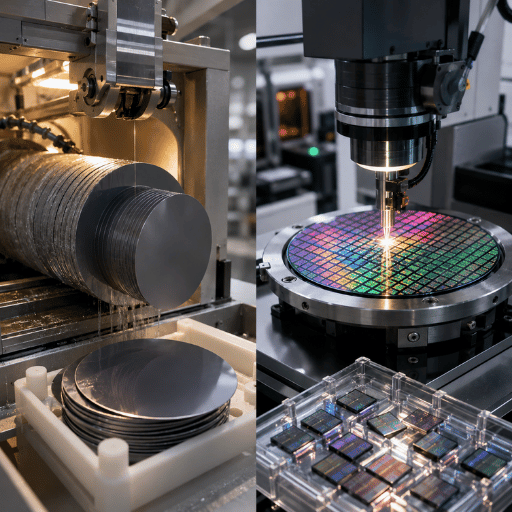
Wenn du dich nur an eines erinnerst, dann merke dir die Bestellung Ein Wafer ist Aufgeschnitten Einmal, kurz vor Beginn seines Lebens, und Gewürfelt Einmal, gegen Ende Dazwischen wird geläppt, poliert, gedopt, mit Schaltungen gemustert, oft auch ausgedünnt Also wenn jemand fragt, ob Slicing oder Dicing “besser” ist, dann ist die ehrliche Antwort, dass die Frage zwei Stufen durcheinander bringt, die nie um den gleichen Job konkurrieren.
Wir schlagen vor, dies The Slice-Then-Dice Timeline zu nennen, weil ein Barren einmal in der Vorderbühne geschnitten wird, dann werden viele fertige Wafer einmal in der Hinterbühne gewürfelt, und Fab-Führer der Universität Beschreiben Sie die gleiche Front-to-Back-Sequenz, während wir jeden Prozess oder jede Ausrüstung, die Sie recherchieren, auf die entsprechende Hälfte der 9-Punkt-Slice-vs-Dice-Matrix “passen” lassen möchten, unten.
| Kategorie | Wafer-schneiden | Waferwürfeln |
|---|---|---|
| Bühne | Front-End (erster Schnitt) | Back-End (letzter Schnitt vor dem Verpacken) |
| Eingabe | Kristalliner Barren / Boule | Fertiger, gemusterter Wafer |
| Ausgabe | Nackte Wafer (noch keine Schaltungen) | Einzelne Matrizen/Chips |
| Schnittbreitenterm | Drahtschere | Kerf innerhalb der Straße/Schreiberlinie |
| Primärwerkzeuge | Diamant-Mehrdrahtsäge | Würfelsäge, Laser, Plasma, Tarnkappe |
| Typische Schnittzahl | Hunderte parallele Drähte auf einmal | Tausende Straßen in X und Y |
| Ertragseinheit | Wafer pro Barren | Gut stirbt pro Wafer |
| Hauptkostenfahrer | Kerf-Verlust von Rohsilizium | Durchsatz- und Kantenausbeute |
| Typische Qualitätsmetrik | Kerf, TTV, Bogen/Warp (µm) | Chip-Out-Größe und Druckbruchfestigkeit |
Freie Synthese aus akademischen Peer-Review- und Standardquellen (unten aufgeführt); Die Anzahl der Schnitte pro Produkt hängt vom Waferdurchmesser und der Matrizengröße ab.
Wafer-Schneiden, erklärt: Wafer vergessen
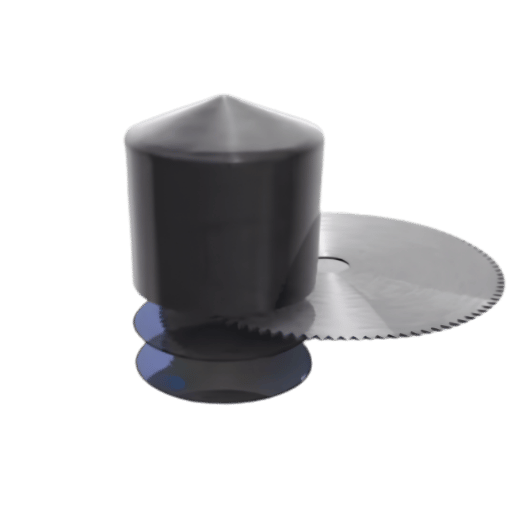
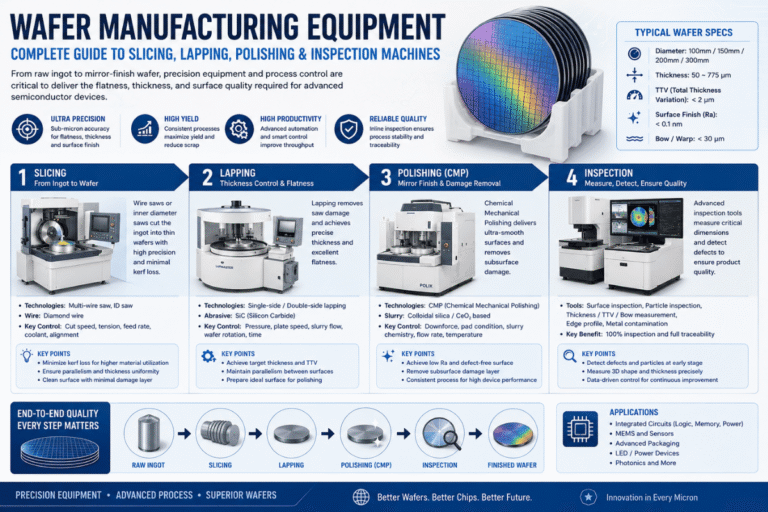
Wafer-Slicing-Frontend-Verfahren, das einen gewachsenen kristallinen Barren in dünne, flache Wafer verwandelt Heute wird es fast vollständig mit einer Diamantsäge durchgeführt, bei der ein Stahldraht Diamant-Schleifmittel über Hunderte von parallelen Führungen wickelt „den ganzen Barren in einem einzigen Durchgang in Waf schneidet.
Ältere Aufschlämmungs- und Innendurchmesser-Klingenmethoden werden weitgehend ausgemustert, und das Problem, das sie verursachten, war Abfall: Eine Klinge mit Innendurchmesser konnte 200300 µm Silizium pro Schnitt wegwerfen, während ein moderner Diamantdraht Krims auf etwa 5070 µm verkanten konnte Mikrometer Futtermaterial auf jedem Wafer gespeichert.
Die Schnittqualität wird anhand der Schnittbreite, der Gesamtdickenschwankung (TTV), des Bugs und der Verformung sowie der Beschädigung des Untergrunds beurteilt. Diese legen die Decke für alles flussabwärts fest: Ein Wafer, der sich mit hohem TTV von der Drahtsäge löst, kann nicht flach poliert werden, ohne zusätzliches Material zu entfernen, und tiefe Sägeschadenskappen, wie dünn er später geschliffen werden kann. Laut Diamantdraht-Schneidstudien schneidet das Halten von TTV unter etwa 10 µm den Schaft, den ein Polierer entfernen muss, scharf ab. Als Hersteller von Mehrdrahtsägen für Silizium, SiC und Saphir sehen wir dies aus erster Hand: Kunden, die mehr Wafer pro Kilogramm Ausgangsmaterial jagen, gewinnen oder verlieren auf Drahtschere, lange bevor der Wafer jemals ein Würfeltool erreicht.
Kerf-Verlust ist nicht trivial Front-End-Studien zum Diamantdrahtschneiden existieren genau deshalb, weil das Silizium in umgewandelt wurde Schnittfugen machen einen großen Teil des Ausgangsmaterials aus Dass Fabs versuchen zu recyceln Bei monokristallinen Barren ist jedes vom Drahtkerf abrasierte Mikrometer Silizium, das anstelle von Aufschlämmung zu einem verkaufbaren Wafer wird Hier beginnt die Waferverarbeitung: Ein einzelner Wafer muss sich flach genug von der Säge lösen für fortgeschrittene Halbleiterarbeiten Standard-Siliziumwafer versorgen den größten Teil der Halbleiterindustrie, und dieser Front-End-Prozess in der Halbleiterproduktion ist ein kritischer Prozess für die gesamte Halbleiterprozesskette, von dem der spätere Ätzprozess und das Würfen abhängen Für einen tieferen Blick auf das Material selbst siehe unseren Leitfaden zu Siliziumwafermaterial.
Wafer-Würfeln, erklärt: Wafer to Die
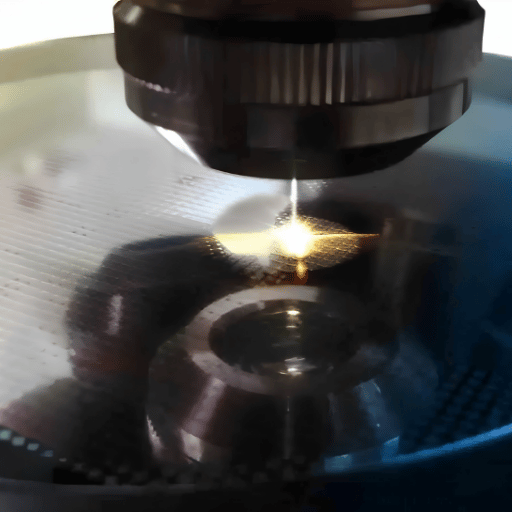
Wafer-Dicing, auch Die-Singulation genannt, ist der Back-End-D-Prozess, der einen fertigen, schaltungstragenden Wafer in einzelne Matrizen schneidet. Dieser Wafer-Dicing-Prozess läuft erst, nachdem der Wafer vollständig gemustert ist.
Bis ein Wafer beim Würfen bereits irgendwo zwischen einigen hundert und weit über 100.000 Stempeln auf einem 300 mm Wafer von bis zu ~77 µm Dicke erreicht, die jeweils durch eine schmale Spur getrennt sind, die Straße oder Schreiberlinie, die über die Jahre geschrumpft ist, von etwa 100 µm auf nur noch 2040 µm bei dichten Konstruktionen schnitt Dicing diese Straßen ab, ohne die aktiven Kreisläufe auf beiden Seiten zu zerschneiden.
Wenn beim Schneiden ein einziges Werkzeug verwendet wird, bietet das Würfeln vier konkurrierende Werkzeugfamilien: die mechanische Würfelsäge, das Laserwürfeln, das Plasmawürfeln und das Stealth-Würfeln. Der Wafer wird auf einem Klebe-Würfelband montiert, das über einen Würfelrahmen gespannt ist, sodass die Matrizen während und nach dem Schnitt stehen bleiben, und UV-Freisetzungsband wird für empfindliche Substrate verwendet, da es nach dem Aushärten sauber loslässt. Gesangsang Wenn der Wert eines Wafers endgültig entriegelt oder zerstört wird, stirbt das Splitterriss ab. Hier ist das Problem echtes Geld: Ein einzelner Crack-Chip auf einem 100.000-Düsen-Wafer ist Schrott, und die Wahl der falschen Würfmethode vervielfacht diesen Verlust.
Jede Würfeltechnik ist eine mechanische Würfelsäge, auf der Diamant-Würfelblätter laufen, ein Laser-Würfelverfahren oder ein Plasmaschrittverfahren und eine bestimmte Würfelmethode, die an das Gerät und seinen Halbleiter angepasst ist. Gießereien wiegen Würfeln, Würfelherausforderungen, die ein bestimmtes Würfelsystem liefert, und viele lagern Wafer-Würfeldienste aus, anstatt Präzisionswafer-Würfeln im eigenen Haus auszuführen. Würfeln ist der Prozess, der einen Wafer schließlich in viele Halbleiterbauelemente verwandelt. Um zu sehen, wo Würfeln im größeren Fluss liegt, lesen Sie unsere Übersicht über den Wafer-Wurf Halbleiterfertigungsverfahren.
Die 8 Unterschiede, die tatsächlich wichtig sind
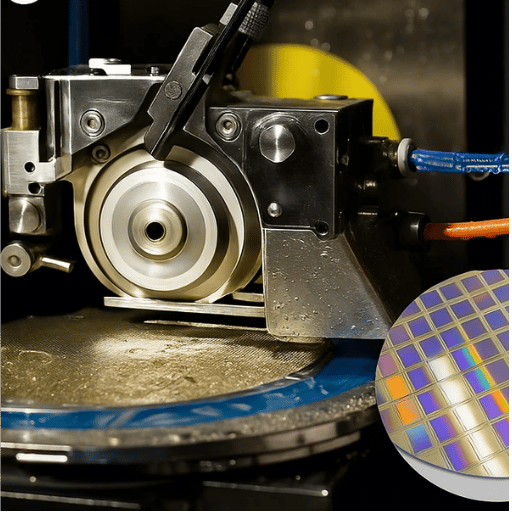
Die acht Dimensionen findest du auf der a-glance-Tabelle, aber hier noch ein kurzer Überblick, warum du vielleicht jeweils anders kaufst Nummer eins: Zwei völlig unterschiedliche Produkte vergleichen, eine Würfelsäge mit einer Drahtsäge “auf Preis kaufen”, wenn sie den Job nicht kann dann kann sie es einfach nicht, es gibt nicht einmal eine Chance auf einen Vergleich zwischen zwei nicht verwandten Werkzeugen, man kann ja keine Drahtsäge herstellen, die wird nie einen gemusterten Wafer einsingen, und eine Würfelsäge wird nie einen Barren in Wafer verwandeln.
️ Häufiger Fehler
Auch das Waferschneiden angeben, ohne anzugeben, in welcher Stufe Einige haben Front End Multiwire Slicing andere Back End Laser Dicing Antworten 2 sehr unterschiedliche Fragen zitiert Geben Sie immer Input (ingot oder fertiger Wafer) und Output (Wafer oder Matrize) an. .
Was Geld antreibt, ist der Schnittbreitenterm und die Ertragseinheit der Schnittbreitenterm und die Ertragseinheit. Beim Schneiden steht Kerf im Verhältnis zum Barren und wird in Wafern pro Barren ausgewertet. Beim Würfeln wird Kerf in Bezug auf bewertet Straße und die Bewertung erfolgt mit guten Matrizen pro Wafer. Die Kombination der beiden Modelle zur Darstellung der Kosten führt dazu, dass Käufer sich auf den kostengünstigen Teil des Zyklus fixieren und den Kostümierungsprozess außer Acht lassen. Das Risiko ist real, da die beiden Stufen unterschiedliche Fragen beantworten, sodass vergleichbar aussehende Zitate nie eine Trennung waren auch in sichtbar USPTO-Speicherungen zur kombinierten Laser- und Ätzsingulation.
Vier verglichene Würfelmethoden: Klinge, Laser, Plasma, Tarnung
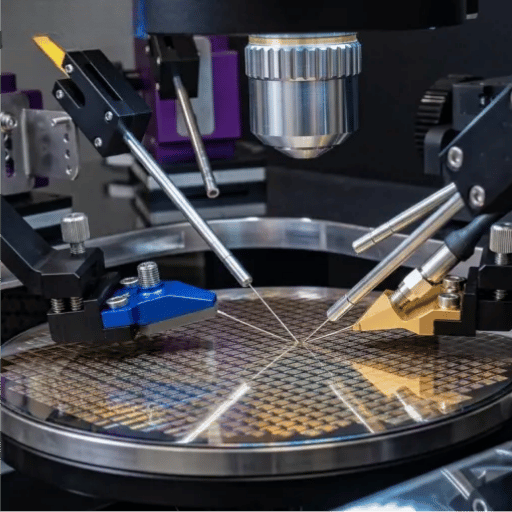
(Typischerweise werden Drei-Wege-Würfeln in vielen Ratgebern erwähnt In Wirklichkeit vier-wenn Stealth enthalten ist-haben unterschiedliche Stärken in Bezug auf Kenf, Würfelleistung, Geschwindigkeit, Stempelstärke etc. Diese Seite listet die vier: Vier-Methoden-Singulation Scorecard. Vergleich über Kerf, Würfelleistung, Stempelstärke usw)
Was sind die drei Haupttypen von Singulationswürfeln?
Es gibt drei Haupttypen im herkömmlichen Sinne: mechanisches Klingenwürfeln (Sägen), Laserwürfeln und Plasmawürfeln Ein viertes, Stealth-Würfeln, verwendet einen Infrarotlaser, der im Inneren des Wafers fokussiert ist und heute Mainstream ist Klingenwürfeln mahlt die Straße, Laser leuchtet sie ab, Plasma ätzt jede Straße auf einmal, und Tarnung bildet einen vergrabenen Riss, den das Band dann auseinanderreißt.
| Methode | Mechanismus | Kerf | Relative Stärke / Geschwindigkeit | Am besten passen |
|---|---|---|---|---|
| Klinge (Säge) | Diamantklinge bei 15.00 Uhr 60.000 Uhr | ~20 – 50 µm | Ausgezeichnete Seitenwand; langsamer auf dünnen Matrizen | Dickeres Si, kostengetriebenes Volumen |
| Laserablation | Gepulster Laser entfernt Straßenmaterial | <10µm | ~6.3× schneller als Klinge auf ultra-dünn | Dünne Wafer, enge Gassen |
| Plasma | Chemische Ätzung aller Straßen auf einmal | Nahezu Null | Hoher Durchsatz; braucht Maskierung | Dichte, kleine Matrizen / MEMS |
| Heimlichkeit | IR-Laser reißt im Wafer und bricht dann | Nahezu Null | Höchste Matrizenstärke; trocken, keine Trümmer | Zerbrechliche / ultradünne Matrizen |
Daten für Kerf und Schnittkräfte, die aus verschiedenen von Experten begutachteten Veröffentlichungen und Fachzeitschriftenpublikationen generiert wurden, alle unten zitiert.
Diese Stealth-Stärkezahl ist immer ein Schocker. Wenn man Äpfel mit Äpfeln vergleicht, so die von Experten überprüften Tests, Mit Stealth-Düsen von 60 µm erreichte die Bruchfestigkeit von 1 kgf, die höchste von allen untersuchten Methoden, die mit 5 kgf gemessen wurde. Das ist wichtig, denn der Ausfall von dünnen Spänen ist fast immer die Back-End-Belastung und nicht eine Folge des Würfelns.
“Im Vergleich zum Laserschneiden ist das Würfeln mit der Klinge immer noch ein wichtiger Prozess mit ausgezeichneter Seitenwandqualität und relativ geringen Kosten, die Methode sollte dem Material und der Dicke der Matrize folgen, nicht der Mode”
Kerf, Straßenbreite und Materialverlust: Wohin das Geld fließt
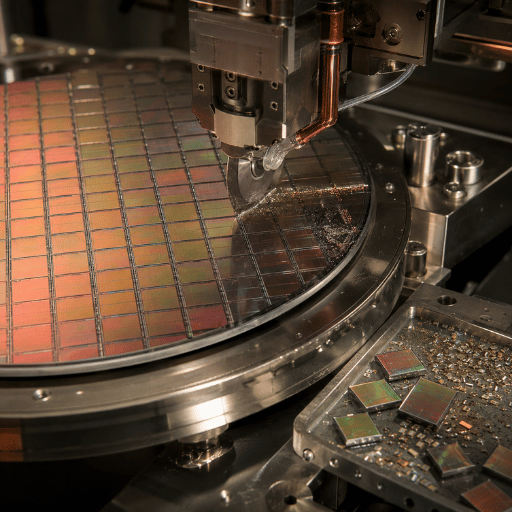
Beide Stufen werfen Material als Schnittfuge weg, aber die Ökonomie lebt an verschiedenen Orten. Beim Schneiden geht Schnittfuge als Ausgangsstoff Silizium verloren; Beim Würfen frisst Schnittfuge in die Straßenbreite, die mehr Würfel hätte aufnehmen können. Wir nennen die zweiseitige Ansicht Die Kerf-zu-Straße-Kostenmatrix: Front-End-Kerf wird in Wafern pro Barren bezahlt, Back-End-Kerf wird in Matrizen pro Wafer bezahlt.
Technische Anmerkung Wafer pro Barren
Wafer pro verwendbarem Barren = verwendbar (Waferdicke + k) Nehmen Sie eine 200 mm verwendbare Säule aus Silizium, die in 0,20 mm Wafer geschnitten ist. Mit einem Legacy 015 mm Kerf: 200 (0,20 + 0,15) = 571 Wafer. Fester Draht auf einen 200 mm Ker 206 mm Kerf: den Diamanten (0,20 + 0,06) = 769 WaferDerselbe Barren, +35% mehr Wafer, „mit Nulländerung an den Matrizen, die später kommen. Stecken Sie Ihre eigene Barrenlänge, Zieldicke und Drahtkerfe ein, um Ihren tatsächlichen Ertrag zu ermitteln.
Nun der kontraintuitive TeilDie Thin-Die-Inversion. Klingenwürfeln sieht am billigsten aus, weil die Ausrüstung am kostengünstigsten zu kaufen ist Aber unter etwa 100 µm Matrizendicke kehrt sich das Bild um: Dünne Matrizen sind zerbrechlich, und Klingensplitter und Rissantrieb führen zu einem Verlust, der die Ausrüstung spart. Auf ultradünnen Wafern, Die Laserablation läuft etwa 6,3 ̄F schneller als das Blattwürfeln (Minuten gegenüber etwa 25 Minuten pro Wafer) unter Beibehaltung stärkerer Matrizenkanten Die “günstige” Methode wird zur teuren, sobald verschrottete Matrizen gezählt werden.
Abstimmungsprozess auf Material: Silizium, SiC, Saphir und Glas
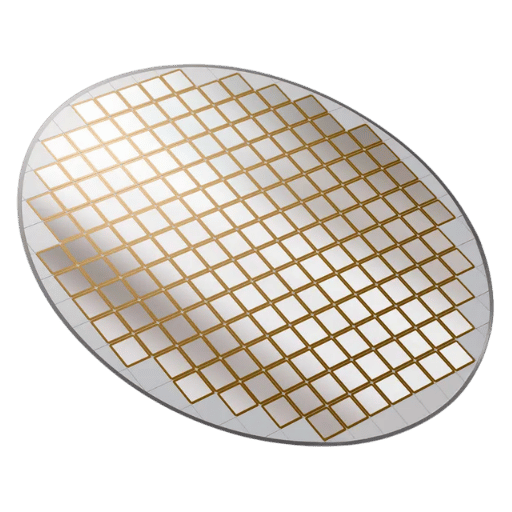
Und natürlich gibt es Materialien, für die die Dicke allein jedoch an und für sich kein bestimmender Faktor ist; die besondere Anforderungen an Materialhärte und Brucheigenschaften haben Standard-Siliziumarbeiten, aber Materialien, die erheblich schwieriger sind, also; härter, zäher, spröder wie Siliziumkarbid, Saphir oder sogar Galliumnitrid; wird beim Schneiden durch inkompatible Maschinen deutlich anfälliger für Absplitterungen oder Brüche sein.
| Material | Slicing-ansatz | Würfelansatz |
|---|---|---|
| Silizium | Diamantdrahtsäge (reif) | Klinge für dick; Laser/Stealth für dünn |
| SiC | Diamantdrahtsäge, langsame Zuführung | Ultradünne Diamantklinge oder Laser |
| Saphir | Diamantdrahtsäge | Stealth/Laser zur Begrenzung des Abplatzens |
| Glas / GaN | Drahtsäge oder nachgewachsen | Laser oder Plasma, geringe mechanische Belastung |
Für unsere eigene Arbeit mit Siliziumkarbid oder Saphir; Wir stellen oft fest, dass Kunden die Leistung unserer Werkzeuge möglicherweise auch nicht ausreichend nutzen, indem sie sie mit so geringer Geschwindigkeit schneiden; sie führen unbeabsichtigt zu kostspieligen Problemen in späteren Verarbeitungsphasen; wie Überpolieren oder sogar Beschädigungen an Kanten, die sich letztendlich auf das Würfeln der Wafer selbst auswirken; siehe unseren Artikel bezüglich Siliziumkarbid-Schleifmittel; oder eines unserer Spezialwerkzeuge, wie z SiC-Waferschneiden und Saphirwafer-Schneiden Anlagen.
Auswahl zwischen Schneiden und Würfeln: Ein Entscheidungsrahmen
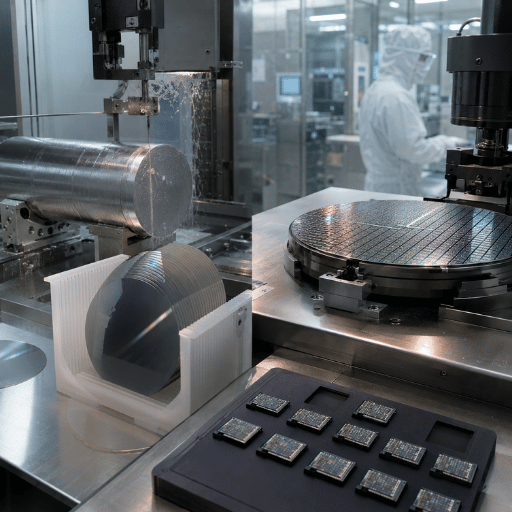
Angesichts der Tatsache, dass es nun zwei sich gegenseitig ausschließende Prozesse gibt; Ihre Wahlmöglichkeiten sind auch zwei unterschiedliche Wahlmöglichkeiten. Erstens; Wie werden Sie Ihre rohen Barren in Wafer schneiden, und zweitens, wie werden Sie Ihre Wafer nach dem Schneiden singulieren (trennen)? Dieser einfache Baum kann den Denkprozess vereinfachen.
Entscheidungsbaum
- Wenn Ihre Aufgabe darin besteht, Ihre Barren in Wafer zu schneiden, dann sind unsere Diamantdrahtsägen mit mehreren Klingen (keine Schneidmethoden) der richtige Weg; Stimmen Sie auf minimale Schnittfuge und TTV, nicht nach dem verwendeten Verfahren.
- Die einfachste Möglichkeit, vorbereitete Wafer mit Matrizen über 150 Mikrometer zu singulieren, ist ein Standard-Klingenwürfsystem (Sägewürfeln).
- Im Fall der Vorbereitung und des Singens von Wafern mit dünnen Matrizen (<100 Mikrometer); zerbrechliche Matrizen oder sehr harte Matrizen wie SiC oder Saphir; Wir empfehlen den Einsatz von Laser- und Stealthdicing-Technologien, da beide sauber und nahe Null Schnittfugen schneiden und gleichzeitig die strukturelle Integrität beibehalten.
- Für kleine Matrizen, ob als große Gruppe geschnitten; (viele kleine dichte Wafer); oder als einzelne Schicht;-Plasmawürfeln (das die gesamte Reihe von Matrizen gleichzeitig einzeln darstellen kann) ist eine weitere Alternative, die eine Schnittfuge von nahezu Null verwendet.
Es gibt auch eine Build-versus-Buy-Entscheidung Bringen Sie einen Prozess mit sich und bringen Sie Investitionsgüter und geschulte Bediener mit; Das Outsourcing zu einem Würfeldienst ersetzt diesen durch eine Gebühr pro Wafer. Als allgemeine Faustregel begünstigt ein stetig hohes Volumen den Besitz des Tools, während ein geringes oder variables Volumen und exotische Materialien ein Servicebüro begünstigen - zumindest bis das Volumen hoch genug ist, um den Kapitalaufwand zu rechtfertigen. Für das Schneiden, insbesondere unser Mehrdrahtsägemaschinen Für die hauseigene Hochdurchsatz-Waferproduktion ausgelegt sind.
Qualitätskontrolle: Kerbverlust, Späne, TTV und Matrizenstärke
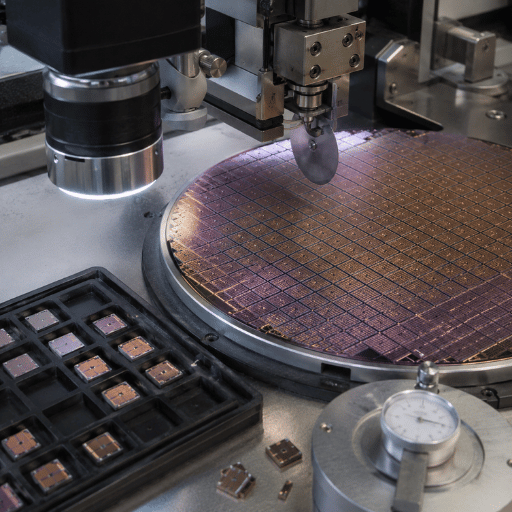
Wie erfolgt die Qualitätskontrolle und -inspektion beim Waferwürfeln?
Die Wurfqualität wird anhand der Chip-Out-Größe auf der Vorder- und Rückseite, der Bruchfestigkeit der Matrize und der Schnittplatzierungsgenauigkeit gemessen, gemessen mit optischer Messtechnik und, bei versteckten Rissen, der akustischen C-Mode-Rastermikroskopie. Das Absplittern entlang der Matrizenkante ist der vorherrschende Fehlermodus, und der Ertragsverlust beim Würfeln hängt von drei Dingen ab: Schnittfehlplatzierung, Kontamination und Absplitterung, die erfahrene Bediener bei jedem Wafer genau beobachten.
Ob Sie nun Wafer oder Dicing-Halbleiterwafer sind, die häufigsten Wafer-Cricing-Herausforderungen gehen auf den Schneidprozess selbst zurück Diese Herausforderungen beim Silizium-Wafer-Dicing und beim Cracken, beim Cracken als Säge bewegt sich der Wafer entlang jeder Straße. Machen Sie eine disziplinierte Wafer-Dricing-Technik unerlässlich, die Wahl des Blatt-Dicing oder Lasers setzt die Decke auf das Erreichbare. Bediener halten den Wafer flach und stimmen die Prozessparameter ab, um die Qualität der Waferoberfläche und die Gesamtqualität des Wafers am Stempelrand zu schützen; Dies sind die Kerntypen der Dicing-Kontrolle beim Halbleiter-Wafer-Dicing-Dicing-Dicing-Dicing-Dicing.
Im speziellen Fall des Siliziumwafer-Würfelns werden höhere Genauigkeitsgrade bei abnehmenden Matrizengrößen erforderlich sein und daher feinere Toleranzen gelten. Ebenso müssen auf der Schneidseite die Schnittgleichmäßigkeit und Präzision zusammen mit der Ebenheit (Bogen, Kette und TTV) berücksichtigt werden. In beiden Bereichen muss eine Konstante verstanden werden: Früher gemachte Schäden werden sich später nur zu höheren Kosten bemerkbar machen; Oberflächenschäden durch den Schnitt bestimmen, wie dünn ein Wafer geschliffen werden kann, ohne zu brechen, und unser Leitfaden dazu Waferverdünnung Beginnt mit geschnittener Qualität Spindel-RPMs werden normalerweise von 15.000 bis 30.000, und noch höher bei 60.000 rpm mit feinen Schnitten, aber das kann eine Vibrationsherausforderung zwischen einer glatten Schnittstraße und einem zerbrochenen Gesenk einführen.
Branchenausblick: Wohin sich die Singulation entwickelt (2025 Uhr 2026)
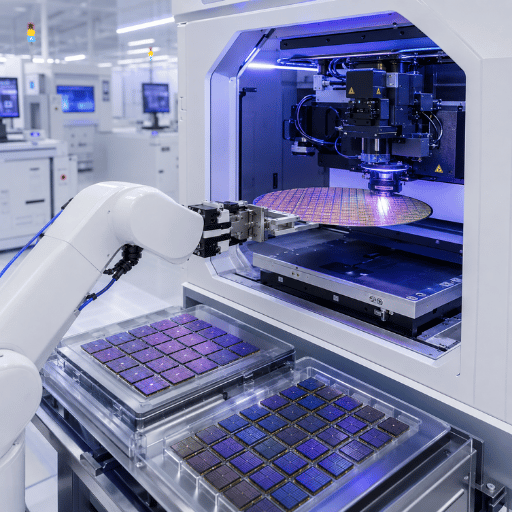
Aber physikalisch-nicht-ökonomische Details verändern alles - die Tatsache, dass die Stäbchen immer dünner werden (weit unter 100 µm) und dass die SiC- und GaN-Volumina weiterhin in die Höhe schnellen, was sowohl das mechanische Schneiden als auch das mechanische Schneiden bestraft. Daher tendiert die Back-End-Singulation zunehmend zu Zero-Kerf-Methoden wie Laser- oder Stealth-Technologie - wie es sogar Plasma ist; Beim Front-End-Schneiden mit den Schneidtechniken werden Diamantdrähte immer feiner, um die Nutzung wertvoller Rohstoffe zu maximieren.
Die praktische Lektion für Käufer ist: Hören Sie auf, alle Linien im Jahr 2026 zu behandeln, insbesondere diejenigen, die Geräte mit weniger als 100 µm wie Klingensägeumgebungen verarbeiten möchten - oder seien Sie bereit, Laser- oder Tarnkappenfähigkeiten darin aufzunehmen!
Wenn man sich anschaut, wo der Aufwand liegt, sind es hybride Ströme, die Ansätze kombinieren. Aktuelle Einreichungen zeigen Backside Stealth Laser-Dicing und Laser-plus-ätz-sequenzen zur steigerung der stanzbruchfestigkeit nur als hintergrundinformationen, market-beobachter prognostizieren, dass ausrüstungswachstum von nur mittleren einstelligen ziffern bis Anfang 2030, also nicht die primäre metrik im vergleich zu einer methodenverschiebung von jeder schlagzeile marktgrößenzahl, wenn sie ihre kapazitätserweiterung für 2026 planen, wählen sie würfelwerkzeuge auf ihrem dünnsten stempel und schneidedrähte auf ihrer engsten schnittspezifikation Das risiko für käufer ist standardmäßig mit dem klingenwürfeln, weil es vertraut ist, selbst wenn dünne sic-und gan-arbeiten bereits weitergegangen sind.
Häufig gestellte Fragen
Was ist der Unterschied zwischen Wafer-Slicing und Wafer-Dicing?
Antwort anzeigen
Wafer-Slicing ist ein Front-End-Schritt: Es schneidet einen kristallinen Barren mit einer Diamantdrahtsäge in dünne, blanke Wafer, bevor irgendwelche Schaltungen existieren Wafer-Dicing ist ein Back-End-Schritt: Es trennt einen fertigen, schaltungstragenden Wafer in einzelne Matrizen mit einer Säge, einem Laser, einem Plasma oder einem Tarnkappenwerkzeug, Sie sitzen an gegenüberliegenden Enden des Lebens des Wafers und laufen auf völlig unterschiedlichen Maschinen, es handelt sich also um aufeinanderfolgende Stufen und nicht um zwei Methoden, zwischen denen Sie wählen.
Ist Wafer-Dicing dasselbe wie Die-Singulation?
Antwort anzeigen
Ja. Die Singulation ist die formale Bezeichnung für Wafer-Dicing, den Back-End-Prozess, der einen fertigen Wafer in einzelne Dies oder Chips trennt. Beide Begriffe werden in der Halbleiterfertigung austauschbar verwendet. Die Singe umfasst alle vier Methoden. Singen mit Klingen (Säge), Laser-Dicing, Plasma-Dicing und Stealth-Dicing, von denen jeder entlang der Straßen schneidet, die zwischen den Diebsingungen verlaufen. Wenn Sie also die Singulation lesen, stellen Sie sich den Wurfschritt nahe dem Ende der Linie vor.
Ersetzt Laser-Dicing das Blade-Dicing
Antwort anzeigen
Nicht ganz. Laser-Dicing gewinnt auf dünnen Wafern und engen Gassen, wo es viel schneller läuft und weniger mechanische Schäden hinterlässt. Aber das Blatt-Dicing ist billiger zu besitzen und bietet eine hervorragende Seitenwandqualität auf dickerem, kostengetriebenem Silizium, sodass es für viele Produkte mit hohem Volumen die Standardeinstellung bleibt. Die Wahl der Methode folgt der Dicke und dem Material der Matrize, nicht der Neuheit, und viele Fabs führen beides aus und passen jede Methode dem Produkt auf der Linie an.
Was ist der Unterschied zwischen dem CZ - und FZ-Verfahren?
Antwort anzeigen
Czochralski (CZ) und Float-Zone (FZ) sind zwei Möglichkeiten, den Siliziumbarren, den das Schneiden später in Wafer schneidet, zu züchten. CZ zieht einen Kristall aus einer Schmelze und dominiert die Produktion in großen Mengen, während FZ eine höhere Reinheit für Strom- und HF-Geräte ergibt.
Was ist Wafer-Coring und wie unterscheidet es sich vom Würfen?
Antwort anzeigen
Aus einem größeren Wafer bohrt das Einkerben kleinerer runder Wafer oder Testcoupons, wobei sich dessen Form ändert, durch das Würfeln wird ein fertiger Wafer in viele rechteckige Matrizen entlang der Straßen geschnitten, kurzum formt das Einkerben das Silizium neu, während das Würfeln es zu Chips singuliert.
Kann eine Maschine sowohl Schneiden als auch Würfeln?
Antwort anzeigen
Nein, die beiden Stufen benötigen unterschiedliche Maschinen Beim Slicing wird eine Diamant-Mehrdraht-Säge über einen Barren geführt, um blanke Wafer herzustellen, während beim Dicing ein Säge-, Laser- oder Plasmawerkzeug auf einem fertigen Wafer zum Trennen der Matrizen verwendet wird. Es handelt sich lediglich um unterschiedliche Maschinen, die für verschiedene Stufen gebaut wurden.
Kurz gesagt, Schneiden und Würfeln sind keine konkurrierenden Methoden, sondern zwei aufeinanderfolgende Stufen desselben Wafers: Eine Diamantdrahtsäge schneidet den Barren am vorderen Ende in blanke Wafer, und ein Säge-, Laser-, Plasma- oder Tarnkappenwerkzeug würfelt den fertigen Wafer am hinteren Ende in einzelne Matrizen. Ordnen Sie jede Maschine an ihre eigene Stufe an und passen Sie die Würfelmethode an Ihre Matrizendicke und Ihr Material an.
Verwandeln Sie Barren mit DONGHE in Wafer im Produktionsmaßstab.
Entdecken Sie DONGHE Mehrdrahtsägemaschinen →
Warum wir das geschrieben haben
DONGHE (Shanghai Donghe Science and Technology Co., Ltd) baut Diamantdrahtsägen zum Schneiden von Silizium, SiC und Saphir mit mehr als 10.000 Schneidkisten bei 300+ globalen Kunden. Wir sehen die Slicing-vs-Dicing-Verwirrung ständig in Käuferfragen, daher trennt dieser Leitfaden zum Wafer-Dicing und -Schneiden die beiden Phasen und teilt die Front-End-Kerf-Daten, die nur bei Dicing-Ressourcen außer Acht gelassen werden. Überprüft vom technischen Team von Shanghai Donghe Science and Technology Co., Ltd.
Referenzen und Quellen
- Si-Charakterisierung bei Ausdünnungs- und SingulationsprozessenNIH National Library of Medicine (PMC)
- Ultrapräzises Schneiden von 4 H-SiC-WafernNIH National Library of Medicine (PMC)
- WürfelbildungWiki der Lurie Nanofabrication Facility, University of Michigan
- Splittgröße in Si- und SiC-Wafer-Dicing mit DiamantsägeblattScienceDirect
- Recycling von Kerf-Loss-Silizium aus dem Diamantdraht-SägenschneidenScienceDirect
- Laserablationswürfeln für ultradünne Wafer-SägenHalbleitertechnik
- WaferwürfelnHalbleiterverdau
- Die SingulationWikipedia
- US20120211748A1: Methode zum Wurfscheiben (Stealth)USPTO über Google Patente
- Diamantdrahtsägen für PV, HerausforderungenPV-Tech