Nehmen Sie Kontakt mit DONGHE Company auf


Aktualisiert: August 2026
Siliziumkarbidkeramik Familie von strukturellen, nicht-oxidischen Keramiken statt einer austauschbaren Sorte ist, drucklos gesinterte, reaktionsgebundene, nitridgebundene, rekristallisierte und heißgepresste Körper können sich in Porosität, Restphasen, Formfähigkeit, Korrosionsantwort und Veredelungsanforderungen unterscheiden Eine fundierte Spezifikation verbindet daher vier Entscheidungen: den Materialweg, den Fertigungsweg, den Betriebsausfallmodus und die fertige Geometrie.
Direkte Antwort
Siliciumcarbid wird zur Strukturkeramik, wenn SiC-Pulver oder - Körner verfestigt, gebunden und zu einem Formkörper verarbeitet werden, das abgegebene Bauteil wird durch seinen Verdichtungsweg, Additive, Restphase, Porosität, Mikrostruktur und Finish definiert, nicht durch die Buchstaben “SiC” allein.
Schlüssel zum Mitnehmen
Wählen Sie zuerst die Servicegüte aus und qualifizieren Sie dann den Prozess, die fehlerempfindliche Geometrie, die Verbindung, den endgültigen Schnitt und die Inspektionsnachweise als ein System.
Dieser Leitfaden behandelt die Eigenschaften von Siliziumkarbidkeramik, die Verwendung von Siliziumkarbidkeramik und die Zusammensetzung von Siliziumkarbid als zusammenhängende technische Fragen. Jeder ändert sich mit der Route, der Serviceumgebung und den Beweisen hinter dem fertigen Teil.
Der strukturelle Geltungsbereich schließt Moissanit-Edelsteine, Siliziumkarbid in Glasurrezepten, Siliziumkarbidfasern, Siliziumkarbidsubstrate in großen Mengen und elektronische Geräte in der Halbleiterindustrie aus. Diese Themen gehören zu unterschiedlichen Materialformen und Suchabsichten.
Geltungsbereichsgrenze: Übliche Hintergrundlinien über natürliche Moissanit - und Schleifmittelproduktionsgeschichte beschreiben mineralischen oder abrasiven Kontext, nicht strukturelle Akzeptanz Ebenso gehören elektronische Geräte, die bei hohen Temperaturen arbeiten, zur Halbleiterschiene; sie begründen keine strukturelle Keramiksorte.
Was macht Siliziumkarbid zu einer Keramik?
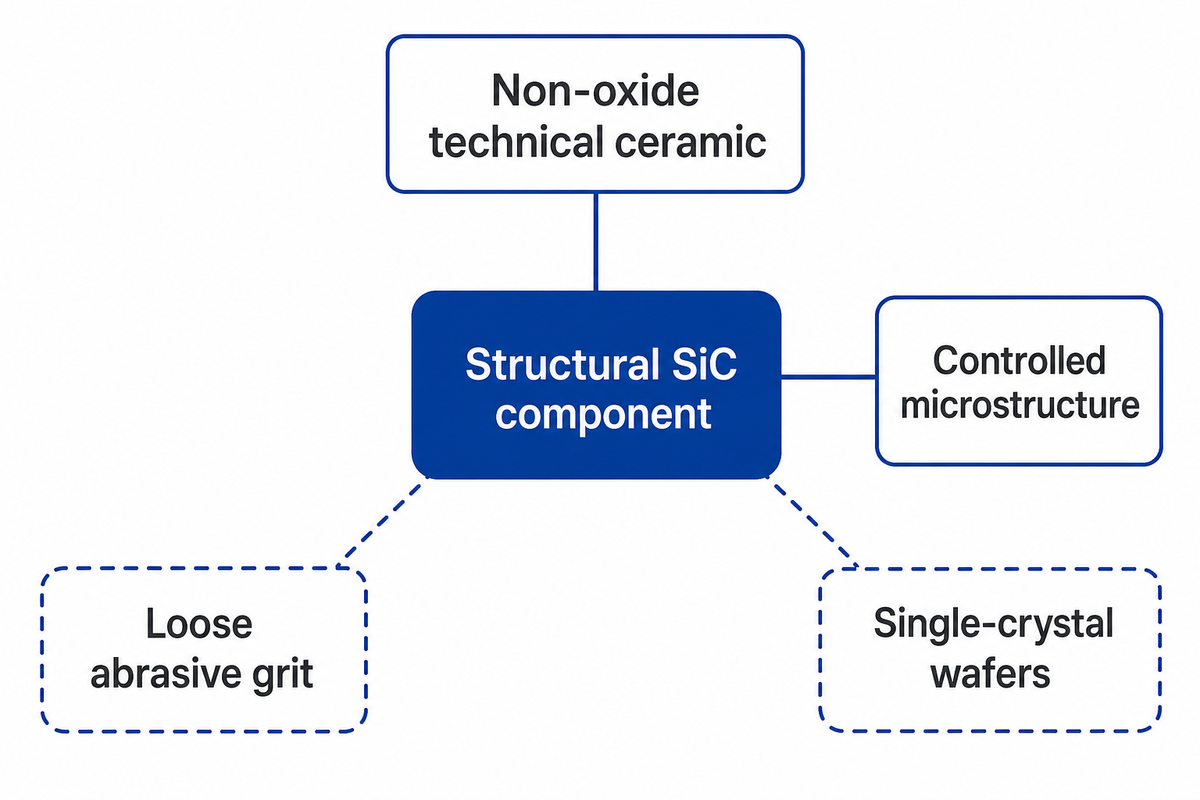
Siliziumkarbid ist eine Keramik in strukturellen Anwendungen, da starke kovalente Bindung, hohe Verarbeitungstemperaturen und eine kontrollierte Mikrostruktur einen harten, spröden anorganischen Körper erzeugen, es gehört zur Familie der nichtoxidischen technisch-keramischen Produkte. Diese Beschreibung trennt einen fertigen Dichtungsring, eine Ofenstütze oder einen Verschleißeinsatz von losem Schleifkorn, einer feuerfesten Mischung und den in der Leistungselektronik verwendeten Einkristallwafern.
Als fortschrittliches Keramikmaterial aus Silizium und Kohlenstoff wird Siliziumkarbid auch als Nichtoxidkeramik beschrieben. Käufer benötigen weiterhin den Prozessweg, da diese Etiketten weder die Sekundärphase noch die Kornstruktur oder den fertigen Zustand definieren.
SiC setzt sich aus Silizium und Kohlenstoff zusammen, aber “aus Siliziumkarbid” oder “aus Siliziumkarbid hergestellt” beschreibt noch eine Familie und nicht eine lieferbare Sorte, “Siliziumkarbid ist ein ausgezeichnetes Material” zu nennen, ist eine vollständige Spezifikation ebenso unhaltbar: Generische Eigenschaften machen Siliziumkarbid für eine Auswahlliste relevant, während der gemessene Zustand und der Fehlermodus entscheiden, ob es auf die Zeichnung gehört.
Für Chemie, Polytypen, Schleifmittel und Halbleiterkontext außerhalb dieses strukturellen Bereichs verwenden Sie die Allgemeine Siliciumcarbid Materialübersicht. Dieser Leitfaden befasst sich weiterhin mit Keramikqualitäten, Komponentenfertigung, Betriebsausfallmodi und Qualifizierung nach dem Sintern.
Diese Unterscheidung ist kommerziell wichtig Chemische Formel allein gibt nicht preis, ob ein Bauteil drucklos gesintert, mit Silizium infiltriert, mit Siliziumnitrid gebunden oder absichtlich porös belassen wurde Außerdem werden die Additive, das freie Silizium, die Kornstruktur oder Bearbeitungsschäden nicht angegeben. Eine aktuelle Überprüfung der SiC-Sinterrouten Behandelt diese Verarbeitungsunterschiede als Teil der Materialdefinition, da sie die Verdichtung, die erreichbare Geometrie und die Leistungsgrenzen verändern.
Für den Kauf sollte “Siliziumkarbidkeramik” der Familienname oben in der Zeichnung oder Anfrage sein, die nächste Zeile muss die Güte - oder Prozessfamilie und die zu verifizierenden Eigenschaften identifizieren Das verhindert, dass ein nominell ähnliches Zitat eine andere Restphase, Porositätsstufe oder Testbasis verschleiert.
Eigenschaften von Siliziumkarbidkeramik, die für das Design von Bedeutung sind
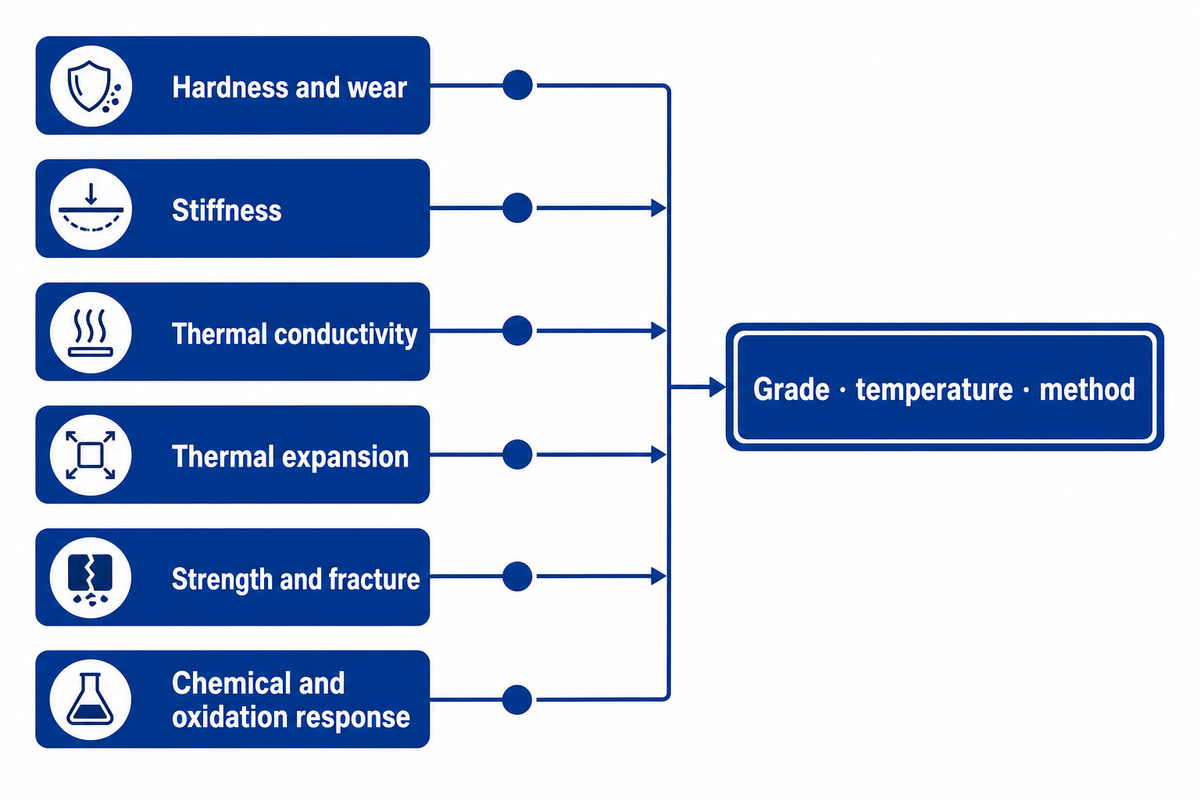
Designer sollten nicht nur fragen “Was sind die Eigenschaften von SiC?”, sie sollten fragen “Welche Eigenschaft, unter welcher Bedingung, steuert dieses Teil?” Härte kann den abrasiven Verschleiß verringern, während Sprödigkeit eine nicht unterstützte Kante immer noch anfällig macht Wärmeleitfähigkeit kann Wärme verbreiten, während ein Gelenk oder ein steiler Gradient eine lokale Zugspannung erzeugt Korrosionsbeständigkeit in einer Atmosphäre stellt keinen Widerstand in einer anderen her.
Unter den strukturellen Keramikmaterialien wird SiC häufig auf hohe Härte und potenziell hohe Wärmeleitfähigkeit untersucht. Diese Etiketten benötigen immer noch eine benannte Qualität und Temperatur. Aluminiumoxid oder Siliziumnitrid können die bessere Wahl sein, wenn Kosten, elektrische Isolierung, Rissbeständigkeit oder Schlagverhalten kontrolliert werden. Vergleichen Sie also den maßgeblichen Fehlermodus und nicht eine Schlagzeileneigenschaft.
Lieferantennachweise sollten Materialeigenschaften in mechanische Eigenschaften und physikalische und chemische Eigenschaften trennen Thermisches Design benötigt den temperaturabhängigen Koeffizienten, einschließlich des Wärmeausdehnungskoeffizienten, plus ein methodenspezifisches Thermoschockwiderstandsergebnis Verschleißfestigkeit und chemische Eigenschaften benötigen das tatsächliche Medium und die Exposition, muss das Teil elektrisch leitfähig sein, geben Sie den Schwellenwert und die Methode an Behandeln Sie “extrem hohe” Eigenschaftssprache als nicht überprüft, bis eine benannte Güte und Testbedingung sie unterstützen.
Innerhalb dieses Leitfadens wird Siliciumcarbid als Material-Familien-Begriff verwendet, sowohl die Eigenschaften von Siliciumcarbid als auch die Beständigkeit von Siliciumcarbid bleiben güte, temperatur - und zustandsspezifisch, SiC als eine der härtesten Ingenieurkeramiken zu bezeichnen, entzieht nicht die Notwendigkeit, Kanten, Fugen, Oberflächenbeschaffenheit und fehlerempfindliche Festigkeit zu qualifizieren.
| Eigentum | Ingenieurvorteil | Bemessungsgrenze | Beweise zu verlangen |
|---|---|---|---|
| Härte und Verschleiß | Widersteht Abrieb und Gleitverschleiß | Erhöht den Endaufwand; verhindert nicht das Abplatzen | Benannte Sorte, Prüfmethode, Oberflächenzustand und Verschleißmedium |
| Steifheit | Begrenzt die elastische Durchbiegung | Ein hoher Modul ist keine Zähigkeit | Modulverfahren, Dichte und Temperatur |
| Wärmeleitfähigkeit | Bewegt Wärme durch ein Bauteil | Variiert je nach Qualität, Porosität, Temperatur und Sekundärphase | Temperaturaufgelöste Lieferantendaten für die gekaufte Sorte |
| Thermische Ausdehnung | Kann die thermische Belastung verringern | Gelenkinkongruenz und -gradienten können immer noch dominieren | Dehnungskurve, Passmaterialien und Fugenmodell |
| Festigkeit und Bruch | Stützt Last in einem leichten, steifen Körper | Die Sprödfestigkeit ist fehler - und größenempfindlich | Exemplar, Methode, Probenzahl, Oberflächenbeschaffenheit und statistische Grundlage |
| Chemische und Oxidationsreaktion | Kann aggressiven Verschleiß- und Hitzeaufgaben gerecht werden | Hängt von Ablagerungen, Gaschemie, Temperatur und Expositionsverlauf ab | Umweltspezifische Prüfung oder Feldqualifikation |
Der ausgewertete Datenbericht des NIST Veranschaulicht die geforderte Disziplin Sein Eigenschaftssatz gehört zu einem eng beschriebenen gesinterten alpha-SiC mit ca. 98 ± 11TP3 T relativer Dichte und einer mittleren Korngröße von 6 ± 2 µm. Diese Werte bleiben an dieser Materialbeschreibung, Temperaturbereich und Unsicherheit hängen; sie sind nicht universelle Design-Erlaubnisse für jede SiC-Keramik.
Haupt-SiC-Keramik-Grade: SSiC, SiSiC/RBSiC, NBSiC, RSiC und heißgepresstes SiC
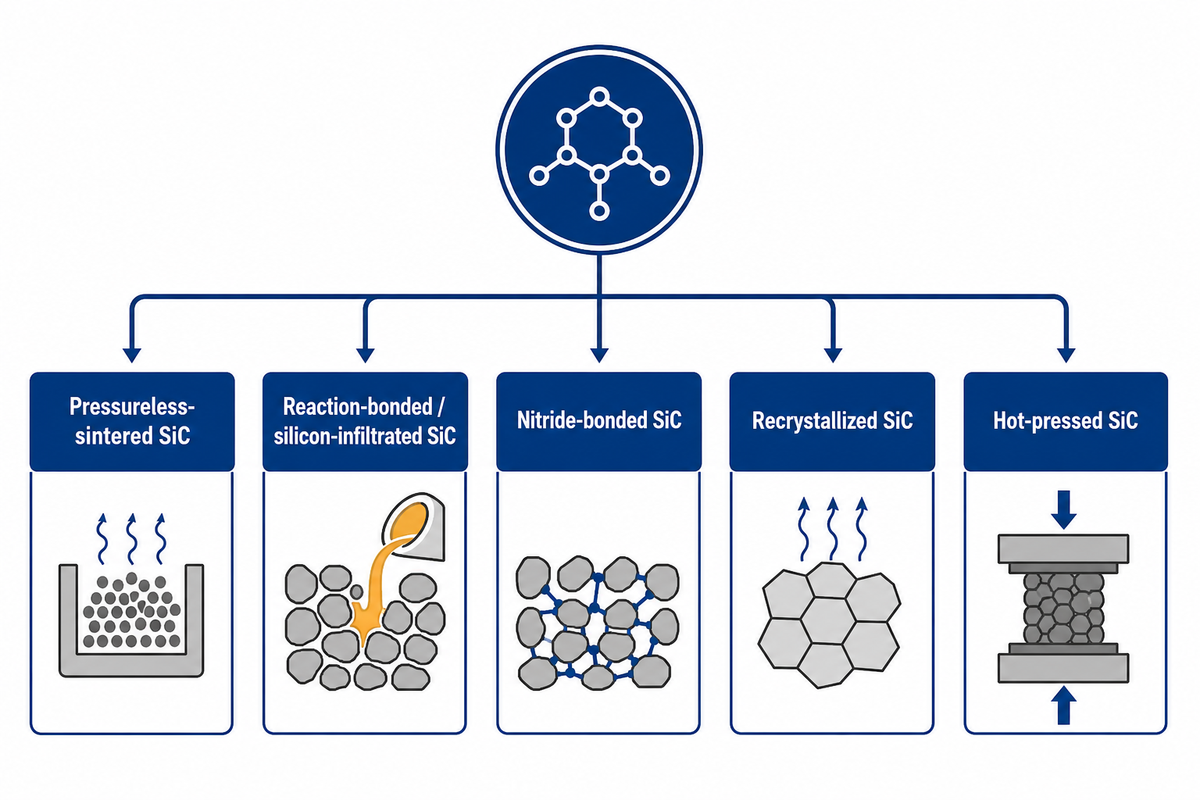
Notennamen sind nützliche Screening-Etiketten, aber die Terminologie der Lieferanten variiert Eine vergleichbare Spezifikation gibt die Zusammensetzung, den Umform - und Verdichtungsweg, die Restphase, das Dichte - oder Porositätsziel, die Testmethode und den Akzeptanznachweis an.
| Streckenfamilie | Wie der Körper geformt wird | Auswahlvorteil | Hauptvorsicht | Abschlussimplikation |
|---|---|---|---|---|
| Drucklos gesintertes SiC (SSiC) | Feines SiC-Pulver mit Sinterhilfsmitteln wird ohne äußeren Druck verdichtet | Dichte Optionen mit niedriger Sekundärphase für anspruchsvolle Verschleiß- oder Korrosionspflicht | Schrumpfung und Fehlerkontrolle schränken Form und Kosten ein | Planen Sie eine grüne Bearbeitung; Bei der gebrannten Endbearbeitung werden Diamantverfahren oder ein anderer qualifizierter Weg eingesetzt |
| Reaktionsgebundenes / siliziuminfiltriertes SiC (RBSiC oder SiSiC) | Ein poröser SiC/Kohlenstoff-Vorformling wird mit flüssigem Silizium infiltriert | Netznahe Formen und relativ geringe Dimensionsänderung während der Infiltration | Restfreies Silizium ändert chemische und Temperaturgrenzen | Staatliche Grenzwerte für freies Silizium und Anforderungen an die fertige Oberfläche |
| Nitridgebundenes SiC (NBSiC) | SiC-Körner werden in einer Silizium-Nitrid-Bindungsphase gehalten | Nützlicher Weg für ausgewählte feuerfeste und thermische Betriebsformen | Porosität und Bindungsphase unterscheiden sich von dichtem monolithischem SiC | Übertragen Sie keine dichte-SSiC-Eigenschaftsdaten |
| Rekristallisiertes SiC (RSiC) | SiC-Körner werden durch Hochtemperatur-Rekristallisation gebunden | Niedrigmassen- und thermisch-stoßorientierte Ofenstrukturen | Offene Porosität verändert Stärke und Umweltreaktion | Versiegeln oder beschichten Sie nur mit qualifiziertem Kompatibilitätsnachweis |
| Heißgepresstes SiC | Hitze und einachsiger Druck verdichten das Pulver | Dichte Mikrostrukturen und kontrollierter Testbestand | Druckwerkzeuge begrenzen Größe und Form; Orientierung kann wichtig sein | Eine komplexe Endgeometrie kann eine erhebliche Entfernung nach dem Brand erfordern |
“Reines SiC” ist kein ausreichendes Vergleichsfeld, ein Käufer sollte fragen, welche Phase ausgeschlossen wird, wie die Reinheit gemessen wurde, ob der Wert Pulver oder Fertigmaterial beschreibt und welche Chargennachweise das Teil begleiten werden.
Verwenden Sie die Qualitätstabelle als Auswahlliste, dann vergleichen Sie Lieferantennachweise Zeile für Zeile Wenn eine chemische Dichtung ein geringes Restsilizium benötigt, kann ein nahezu Netto-RBSiC-Angebot in Bezug auf die Form attraktiv sein, aber das Chemiebildschirm nicht bestehen Wenn ein großer Ofenstrahl eine geringe Masse und eine schnelle thermische Reaktion benötigt, passt möglicherweise eine poröse rekristallisierte Route zur Struktur, während sie für eine druckhaltende Wand ungeeignet ist. Serviceanforderungen entscheiden, ob Porosität oder eine sekundäre Phase ein Vorteil, ein akzeptabler Kompromiss oder ein Disqualifikator ist.
Wie Siliziumkarbid-Keramikkomponenten hergestellt werden
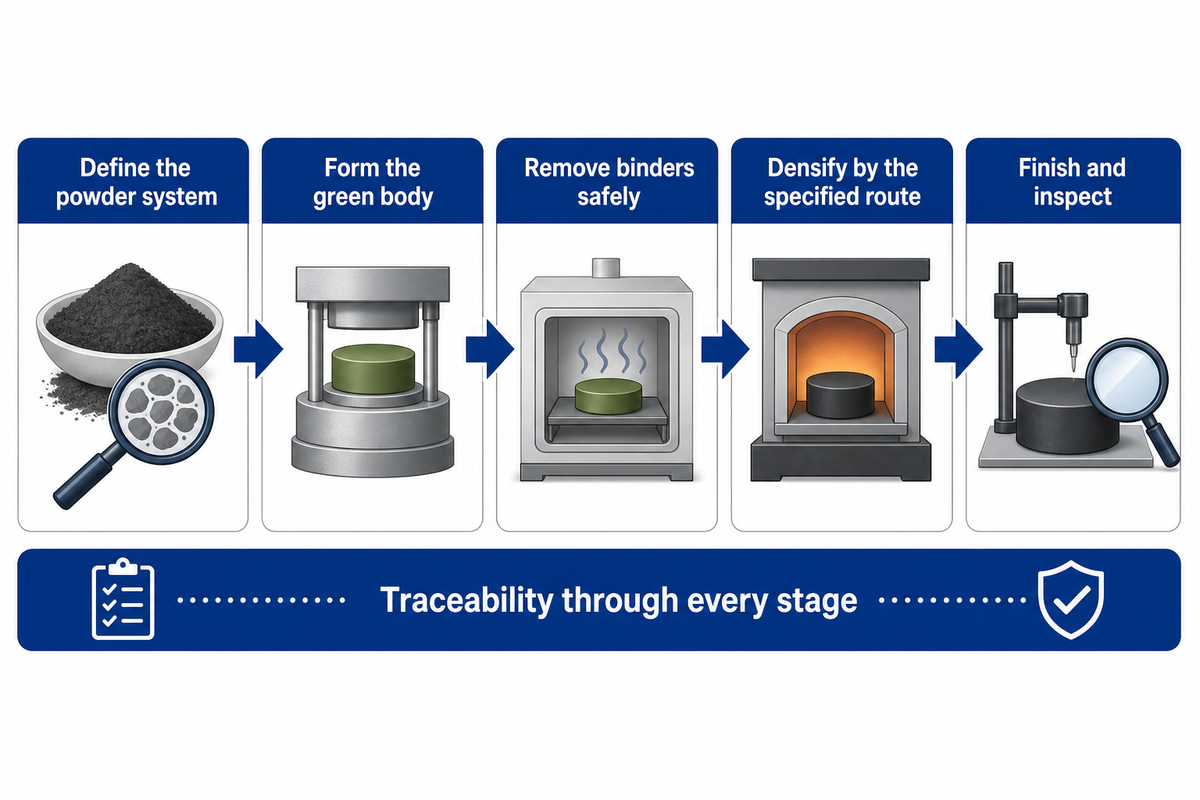
Die Fertigung ist eine Kette, bei der eine frühe Variation als Spätveredlungs - oder Zuverlässigkeitsproblem auftreten kann Pulverpartikelverteilung, Additive und Verunreinigungen beeinflussen die Umformung bestimmt Dichtegradienten und Grünfestigkeit Durch die Bindemittelentfernung müssen Gase freigesetzt werden, ohne dass Risse entstehen Durch die Verdichtung werden Schrumpfung, Restphase und Porosität kontrolliert, durch die Endbearbeitung können Kantenschäden oder Untergrundfehler entstehen.
Ein kommerzieller Herstellungsprozess von Siliciumcarbid beginnt mit kontrolliertem Siliciumcarbidpulver oder abgestuften Körnern von Siliciumcarbid. Die Spezifikation sollte Additive benennen, anstatt Daten von Borcarbid zu übernehmen, und sie sollte jedes Siliciumdioxid oder jede andere Oberflächenphase identifizieren, die für den Dienst wichtig ist. Formung, Bindemittelentfernung, Wärmebehandlung und Verdichtung müssen rückverfolgbar bleiben, da sich der Körper in jeder Phase chemisch, dimensional und thermisch verändert.
Auf der Ebene der Prozessfamilie reagiert Silizium bei der Infiltration mit Kohlenstoff, während Siliziumkarbid durch Sintern zu sehr harter Keramik miteinander verbunden werden kann. Diese Zusammenfassungen sind nützliche Routenbeschreibungen, beweisen jedoch nicht, dass das resultierende gesinterte Siliziumkarbid einer Zeichnung entspricht. Kontrollierte Verarbeitung macht Siliziumkarbidkeramik; Inspektionsnachweise bestimmen, ob eine bestimmte Komponente akzeptabel ist.
- Definieren Sie das Pulversystem (SiC-Quelle, Partikelverteilung, Bindemittel und.
- Den grünen Körper bilden „Dichtepressen, Gießen, Extrudieren oder Additivformen um die Gleichmäßigkeit herum.
- Bindemittel sicher entfernen Es besteht die Gefahr, dass der thermische Zyklus und der Teilabschnitt Gas freigesetzt und reißt.
- Nach der angegebenen Route dichten „Sich mit streckenspezifischen Akzeptanznachweisen auskristallisieren, infiltrieren, nitridbinden, rekristallisieren oder heißpressen.
- Beenden und inspizieren „Daten, Kanten, Oberflächenzustand, Reinigung, Fehler und Rückverfolgbarkeit nach Materialentfernung.
Durch die grüne Bearbeitung wird Material entfernt, bevor der Körper die volle Härte erreicht, sodass die Zeit für die gebrannte Bearbeitung verkürzt werden kann. Sie muss eine vorhersehbare Schrumpfung und die Zerbrechlichkeit des grünen Körpers berücksichtigen. Die netznahe Formung reduziert die Entfernung, macht die Inspektion jedoch nicht optional. A NETL-geführte Studie zum Schreiben direkter Tinten und zum Sintern von Funkenplasma Erhöhte Dichte gemeldet und dennoch Trocknungsrisse, Verformungen und Restspannungsmikrorisse dokumentiert. Die Verdichtung verbesserte das Testmaterial; Es wurde nicht jeder vorherige Defekt gelöscht.
Platzieren Sie kritische Daten, Radien, Wandübergänge, Bearbeitungszulagen und Inspektionszugriff auf der Zeichnung, bevor ein Lieferant Werkzeug wählt. Wenn eine Verbindung, Beschichtung oder ein Metalleinsatz erforderlich ist, qualifizieren Sie diese Schnittstelle als separaten Prozess. Massenkeramikdaten können nach der Montage keine Grenzflächenreaktionen, Dichtungsintegrität oder Eigenspannung feststellen.
Ein wirksamer Kontrollplan folgt dem Risiko nachgeschaltet Nach dem Sintern entdeckte Dichtegradienten weisen auf Pulververpackung oder - umformung zurück; ein gerissener dicker Abschnitt kann eine Überprüfung der Bindemittelentfernung oder thermischer Gradienten erfordern; Randfehler treten erst nach dem endgültigen Schleifpunkt auf, bis zum Werkstück, Werkzeugzustand oder Lagerzulage Erfassen Sie den letzten überprüften Zustand nach jeder irreversiblen Stufe. Das macht eine fehlgeschlagene Inspektion umsetzbar, anstatt Lieferant und Käufer über einen undifferenzierten “Materialfehler” debattieren zu lassen”
Industrielle Anwendungen: Passen Sie die Note an den Fehlermodus an
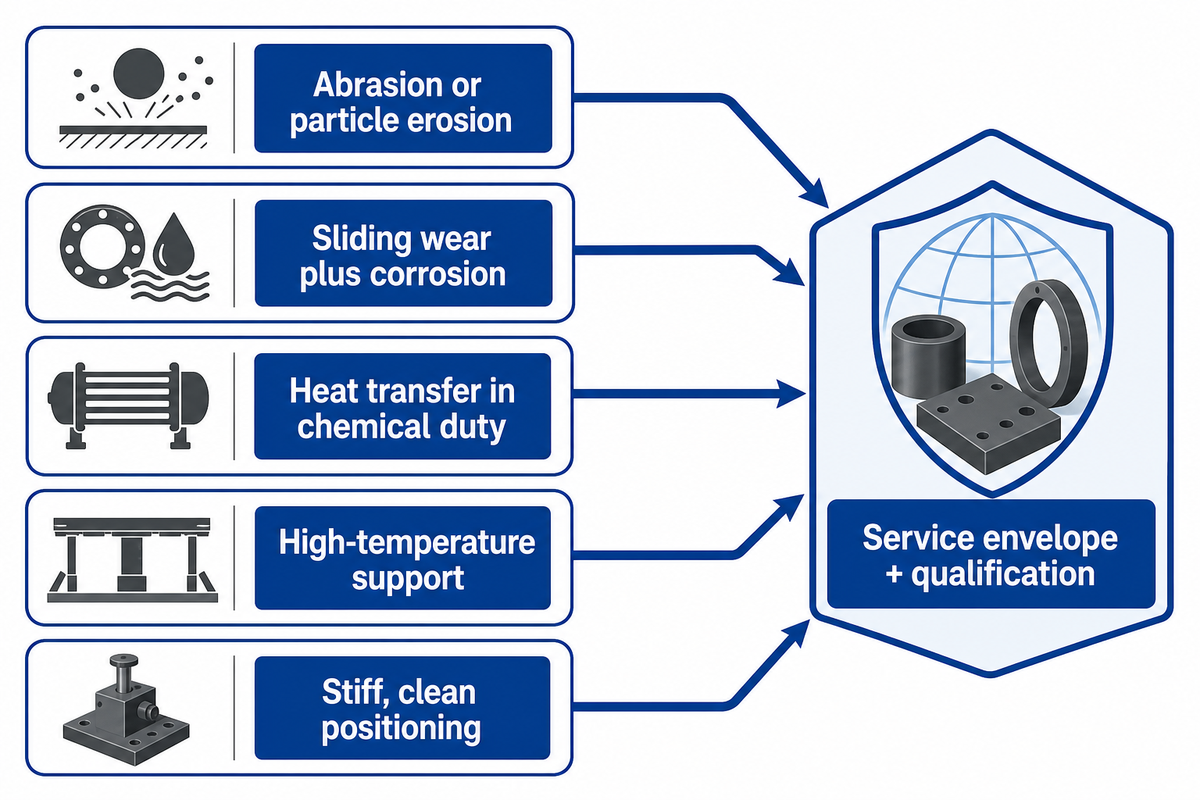
SiC verdient seine Kosten, wenn seine kombinierte Härte, Steifigkeit, Wärmeübertragung, geringe Ausdehnung und Umgebungsbeständigkeit einen definierten Fehlermodus lösen Ein Anwendungsname reicht nicht aus Jeder Kandidat muss an die Flüssigkeit oder Atmosphäre, Temperatur und Zeitprofil, Belastung, Geometrie, Verbindung und Inspektionsplan gebunden sein.
Siliziumkarbidkeramik wird häufig in Anwendungen eingesetzt, zu denen Gleitringdichtungen und Pumpenteile, Ofenmöbel und Verschleißkomponenten gehören. Selbst in diesem breiten Anwendungsspektrum ist die Verwendung von Siliziumkarbid nur dann gerechtfertigt, wenn die Servicehülle mit der qualifizierten Qualität übereinstimmt; Die Verwendung von SiC als Familienkennzeichnung ist kein Akzeptanzbeweis.
| Service-nachfrage | Kandidatenkomponenten | Risikokontrolle | Qualifikationsnachweis |
|---|---|---|---|
| Abrieb oder Partikelerosion | Düsen, Laufbuchsen und Durchflusseinsätze | Aufprallwinkel, Partikelverteilung, Kantenunterstützung und lokale Ausdünnung | Mittelspezifischer Verschleißversuch und Mindestwandinspektion |
| Gleitverschleiß plus Korrosion | Gleitringdichtungen, Lager und Ventilteile | Gegenfläche, Schmierung, thermische Verformung und chemische Verträglichkeit | Paarmaterialtest, Ebenheits-/Endbeweis und Leckagekriterium |
| Wärmeübertragung im chemischen Arbeitseinsatz | Rohre, Platten und Wärmetauscherelemente | Druck, thermischer Gradient, Ablagerungen, Fügen und langsames Risswachstum | Druck-/Thermocycle-Plan und gemeinsame Qualifizierung |
| Hochtemperaturunterstützung | SiC-Ofenmöbel, Brennerteile und Ofenstrukturen | Atmosphäre, Ablagerungen, Belastungsdauer, Oxidation und Kriechen | Beladener Belichtungstest mit aufgezeichneter Zeit und Atmosphäre |
| Steife, saubere Positionierung | Ausgewählte Halbleiterbauelemente | Reinheits, Partikel, Reinigungs, Beschichtungs - und Präzisionsschnittstellen | Kontaminationsspezifikation, Dimensionsbericht und Reinigungsaufzeichnung |
Umwelt und Expositionsverlauf können eine einfache Notenwertung umkehren. NIST-Industrieofenaufzeichnungen Zeigen, dass sich Korrosion und Festigkeitseinbehalt mit Ofenchemie, Ablagerungen, Temperatur, Zyklen und Belichtungszeit ändern, die verantwortliche Schlussfolgerung ist nicht, dass immer eine benannte Sorte gewinnt Es ist, dass die Qualifikation die kontrollierende Umgebung genau genug reproduzieren muss, um die Designentscheidung zu unterstützen.
Übersetzen Sie einen Anwendungsfall in eine Fehleranzeige, bevor Sie Proben anfordern “Verschleißdüse” wird zu Partikeltyp, Geschwindigkeit, Aufprallwinkel, Fluidchemie, Wandverlustgrenze und Wechselrandgeometrie “Wärmetauscherrohr” wird zu Druck, Ein - und Auslasstemperaturen, Rampenrate, Reinigungschemie, Stützabstand, Fügeverfahren und Leckkriterium Diese Übersetzung lässt den Keramiklieferanten eine relevante Sorte vorschlagen und gibt dem Käufer messbare Akzeptanzbedingungen anstelle eines Kataloganwendungsetiketts.
Nachteile und Designgrenzen
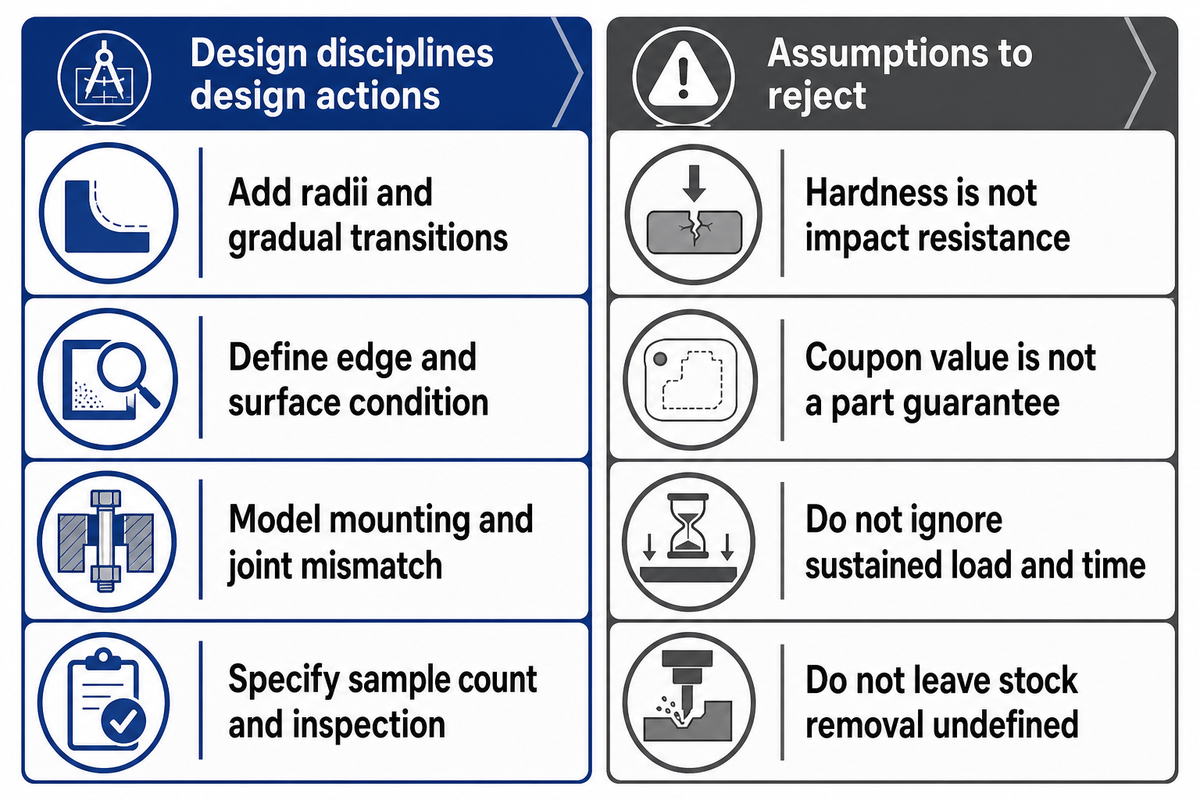
Siliziumkarbidkeramik passt schlecht, wenn eine Konstruktion auf plastischer Verformung beruht, wiederholte unkontrollierte Stöße toleriert, Zugspannungen auf scharfe Merkmale konzentriert oder keinen praktischen Weg zum Fügen und zur Endkontrolle lässt. Seine Härte kann auch späte Ziehänderungen teuer machen, da dichtes gebranntes Material im Allgemeinen Diamantwerkzeuge oder ein anderes spezielles Verfahren erfordert.
Tun
- Radien und allmähliche Schnittübergänge hinzufügen.
- Definieren Sie den Rand- und Oberflächenzustand.
- Modellmontage und Gelenkinkongruenz.
- Geben Sie die Probenanzahl und die Inspektionsbasis an.
Nicht
- Behandeln Sie Härte als Schlagfestigkeit.
- Nutzen Sie einen Couponwert als Komponentengarantie.
- Dauerbelastung und Belichtungszeit ignorieren.
- Lassen Sie die Bestandsentfernung nach dem Brand undefiniert.
Festigkeit in einer fortschrittlichen Keramik ist probabilistisch Der Beamte ASTM C1239-26a Umfang erklärt, warum Probe - oder Bauteilgröße, Geometrie, beanspruchte Fläche oder Volumen, Fehlerpopulation, Bearbeitungsschäden, Probenanzahl und Konfidenzniveau von Bedeutung sind Eine hohe mittlere Kuponfestigkeit kann für sich genommen nicht die Zuverlässigkeit eines größeren Teils mit einer anderen Oberfläche und einem anderen Spannungsfeld vorhersagen.
Bruchzähigkeit und Thermoschock benötigen ebenfalls Methodenetiketten. ASTM C1421-18 (2025) Bietet verschiedene Bruchzähigkeitsmethoden mit unterschiedlichen Risspräparaten und Probenkontexten. ASTM C1525-18 (2024) Wasserlöschsiebverfahren ist; Sein Ergebnis stellt nicht direkt einen wiederholten Stoß, einen stetigen Wärmegradienten, einen verbundenen Körper oder eine fertige Komponente dar.
Momentane Festigkeit ist nicht dasselbe wie Leben unter anhaltender Belastung. NIST-Arbeit an Kriechen und Kriechen bei Nichtoxidkeramiken Zeitabhängige Verformung von Kurzzeitfestigkeit trennt Oxidation ist auch nicht monoton: Eine kurze Belichtung kann manchmal Oberflächenrisse heilen, während eine andere Umgebung oder längere Belichtung die Festigkeit verringern kann Zustandsspannung, Temperatur, Atmosphäre und Zeit bei der Qualifizierung eines Hochtemperaturteils.
Bearbeitung und Schneiden von Siliziumkarbidkeramik
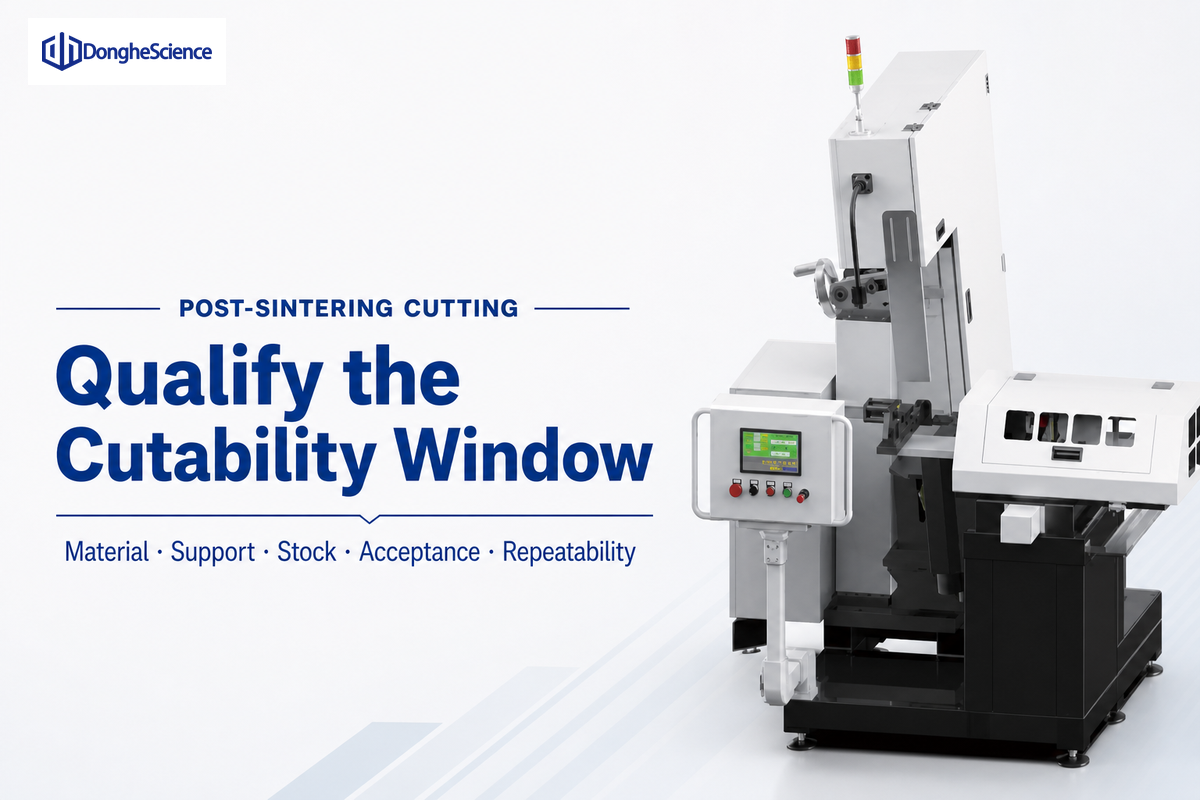
Form so viel wie praktisch vor der endgültigen Verdichtung, aber gehen Sie nicht davon aus, dass jedes kritische Merkmal im Grünkörper belassen werden kann. Gebranntes SiC benötigt möglicherweise Diamantschleifen, Läppen, Sägen oder eine andere kontrollierte Entfernungsmethode, um Datumsangaben, Dichtflächen, Löcher oder getrennte Rohlinge festzulegen. Die Elektroentladungsbearbeitung ist nur für Material mit ausreichender elektrischer Leitfähigkeit relevant. Laserwege erfordern außerdem eine güte-, dicken- und schadensspezifische Qualifikation.
Zu weit gefasst ist die Aussage “nur Schleifen funktioniert” Peer-reviewte Untersuchungen belegten Festplattiertes Diamantdrahtschneiden von heißgepresstem polykristallinem SiC Unter kontrollierten Bedingungen, wobei sowohl spröde als auch plastische Entfernungsmechanismen beobachtet wurden. Eine kontrollierte Ultrapräzisionsstudie berichtete über ein schmales Fenster im duktilen Regime für PCD-Flächenfräsen von gesintertem 6 H-SiC. Es handelt sich um prozessfähige Erkenntnisse, nicht um Erlaubnis, Feed, Speed, Kerf, Finish oder Toleranz in ein Produktionsversprechen zu kopieren.
5-Checkpoint-Post-Sintering-Schneidbarkeitstor
- Identifizieren Sie das Material. Erfassen Sie Qualität, Dichte, Restphase, Porosität und elektrisches Verhalten.
- Stützen Sie den Rohling. Definieren Sie Geometrie, Befestigung, Ein-/Ausgangskanten, Schnittlänge und fragile Merkmale.
- Lagerbestand zuweisen. Staatliche Lagerbestandsdicke, Schnittfugenzulage, Datumsstrategie und nachgelagerte Endbearbeitung.
- Akzeptanz definieren. Legen Sie Maß-, Konus-, Rand-, Oberflächen- und Untergrundschadenskriterien fest.
- Den Vorgang überprüfen. Zeichnen Sie Draht-/Werkzeugzustand, Kühlmittel, Schmutzentfernung, Inspektion und Wiederholbarkeit über repräsentative Rohlinge hinweg auf.
Für Blöcke, Platten, Rohre oder unregelmäßige Rohlinge, die eine Trennung mit geringer Kraft erfordern, Diamantdrahtsägemaschinen Durch einen materialspezifischen Probenschnitt ausgewertet werden können, bevor Produktionsparameter festgelegt werden.
Glaubwürdige Probenschnittberichte messen mehr als ob der Rohling sich getrennt hat Sie zeichnen Unterstützung, Schnittzeit, Draht - oder Werkzeugzustand, Schnittfuge, Konizität, Ein - und Austrittsabsplitterung, Oberflächenzustand, Schmutzverhalten und jede nachträgliche Schleifzulage auf, wenn die Integrität des Untergrunds kritisch ist, verwenden Sie eine Inspektionsmethode, mit der die relevante Fehlerpopulation erkannt werden kann Wiederholen Sie dies auf mehr als einem repräsentativen Rohling, bevor Sie ein Produktionsfenster setzen.
Verwandte Prozessanleitungen können helfen, die Testversion zu definieren, ohne sie zu ersetzen. Setzen Kriterien für die Keramikoberflächenqualität, Überprüfung Risskontrollpraktiken für das Keramikschneiden, und Vergleichen Sie Diamantdraht-, Laser- und Wasserstrahlrouten Vor der Auswahl einer Methode für Hartkeramik Die SiC-Probe kontrolliert noch die Endabnahme.
Durchführbarkeit von Fähigkeit trennen Durchführbarkeit fragt, ob ein qualifiziertes Setup einen akzeptablen Schnitt erzeugen kann Fähigkeit fragt, ob der Prozess dieses Ergebnis über die geplante Gütevariation, Leergröße und Produktionsmenge hinweg wiederholen kann Ein Pilot kann die erste Frage bestehen, während er dennoch Vorrichtungsänderungen, Werkzeuglebensnachweise, Überprüfung des Messsystems oder eine größere Stichprobe benötigt, bevor die zweite beantwortet wird.
Die SiC-Keramikauswahlkarte für 4 Routen
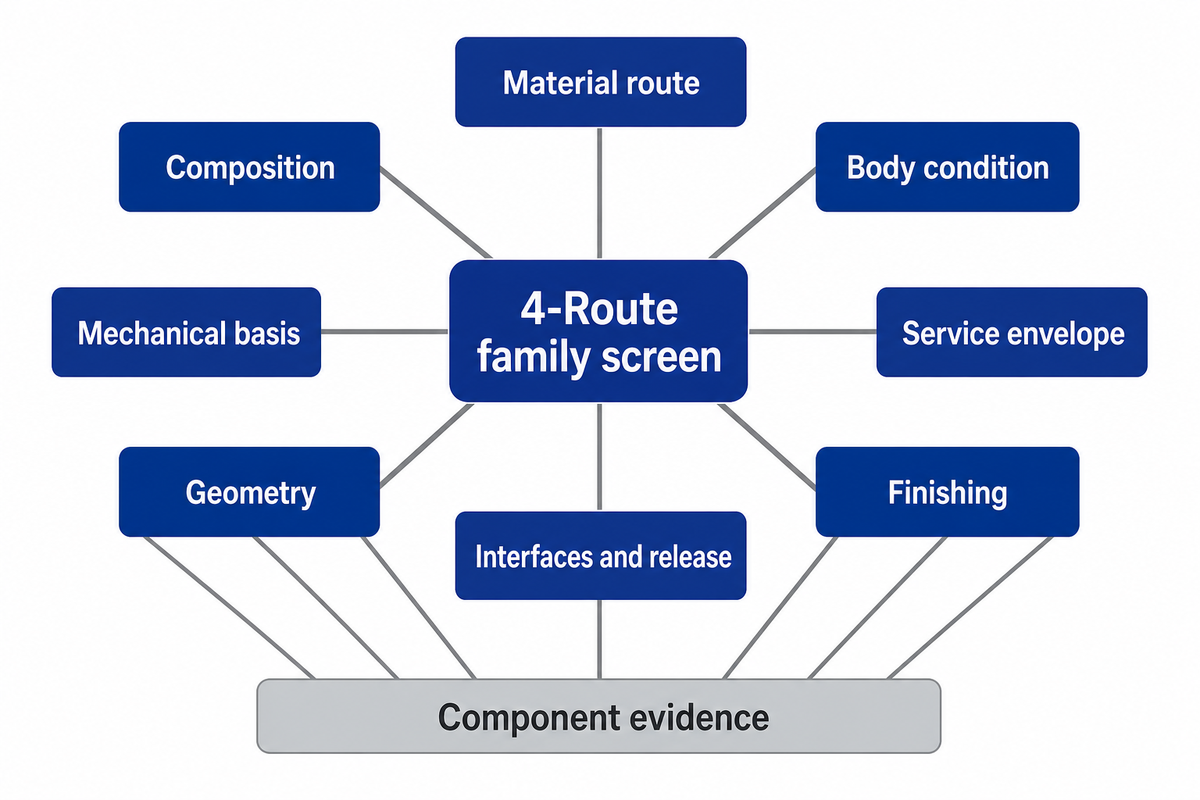
Diese Karte schränkt die erste Lieferantendiskussion ein, sie ersetzt nicht Materialtechnik, Bauteilanalyse oder Servicequalifikation.
Qualifikationsregel: Familiennamen schränken den Suchraum ein; Grad, Zustand, Geometrie und Evidenz entscheiden über die Komponente.
| Beginnen Sie hier, wann | Zuerst untersuchen | Aufpassen auf | Zuverlässigkeitsnachweise |
|---|---|---|---|
| Reinheit oder Korrosion steuert die Entscheidung | Dichte gesinterte oder abgelagerte Qualitäten | Zusatzstoffe, Korngrenzen, Atmosphäre und Reinigung | Zusammensetzung, Rückverfolgbarkeit der Charge und umweltspezifischer Test |
| Große oder komplexe netznahe Geometriesteuerungen kosten | Reaktionsgebundene oder siliziuminfiltrierte Qualitäten | Restsilizium, Infiltrationsgleichmäßigkeit und Leistungsobergrenze | Phaseninhalt, Abschnittsinspektion und Serviceexpositionsversuch |
| Ofenstruktur und Temperaturwechsel steuern die Entscheidung | Nitridgebundene oder rekristallisierte Qualitäten | Porosität, Bindungsphase, Belastungsdauer und Atmosphäre | Beladener Wärme-/Expositionstest und gemeinsame Überprüfung |
| Enge fertige Geometrie steuert die Akzeptanz | Wählen Sie die Servicegrade, dann die grüne und gebrannte Endbearbeitungsroute | Bearbeitungsschäden, Bezugstransfer, Kantenzustand und Ertrag | Repräsentativer Probenschnitt, Maßbericht und Fehlerprüfung |
| Qualifikationsklasse | Im RFQ deklarieren | Kontrolliert die Entscheidung |
|---|---|---|
| Materialweg | Gradefamilie und Verdichtungspfad | Welche Eigentumsnachweise können verglichen werden |
| Komposition | Zusatzstoffe, Restphase und Kontaminationsgrenzwerte | Chemische und Temperaturverträglichkeit |
| Körperzustand | Dichte, Porosität und grüner oder gebrannter Zustand | Festigkeits-, Durchlässigkeits- und Endbearbeitungsannahmen |
| Mechanische Basis | Exemplar, Oberfläche, Methode, Probenanzahl und Statistik | Ob Stärkedaten das Komponentenrisiko darstellen |
| Dienstleistungsumschlag | Belastung, Temperatur, Atmosphäre, Chemikalien und Zeit | Regulieren des Fehlermodus und des Expositionstests |
| Geometrie | Daten, Abschnitte, Kanten, Toleranzen und Inspektionszugang | Umformweg, Schrumpfungskontrolle und messbare Akzeptanz |
| Veredelung | Lager-, Stütz-, Schnittweg-, Oberflächen- und Fehlergrenzen | Nachsinterschäden und Probenschnittabnahme |
| Schnittstellen und Release | Gemeinsame Qualifizierung, Rückverfolgbarkeit der Chargen und Änderungskontrolle | Montagerisiko und Wiederholbarkeit nach Genehmigung |
Fordern Sie für jede Route die an Statistische Grundlage von Festigkeitsdaten, ‘die vorgesehene Last-Zeit-Temperatur-Umgebungshülle und gemeinsame Qualifizierung für nicht-monolithische Teile Wenn zwei Lieferanten denselben Familiennamen, aber unterschiedliche Phasengrenzen oder Testmethoden verwenden, sind ihre Zahlen noch nicht vergleichbar.
Wie man eine Bindung zwischen zwei Routen aufbricht
Beginnen Sie mit dem Ausfall, der nach der Lieferung nicht repariert werden kann. Wenn Restsilizium mit der Prozessflüssigkeit nicht kompatibel ist, streichen Sie die Route, bevor Sie den Bearbeitungspreis vergleichen. Wenn eine monolithische Geometrie nicht geformt oder überprüft werden kann, überarbeiten Sie den Entwurf oder bewerten Sie eine Baugruppe mit einer expliziten Verbindungsqualifikation. Wenn beide Routen realisierbar bleiben, vergleichen Sie das Beweispaket: Losdefinition, Eigenschaftstestbasis, Fehlerprüfung, Endbearbeitungszulage, Musterschnitt-Ergebnis und Änderungskontrollregel. Der niedrigste Blindpreis ist nicht die risikoärmste Option, wenn er Unsicherheit in die gebrannte Bearbeitung oder Feldvalidierung verlagert.
Was verändert sich in der Herstellung und Beschaffung von SiC-Keramik im Jahr 2026?
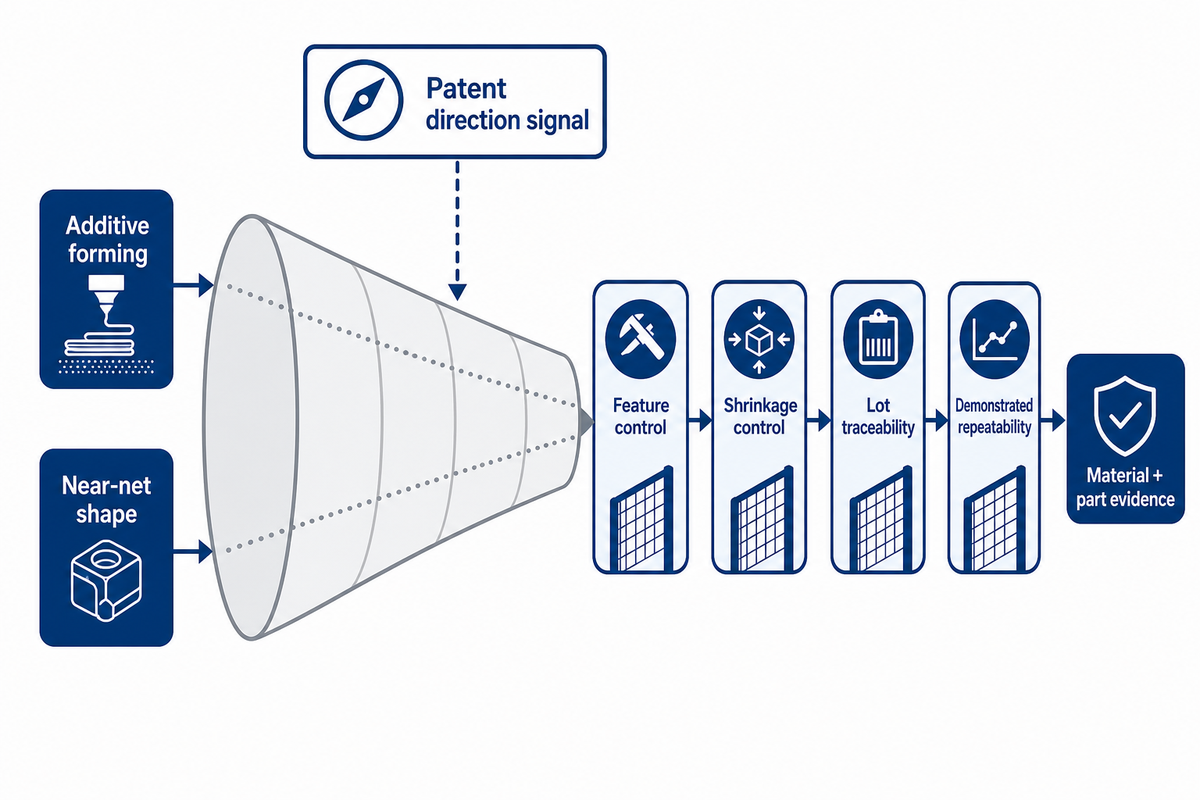
Der heutige nützliche Trend ist keine Marktgrößenprognose Es ist die Ausweitung der Routen für komplexe Grünkörper, schnellere Verdichtung, hochreine Strukturen und eine lagerärmere Veredelung Additive Formung kann interne Merkmale schaffen, die herkömmliche Pressung nicht kann, aber Trocknung, Entbindung, Schrumpfung, Porosität, Rissbildung und Scale-up erfordern immer noch Beweise. Eine 2025 veröffentlichte Übersicht über die Forschung zur Herstellung von Keramik-Additiv-Herstellung für SiC-Keramik-Matrix-Verbundwerkstoffe hebt Restporosität, Schrumpfungsrisse, ungleichmäßige Mikrostruktur, Kosten, Zuverlässigkeit und Skalierbarkeit als fortlaufende Einschränkungen der Massenproduktion hervor.
Patente sind Richtungssignale, keine Produktionszertifikate Eine TOTO-zugeordnete Drittanbieter-Patentfamilie (US20160083300A1/US9994487B2) beschreibt selektives Lasersintern eines SiC/Bindemittel-Vorformlings mit anschließender Kohlenstoffverarbeitung, Siliziuminfiltration und Reaktionssintern Die Patentreklame veröffentlicht Unterstützt die Existenz dieser Route; Es beweist nicht die aktuelle serielle Ausgabe, den Client-Besitz oder das Leistungsniveau der Komponente.
Fragen Sie für ein Lieferantenaudit 2026, was sich am Zeichen - oder Kontrollplan geändert hat: unterstützte Merkmalsgröße, Schrumpfungsausgleich, Kontaminationskontrolle, Rückverfolgbarkeit der Charge, Nachverdichtungsinspektion und nachgewiesene Wiederholbarkeit “Additiv hergestellt” oder “Netznahe Form” ist eine Prozessbeschreibung, bis der Lieferant Material - und Teilebenennachweise beifügt.
RFQ-Checkliste für Siliziumkarbid-Keramikkomponenten
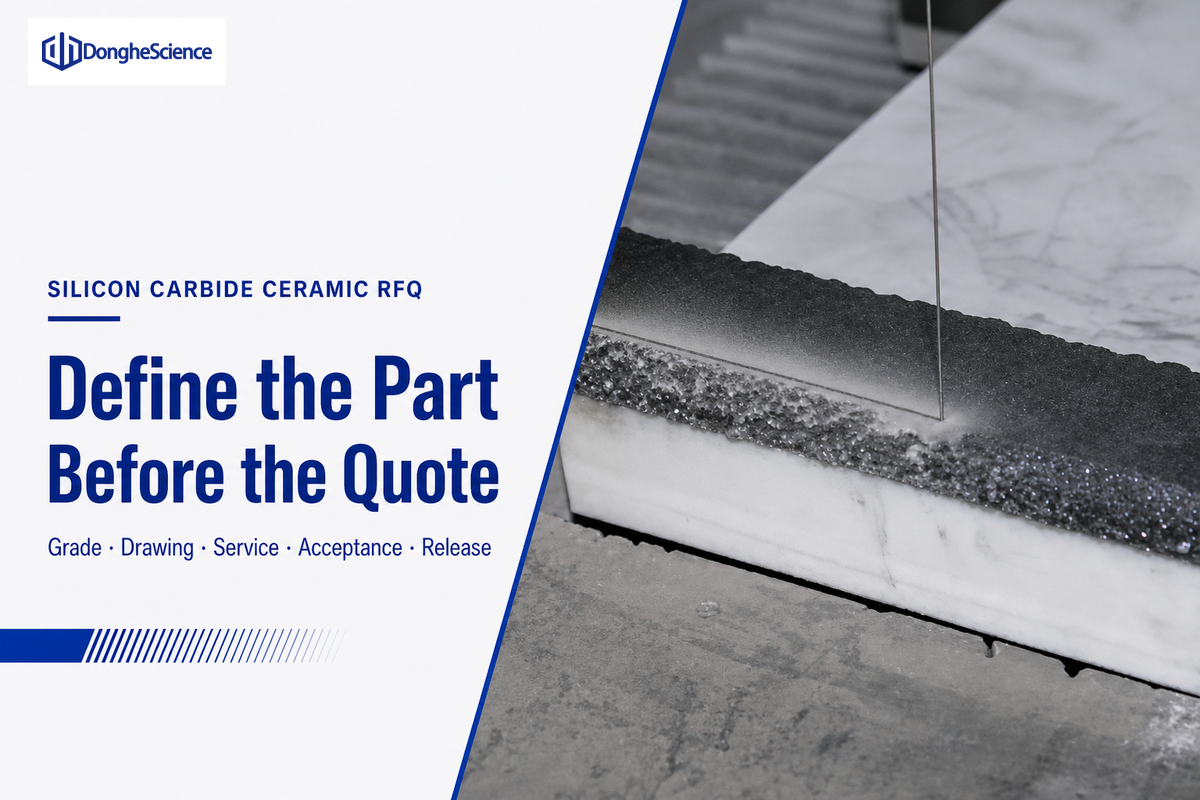
Kopieren Sie diese Gruppen in die Anfrage, damit die Lieferanten den gleichen technischen Umfang angeben Ersetzen Sie jeden “projektdefinierten” Eintrag durch die Zeichnungs-, Servicebedingungs- oder Annahmeregel, die Ihren Teil steuert.
RFQ-Checkliste: Kopieren Sie diese in Ihre Angebotsanfrage
| Parameter | Empfohlener Bereich | Warum es wichtig ist | Wie zu überprüfen |
|---|---|---|---|
| Materielle Identität | Genaue Qualität, Route, Zusammensetzung und Restphase | Verhindert die Ersetzung von Familiennamen | Loszertifikat und vereinbarte Analysemethode |
| Physikalischer Zustand | Dichte, Porosität und Grün-/Brandzustand | Kontrolliert Eigenschafts- und Endbearbeitungsannahmen | Benannte Testmethode und Chargenergebnis |
| Geometrie | Zeichnungsrevision, Daten, Abmessungen und Toleranzen | Definiert den Umform- und Lagerentfernungsplan | Dimensionsbericht zum ersten Artikel |
| Oberfläche und Kanten | Finish, Ebenheit, Fase/Radius und Schadensgrenze | Fehler an Oberflächen und Kanten können die Festigkeit bestimmen | Prüfverfahren und Abnahmeprobe |
| Dienstleistungsumschlag | Temperatur, Atmosphäre, Chemikalien und Einwirkzeit | Die Reaktion der Noten ist umweltabhängig | Anwendungsspezifische Expositionsnachweise |
| Belastungen und Zuverlässigkeit | Vorübergehende/anhaltende Belastung, Probenbasis und Probenanzahl | Trennen Sie die Stärke des Coupons von der Zuverlässigkeit der Teile | Methode, Statistiken, Fehlerherkunft und Vertrauenserklärung |
| Schnittstellen | Verbindungsmaterialien, Dichtungsregel und thermische Nichtübereinstimmung | Die Schnittstelle kann den Komponentenausfall steuern | Gemeinsamer Coupon und Montagequalifikation |
| Lieferbeweis | Rückverfolgbarkeits-, Inspektions-, Verpackungs- und Probenschnittkriterien | Macht Zitate und Lose vergleichbar | Vereinbarte Dokumentenliste und Freigabeprüfung |
DONGHE-Fähigkeitsgrenze
DONGHE-staaten Dass sie Diamantdrahtsägesysteme zum Schneiden von harten und spröden Materialien entwirft und herstellt Behandeln Sie das als zugeschriebene Fähigkeitserklärung des Unternehmens, nicht als unabhängigen Beweis einer Keramiksorte, eines universellen Schneidparameters oder eines garantierten SiC-Ergebnisses. Binden Sie die Akzeptanz an den identifizierten Rohling, zeichnen Sie und dokumentieren Sie den Probeschnittnachweis.
Wenn die Durchführbarkeit des Schneidens Teil der Anfrage ist, senden Sie die Notenbezeichnung, die Leergröße, die Zeichnung, die Toleranz, das Oberflächenziel, die Menge und die Inspektionsregel. Besprechen Sie einen materialspezifischen Probenschnitt
FAQ: Siliziumkarbidkeramik
Ist Siliziumkarbid eine Keramik?
Antwort
Ja. Strukturelles Siliciumcarbid ist eine nichtoxidtechnische Keramik, die durch Verfestigen oder Verkleben von SiC-Körnern zu einem Formkörper hergestellt wird, Sie unterscheidet sich von losem Schleifkorn und einkristallinen elektronischen Wafern, deren Herstellungsweg, Additive, Restphasen, Porosität und Finish bestimmen, welche Eigenschaften zutreffen Eine vollständige Kaufbeschreibung nennt daher die Güte - oder Verfahrensfamilie und die erforderlichen Nachweise aus der fertigen Partie.
Welche Nachteile hat Siliziumkarbid?
Antwort
SiC-Keramik ist spröde, empfindlich gegenüber Fehlern und Spannungskonzentrationen und nach vollständiger Verdichtung langsam fertig Schlag, abrupte Abschnittsänderungen, schlechte Montage, thermische Gradienten und unqualifizierte Verbindungen können Versagen steuern Gemeldete Eigenschaften variieren auch mit Güteklasse, Porosität, Restphase, Oberflächenbeschaffenheit, Temperatur und Prüfmethode Konstrukteure sollten Radien, Abschnittsübergänge, Montagelasten, Endbearbeitungszulagen und Inspektionszugriff frühzeitig festlegen Käufer sollten Daten nur dann vergleichen, wenn Probe, Methode und Wartungszustand kompatibel sind.
Was ist das Besondere an Siliziumkarbid?
Antwort
Seine nützliche Kombination aus Härte, Steifigkeit, Wärmeübertragung, relativ geringer Wärmeausdehnung, geringer Dichte und Beständigkeit gegenüber vielen Verschleiß- oder chemischen Umgebungen kann anspruchsvolle Komponentenprobleme lösen. Dieser Eigenschaftssatz kann für Dichtungsflächen, Düsen, Ofenstrukturen, Wärmeübertragungsteile und ausgewählte Halbleiter-Gerätestrukturen geeignet sein, wenn der Fehlermodus mit der Qualität übereinstimmt. Die Kombination ist keine pauschale Garantie: Bruch, Oxidation, Restphasen, Temperatur, Belichtungszeit und Oberflächenzustand müssen noch qualifiziert werden. Eine zuverlässige Wahl verbindet den Materialweg mit der Bauteilgeometrie, Belastung, Atmosphäre, Verbindung und Endinspektionsplan. Aus diesem Grund können zwei SiC-Angebote sowohl technisch glaubwürdig sein als auch unterschiedliche Aufgaben erfüllen. Vergleichen Sie ihre genauen Prozesswege und Überprüfungsaufzeichnungen vor dem Rangfolgepreis.
Was ist die härteste Keramik?
Antwort
Es gibt keine universell härteste Keramik Bruchzähigkeit, Festigkeit, Schlagfestigkeit, Thermoschock und Härte beschreiben unterschiedliche Reaktionen, und die Ergebnisse hängen von Methode, Mikrostruktur und Temperatur ab Siliziumkarbid ist sehr hart, aber eine andere Keramik kann Risswachstum, Stößen oder Temperaturwechsel besser widerstehen in einem bestimmten Design.
Kann ein Diamantdraht Siliziumkarbidkeramik sägen?
Antwort
Es kann ein Kandidat für die Trennung eines abgefeuerten SiC-Rohlings sein und Kontrollierte Forschung hat das Diamantdrahtschneiden von polykristallinem SiC gezeigt. Die Durchführbarkeit hängt weiterhin von Güte, Dichte, Rohling, Schnittlänge, Drahtkonstruktion, Spannung, Kühlmittel, Vorschub, Kantenkriterium und akzeptablen Untergrundschäden ab Beginnen Sie mit einem dokumentierten Probenschnitt und setzen Sie Produktionsgrenzen aus repräsentativen Ergebnissen.
Referenzen und Quellen
- NIST, ausgewertete Daten für ein gesintertes Alpha-Siliziumkarbid
- Materialien und nachhaltige Entwicklung, Überprüfung der Sintermethoden für Siliziumkarbid
- ASTM International, C1239-26 a, Weibull Statistik für fortgeschrittene Keramik
- ASTM International, C1421-18 (2025), Bruchzähigkeit fortschrittlicher Keramik
- ASTM International, C1525-18 (2024), Water-Quench Thermal Shock
- OSTI / NETL, Additiv hergestelltes und Spark-Plasma-gesintertes SiC
- Materialien, fest plattiertes Diamantdrahtschneiden von polykristallinem SiC
- Mikromaschinen, ultrapräzises Gesichtsfräsen von gesintertem SiC
- NIST, Kriechen und Kriechen von nicht-oxider Keramik
Öffentliche Zusammenfassungen und überprüfte Fachliteratur unterstützen den Entscheidungsrahmen Gekaufte Standards, Zeichnungen, Lieferantendaten und anwendungsspezifisches Engineering bleiben kontrollierend.

![Polysiliziummaterial: Eigenschaften, Güteklassen und Verwendungszwecke [Leitfaden]](https://wiresawcutter.com/wp-content/uploads/2026/08/polysilicon-material-featured-150x150.webp)