Get in touch with DONGHE Company
-
Phone: +86 181-1645-5490
-
Email: Sales18@DongheScience.com

Sapphire cutting wire saw
Get Instant Quote
One Stop Precision Sapphire Cutting Solution
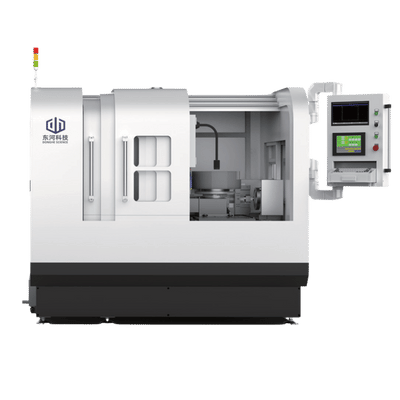
Donghe Science sapphire cutting solution uses an endless diamond wire saw with white mineral oil cooling and delivering chip-free edges, Ra ≤ 0.5 μm surface finish, and rotary cut capability for the world’s second-hardest material. Whether you are producing LED substrates, aerospace infrared windows, consumer electronics cover glass, or semiconductors, the stakes are high. Sapphire is an expensive material where any processing damage translates directly into yield loss and rework cost. A reliable precision sapphire cutting solution will help you save cost. Feel free to get a quote if you are looking for sapphire cutting wire saw solution.
0.35mm
Minimum Kerf Loss
30min
Cut Time (2-3″)
Ra 0.5μm
Surface Roughness
Understanding Diamond Wire Saw Technology for Sapphire
What Is a Diamond Wire Saw?
A diamond wire saw is a precision cutting tool that uses a thin steel wire embedded with diamond abrasive particles to cut through hard materials. The diamond wire saw cutting process primarily removes material through controlled abrasion rather than mechanical shearing, making it well-suited for brittle materials such as sapphire crystal.
The wire typically consists of three key components:
Steel core wire
High-tensile steel wire (typically 0.10mm – 0.35mm diameter) providing structural strength
Diamond abrasive layer
Synthetic diamond particles (20-60μm grit size) bonded to the wire surface
Bonding matrix
Electroplated nickel or resin coating that secures diamonds to the wire
Why Use Diamond Wire for Sapphire Cutting?
Sapphire is one of the most challenging materials to polish in the presence of extremely hard zirconium. Slicing methods like ID saws and blade saws are not quite successful in dealing with sapphire, and often require substitution with a new method for proper working:
❌ Problems with Traditional Methods
• High kerf loss (0.3-0.5mm material waste per cut)
• Significant subsurface damage (SSD)
• Poor surface roughness (Ra > 2μm)
• Micro-cracking and chipping
• Slow cutting speed
• High thermal stress causes warpage
✅ Diamond Wire Saw Advantages
• Minimal kerf loss (0.15-0.25mm)
• Reduced subsurface damage
• Superior surface finish (Ra < 0.5μm achievable)
• Clean, chip-free edges
• Higher throughput with multi-wire systems
• Lower thermal impact
The Evolution of Wire Saw Technology
The technology of wire saws has evolved significantly over the past decades. The transition from loose-abrasive slurry (LAS) cutting to fixed-abrasive diamond wire cutting significantly improved the efficiency and quality of sapphire wafer manufacturing.
| Generation | Technology | Kerf Loss | Surface Quality | Speed |
|---|---|---|---|---|
| 1st Gen | ID Saw / Blade Saw | 0.4-0.6mm | Poor | Slow |
| 2nd Gen | Loose Abrasive Slurry Wire Saw | 0.2-0.3mm | Moderate | Moderate |
| 3rd Gen | Fixed Abrasive Diamond Wire Saw | 0.15-0.25mm | Excellent | Fast |
| 4th Gen | Endless Loop Diamond Wire Saw | 0.12-0.20mm | Superior | Very Fast |
Types of Diamond Wire Saw Systems for Sapphire
Endless Loop Diamond Wire Saw
Advanced Precision Cutting
The endless-loop diamond-wire saw (also known as loop diamond-wire cutting or circular diamond-wire saw cutting) is the most advanced technology in precision sapphire cutting. This model uses a diamond-coated continuous wire loop that moves in a single direction, thereby eliminating the marks typically associated with reverse strokes in reciprocating systems.
How Endless Loop Technology Works
Unlike traditional loop configurations, an endless-loop configuration allows the wire to flow without direction changes, even at high speeds (up to 35 m/s). Such a unidirectional move; thus, it brings several key advantages:
- No reversal marks – Eliminates surface irregularities caused by wire direction changes
- Consistent cutting force – Uniform material removal across the entire cut
- Higher linear speed – Achieves faster cutting with better surface quality
- Reduced wire vibration – Lower amplitude oscillation for precise cuts
35 m/sMax Wire Speed
< 0.5μmAchievable Ra
30-50%Kerf Loss Reduction
2-4mLoop Length
Reciprocating (Spool) Wire Saw
A reciprocating wire saw uses a long spool of diamond wire that moves back and forth across the workpiece. While offering cost advantages, it still has inherent limitations for high-precision sapphire applications.
Key Characteristics:
- Wire length: 20-40 meters wound on spools
- Bi-directional cutting motion with reversal points
- Lower wire speed (typically 10-20 m/s)
- Visible reversal marks on the cut surface
- Better wire utilization efficiency
Endless Loop vs. Reciprocating: Detailed Comparison
| Feature | Endless Loop Wire Saw | Reciprocating Wire Saw |
|---|---|---|
| Surface Quality | Excellent (Ra < 0.5μm) | Good (Ra 0.5-1.0μm) |
| Wire Marks | None | Visible at reversal points |
| Cutting Speed | 20-35 m/s | 10-20 m/s |
| Kerf Loss | 0.12-0.20mm | 0.20-0.30mm |
| Wire Cost | Higher (loop replacement) | Lower (per meter) |
| Best For | LED substrates, optical windows | General purpose, cost-sensitive |
💡 Expert Recommendation: For manufacturing high-value sapphire wafers where surface quality and yield are major considerations, such as LED substrates and optical components, metal-free drivers deliver better results despite higher consumable costs, with the general rule that reduced post-processing requirements tend to offset the higher wire expenses.
Multi-Wire vs. Single-Wire Systems
Beyond the cutting mechanism, wire saw the number of cutting wires also classifies systems:
Single-Wire Saw
- One cutting wire makes individual cuts
- Maximum flexibility for different wafer thicknesses
- Ideal for R&D, small batches, and custom cutting
- Lower throughput but higher precision control
Multi-Wire Saw
- Multiple parallel wires cut simultaneously
- High-volume production capability (hundreds of wafers per run)
- Fixed pitch between wires determines wafer thickness
- Industry standard for LED substrate mass production
Diamond Wire Specifications for Sapphire Cutting
Selecting the correct diamond wire is essential for achieving optimal results in sapphire wafer cutting. The wire specification directly influences kerf loss, surface quality, cutting speed, and wire life.
Wire Diameter and Core Material
The total wire diameter determines the minimum kerf opening for fusion cutting sapphire. The standard diameter ranges for sapphire cutting applications include:
| Wire Diameter | Typical Kerf | Application | Considerations |
|---|---|---|---|
| 0.20-0.25mm | 0.25-0.32mm | Ultra-thin wafers, high-value materials | Higher breakage risk, requires precise tension control |
| 0.28-0.30mm | 0.35-0.40mm | Standard LED substrates | Best balance of kerf loss and durability |
| 0.35-0.40mm | 0.45-0.55mm | Large ingots, thick wafers | Maximum durability, higher material loss |
Diamond Grit Size and Distribution
The size and density of diamond particles on the wire surface determine cutting efficiency and surface finish quality:
Fine grit (20-30μm)
Produces smoother surfaces, slower cutting, ideal for final slicing
Medium grit (30-45μm)
Balanced performance for most sapphire applications
Coarse grit (45-60μm)
Faster cutting, rougher surface, suitable for cropping operations
Optimal Grit Density for Sapphire
Research findings indicate that optimal pertinence is achieved at a particle density of 200-300 particles per mm² for sapphire processing. High density is disadvantageous due to the formation of particle clusters, which reduce chip clearance, whilst low density is disadvantageous due to reduced cutting action.
Coating Methods: Electroplated vs. Resin Bonded
Electroplated Diamond Wire
Diamonds fixed by nickel electroplating
Strong diamond retention
Consistent cutting performance
Industry standard for sapphire
Higher cost but a predictable life
Resin Bonded Diamond Wire
Diamonds embedded in resin matrix
Self-sharpening effect
Lower cost per meter
Better for softer materials
Less common for sapphire
Endless Diamond Wire Saw vs. Reciprocating Wire Saw
When choosing diamond wire-saw machinery for sapphire cutting, it is essential to understand the distinctions between the endless (cyclic) and reciprocating systems. Indeed, each technology has peculiar characteristics to offer to an end-user audience.
| Comparison Criteria | Endless Diamond Wire Saw | Reciprocating Wire Saw |
|---|---|---|
| Cutting Mechanism | Continuous loop, unidirectional cutting | Wire moves back and forth |
| Wire Speed | 20-35 m/s (high speed) | 5-15 m/s (lower speed) |
| Cutting Time (2-3″ sapphire) | ~30 minutes | 3-4 hours |
| Surface Quality | Excellent (Ra 0.5-0.7μm), no wire marks | Good, may have visible wire marks |
| Kerf Width | 0.35-0.45mm | 0.4-0.6mm |
| Wafer Warpage | Lower (consistent force direction) | Higher (alternating forces) |
| Equipment Cost | Medium-High | Lower initial investment |
| Best For | High-volume production, precision requirements | R&D, small batch, cost-sensitive applications |
When to Choose Each Technology
Choose Endless Diamond Wire Saw when:
Production volume requires high throughput and short cycle times
Surface quality requirements demand Ra < 1.0μm
Manufacturing LED sapphire substrates or precision optical components
Material cost savings justify equipment investment
Downstream processes are sensitive to wafer warpage
Choose Reciprocating Wire Saw when:
Lower production volumes or R&D applications
Budget constraints limit initial capital investment
Cutting diverse materials beyond sapphire
Surface quality requirements are less stringent
Industry Applications for Sapphire Cutting
Precision sapphire cutting serves multiple industries, each with specific requirements for wafer size, thickness, surface quality, and production volume. Understanding these application-specific needs helps us select the correct cutting solution.
LED Manufacturing
GaN-based LED substrates, PSS patterned sapphire, Micro-LED & Mini-LED displays
Consumer Electronics
Smartphone camera covers, smartwatch crystals, fingerprint sensor covers
Optical & Defense
Laser windows, IR optical elements, missile domes, sensor windows
Semiconductor
Silicon-on-Sapphire (SOS), RF devices, power electronics substrates
Luxury Watches
Watch crystals, case backs, high-end timepiece components
Research & Lab
Sample preparation, material research, university laboratories
Medical Devices
UV-C LED disinfection, surgical instruments, medical imaging
5G/6G Technology
High-frequency RF substrates, antenna components, telecom infrastructure
Sapphire Cutting Resource Hub
Analyze, Estimate, and Select the perfect solution.
Production Efficiency & Yield
Calculate wafer output based on ingot parameters.
Est. Wafers (per 100mm length)
—
Material Utilization
–%
Kerf Loss (Waste)
— μm
Cost Savings & ROI
Estimate annual savings by switching to Diamond Wire.
Cost Reduction per Wafer
—
Monthly Savings
—
Projected Annual Savings
—
Wire Specification Guide
Find the recommended specifications for your process.
Recommended Wire Diameter
—
Recommended Diamond Grit
—
Client Success & Strategic Impact
Our data-driven methodology resolves complex challenges. Explore how we utilize core optimization strategies to deliver measurable ROI and sustainable growth for our partners.
Digital Transformation
Scalability
FinTech Infrastructure Overhaul
40%
Reduction in Latency
Challenge:
Legacy architecture caused transaction bottlenecks during peak trading hours, affecting user retention.
Solution:
We implemented a microservices layer and optimized database queries, ensuring high-availability and fault tolerance.
Conversion Rate Optimization
UX/UI
E-Commerce Revenue Surge
215%
ROI Increase
Challenge:
High cart abandonment rates due to friction in the checkout process on mobile devices.
Solution:
By auditing the user journey and implementing streamlined payment gateways, we removed friction points.
Automated Workflow
Cost Efficiency
Enterprise Logistics Automation
30hrs
Saved Per Week/Employee
Challenge:
Manual data entry for inventory management was leading to a 12% error rate and ballooning operational costs.
Solution:
Deployed a custom AI-driven automation script that synchronizes inventory across all global depots in real-time.
Frequently Asked Questions (FAQs)
What are the key difficulties associated with cutting sapphire with a wire saw?
Sapphire is one of the toughest materials on the planet, so cutting sapphire presents challenges: producing an extremely accurate cut without inflicting subsurface damage; maintaining a high surface finish; and controlling kerf width to minimize material waste. A wire saw uses diamond particles as the cutting medium to cut sapphire, and operators must balance wire diameter, loop tension, and abrasive concentration to achieve accurate cuts without compromising the condition of the components.
What relationship does the development of diamond wire saw technology have with cutting challenges?
By employing diamond wire saw technology, companies have developed a new tool that enables precision cutting of sapphire and other advanced materials. The diamond particles on the wire act as micro-cutters and, as such, can steadily remove material from the sides of the sapphire, resulting in the achievement of tighter tolerances, higher quality cuts and less kerf than traditional blade saws. This technological advancement has improved both the efficiency and accuracy of industrial and lab applications.
What influence does the loop design of a wire saw have on overcoming cutting challenges in sapphire?
The wire saw's loop design plays a significant role in determining cutting precision for sapphire and in controlling the loop's motion. By using a thinner-diameter wire and an optimally engineered loop design, a wire saw reduces vibration and enables more precise, consistent contact with sapphire. In addition, using a properly designed loop wire with an even distribution of diamond particles will improve cutting accuracy, reduce unnecessary material removal, and yield components with a superior surface finish with minimal material loss.
What role do the diamond particles have in overcoming cutting challenges associated with sapphire?
The diamond particles used to cut through sapphire form the cutting medium on the wire and are crucial to enabling the wire to perform the required machining operations on the hardest materials. The size, distribution, and bonding method of the diamond particles on the wire will affect the rate at which the surface is cut, the quality of the finished surface, and the tool's useful life. A wire saw equipped with a series of durable, optimally graded diamond particles will increase productivity while maintaining high precision and control, enabling the operator to achieve consistent results across a wide range of applications.
Is it possible for the sapphire cutting wire saw to make very small kerfs while still maintaining the same level of excellence?
Yes. The sapphire cutting wire saw's ability to produce very small kerfs whilst maintaining high-quality parts depends on the proper cutting strategies and equipment parameters. Selecting the correct wire diameter, controlling feed rates, and ensuring the wire-coated surface has optimal diamond loading significantly reduces waste and enables parts with minimal material loss. This is especially important when the part being cut is made of expensive or thin materials.
How do precise control and positioning reduce the issues typically encountered in manufacturing sapphire?
Precise control and positioning are fundamental to preventing problems during sapphire manufacturing. These advantages reduce micro-cracking, improve dimensional accuracy, and preserve the finished part's optical properties. This can be achieved through advanced cutting parameters, closed-loop tension control, and positioning systems that deliver consistent, repeatable tolerance and surface finish levels that meet strict requirements for sapphire and other advanced materials used in optics, semiconductors, and aerospace.
What are some of the advantages of using a sapphire cutting wire saw to help with the difficulties of sapphire production?
The sapphire cutting wire saw is advantageous to numerous industries due to increased efficiencies, greater productivity, reduced waste, and improved quality. More specifically, it enables the creation of thin slices of sapphire for the electronics industry, the production of sapphire windows capable of withstanding the rigors of severe-environment applications, and the use of sapphire as a substrate for LEDs. Additionally, it is a reliable, efficient technique for producing high-quality parts and allows sapphire manufacturers to meet the stringent tolerances required to scale production.
What types of operational factors can improve the reliability of sapphire manufacturing with wire saws?
When aiming to improve the reliability of manufacturing sapphire with wire saws, the following operational considerations should be addressed: wire life monitoring, coolant selection, abrasive replenishment, and operator training. Maintaining appropriate wire tension and monitoring wire wear are critical to consistent cutting performance. Selecting the proper cutting wire and optimising wire parameters will not only improve the quality of parts produced with the wire saw but also enable operators to achieve higher precision and increased throughput on tough materials, such as sapphire.
Trending Blogs

![Polysilicon Material: Properties, Grades & Uses [Guide]](https://wiresawcutter.com/wp-content/uploads/2026/08/polysilicon-material-featured-150x150.webp)