
Get in touch with DONGHE Company
-
Phone: +86 181-1645-5490
-
Email: Sales18@DongheScience.com

How Diamond Wire Saw Works: Working Principles Explained

Understanding the working mechanism of a diamond wire saw requires examining the cutting method, components that constitute the cutting machine, and the specific mechanics of wire sawing technology. Unlike conventional saws, a diamond wire saw operates with a very fine and flexible wire coated with diamonds, designed for grinding through exceptionally hard materials.
This unique feature gives diamond wire cutting the ability to work in extreme environments where traditional cutting methods would fail. Applications range from marble extraction in quarries to urban concrete cutting, where speed, precision, and minimized vibrations are the primary objectives.
What is a Diamond Wire Saw?
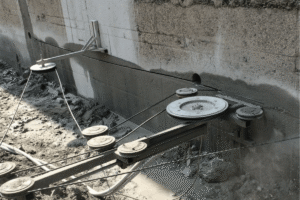
A diamond wire saw is a specialized cutting tool designed to cut through concrete, marble, granite, and metals using a diamond wire loop propelled by a wire cutting machine. The cutting process is executed by diamond beads that are crimped or sintered onto the wire, forming an abrasive diamond-coated wire that grinds away material at a constant cutting speed.
The primary advantage of a diamond wire saw over conventional cutting blades is its remarkable flexibility, almost zero kerf loss, and the capability to operate where standard machinery cannot reach, including extreme depths and thick concrete walls.
Core Definition
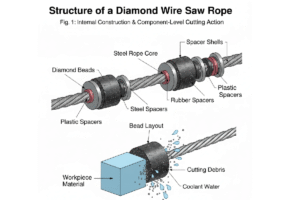
A wire saw is a wire-cutting apparatus featuring an endless circumvolving diamond wire fitted with diamond beads that are spaced uniformly. As the wire with diamond abrasives moves around the pulleys installed at both ends of the machine, it transforms into a cutting instrument of exceptional efficiency. The diamond beads grind instead of shear, making the cutting method suitable for treating both fragile stone and tough metal simultaneously.
Historical Evolution of Wire Sawing Technology
Wire sawing originated from the quarrying of marble and other rock types, initially using abrasive slurry and later transitioning to diamond tools. The concept of diamond wire saw began with the utilization of beads furnished with diamonds to enhance cutting speed, tool life, and clean performance.
Increased tension in wire cutting machine tools and better water controls enabled effective waste removal management. Currently, diamond wire saws dominate in mining, demolition, and precision industries, particularly when they outperform traditional saws and enable operations in locations where conventional cutting methods prove unsuitable.

Key Components of a Diamond Wire Saw System
| Component | Function | Importance |
|---|---|---|
| Diamond Wire | Primary cutting element with diamond-coated beads | Core cutting mechanism |
| Diamond Beads | Abrasive particles that grind through material | Determines cutting efficiency |
| Guide System & Pulleys | Maintains wire alignment and path | Ensures cutting accuracy |
| Tension Control | Prevents wire slackness and wandering | Maintains cutting stability |
| Power Source | Drives wire at optimal cutting speed | Controls cutting rate |
| Cooling System | Controls heat, removes swarf, clears dust | Prevents thermal damage |
The diamond coated wire serves as the essential cutting element, assisted by pulleys that guide and maintain alignment. Wire tension controls slackness, while the power source sets the cutting speed. Water performs three essential functions: controlling thermal levels, moving swarf off the site, and ensuring efficient clearing of dust particles.
How Does a Diamond Wire Saw Work?
The operation of a diamond wire saw fundamentally transforms a flexible wire studded with diamond abrasives into a high-capability cutting implement that grinds rather than shears. The essential prerequisite is a wire-saw machine that handles tension and cutting velocity while engaging in the endless circular propagation of diamond wire through the pulley system.
Understanding the Cutting Process
The cutting method employs diamond beads that are set or sintered to the surface of a diamond wire, which operates under regulated feed and cutting speeds. With each advancing loop of the wire saw, the abrasive chips away micro-particles from the substrate, which are flushed away with water to cool the interface.
Step-by-Step Cutting Process
- Wire Loop Circulation: The endless diamond wire circulates continuously through the pulley system at controlled speeds.
- Material Contact: Diamond beads make contact with the workpiece surface.
- Abrasive Grinding: Each bead grinds away microscopic chips through abrasive action rather than shearing.
- Cooling & Flushing: Water continuously cools the cutting interface and removes debris (swarf).
- Tension Maintenance: The wire saw machine maintains proper tension to prevent wire wandering.
- Progressive Advancement: The wire advances through the material at a controlled feed rate.
Compared to a saw blade, this method dissipates force across multiple points of contact, allowing efficient cutting of complex geometries with minimal resistance. The wire maintains straight alignment, preventing wandering and ensuring consistent cut quality.
The Role of Diamonds in Cutting
Diamonds provide exceptionally high wear-resistant action as superhard abrasives, causing brittle fracture and micro-scratches that remove materials more effectively in stone cutting operations. Each diamond bead carries several cutting points that grind as an alternative to shearing, keeping the possibility of chipping to a minimum.
Diamond Self-Sharpening Mechanism
Due to the cutting process, the diamond-embedded wire continuously self-sharpens as worn grains fall away to expose new facets. This natural renewal, combined with proper selection of diamond tools appropriate to the material and maintaining correct cooling solution pressure, works to preserve cutting integrity throughout the operation.
Mechanics of Wire Saw Operation
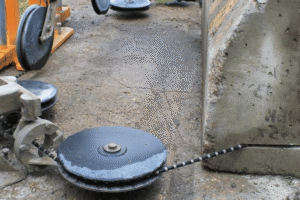
In the diamond wire saw machine, torque, pulley alignment, and tension are carefully controlled while the diamond wire loops through the system. The wire cutter head sets the approach angle and contact length, balancing feed force with frictional heat generation.
To prevent glazing of diamond abrasives and premature bead wear, precise control is maintained with respect to cutting speed and feed rate. Because the cutting tool grinds along the kerf continuously, forces are gradually distributed, thereby reducing vibration compared to traditional sawblades. This characteristic enables cutting of reinforced concrete while achieving minimal structural disruption.
Advantages of Using a Diamond Wire Saw
Primary Benefits
Diamond wire sawing represents a highly capable method for cutting through materials compared with traditional cutting techniques. It provides exceptional speed, minimal vibration, minimum kerf width, and the robustness to access locations where conventional saws would fail entirely.
Cutting Efficiency and Precision
Wire cutting with diamond achieves high efficiency compared to other cutting methods because the grinding process proceeds with motorized power distributed across individual abrasive grits, drawing minimal power waste. The precision of wire sawing operations depends heavily on proper maintenance of the wire saw system.
| Performance Metric | Diamond Wire Saw | Traditional Blade Saw |
|---|---|---|
| Kerf Width | Minimal (3-12mm) | Wider (10-30mm) |
| Vibration Level | Very Low | Moderate to High |
| Maximum Cut Depth | Virtually Unlimited | Limited by blade diameter |
| Complex Geometry | Excellent capability | Limited |
| Material Waste | Minimal | Higher |
| Surface Finish | Smooth, minimal cracking | Rougher surface |
Diamond wire cutting achieves tight tolerances through very low kerf, reduced vibration, and wire path control from the series of pulleys. It handles complex geometry accurately and can cut through large structural members without the deflection common to rigid saw blades. The apparatus moves through steel reinforcement and aggregates in reinforced concrete without losing dimensional accuracy.
Reduced Waste and Cost-Efficiency
The narrow passage created by the wire results in minimal material removal, thereby reducing waste in marble blocks and structural elements. Additionally, reduced micro-cracking from the grinding action offers better material yield. The combination of these factors provides several economic advantages:
- Extended Tool Life: Diamond beads last longer due to self-sharpening properties
- Effective Coolant Use: Efficient cooling system reduces consumable costs
- In-Situ Fabrication: Enables on-site cutting, reducing transportation costs
- Labor Savings: Reduced setup and operational time
- Equipment Efficiency: Lower crane time requirements for concrete cutting
- Accelerated Schedule: Faster completion compared to traditional methods
Applications of Diamond Wire Saw Technology
Diamond wire technology finds major applications in quarries, construction, demolition, and specialized industrial cutting where traditional saws fail to meet accuracy requirements and safety standards. The diamond-coated wire with diamond abrasives excels at grinding very hard materials with low vibration, making it suitable for diverse industrial operations.
Quarrying and Stone Cutting
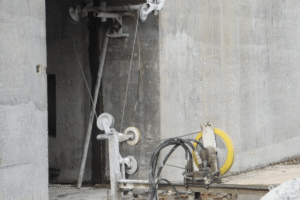
In stone cutting operations, diamond wire cutting proves the optimal method, ensuring minimal wastage when extracting marble and granite blocks. The wire saw machine features an endless diamond wire strung and moved around drive and guide pulleys for uniform grinding across proposed cuts.
Quarry Operations Benefits
Diamond beads are engineered according to geological formations to continuously initiate rock removal at consistent rates and qualities. Compared to conventional blades, wire-sawing demonstrates superior performance in cutting deeper and wider sections, producing finer geometry with significantly reduced micro-cracks. This results in increased block yields, improved slab flatness, and easier polishing processes.
Construction and Demolition Applications
Diamond wire technology offers distinct advantages in construction and demolition work, particularly for cutting concrete, creating openings in structures, selective demolition, and cutting reinforced concrete. The diamond wire operates vibration-free in the machine with minimal seismic disturbance.
Construction Use Cases
- Creating precise openings in concrete walls and floors
- Selective demolition of building sections
- Bridge section removal and modification
- Cutting through heavily reinforced concrete structures
- Underwater cutting operations
- Complex shaped cuts for architectural modifications
- Salvaging large structural pieces intact
The wire passes through concrete aggregates and steel rebars effectively. Water channels evacuate heat generated during cutting. Wire saw machines can salvage substantially massive structural pieces or execute underwater cuts and complicated shapes, serving controlled demolition purposes where conventional tools cannot operate.
Specialized Industrial Cutting
Diamond wire cutting now extends to metals, composites, and high-tech ceramics where conventional cutting systems fail due to material properties. Ultra-precise diamond tools enable wire-sawing of delicate micro-structures for component sizing applications.
For decommissioning work, diamond wire saw machines serve as the premier cutting tool for underwater operations, remote locations, or environments with radiation concerns. The aerospace and energy sectors utilize diamond wire technology to cut heat-resistant heavy alloys. The technology proves valuable for cutting miscellaneous material-composite elements, offering variable feed rates, low kerf, and clean grinding that minimizes material stress.
Comparison with Traditional Cutting Methods
Comparing diamond wire saws with traditional cutting methods reveals fundamental differences in cutting principles, power transfer mechanisms, and impact on the workpiece. Diamond cutting through wire employs grinding via diamond abrasives, whereas traditional saws operate through rigid saw blades that shear material.
Traditional Cutting Tool versus Diamond Wire Cutting
Conventional cutting machines rely on toothed blades or abrasive wheels that concentrate forces at discrete teeth, thereby increasing impact and vibration levels. Comparatively, diamond-wire cutting redistributes forces among numerous diamond beads on an endless diamond wire for controlled grinding action.
| Aspect | Diamond Wire Saw | Traditional Saw |
|---|---|---|
| Cutting Mechanism | Grinding with distributed forces | Shearing with concentrated forces |
| Force Distribution | Multiple contact points across beads | Discrete tooth contact points |
| Vibration | Minimal | Moderate to high |
| Depth Limitation | Virtually unlimited |
Recommend reading: Laboratory Diamond Wire Saw: The Complete Guide to Precision Sample Cutting
Related Posts

Trending Blogs

![Polysilicon Material: Properties, Grades & Uses [Guide]](https://wiresawcutter.com/wp-content/uploads/2026/08/polysilicon-material-featured-150x150.webp)