
Get in touch with DONGHE Company
-
Phone: +86 181-1645-5490
-
Email: Sales18@DongheScience.com

Precision Diamond Wire Saw
Complete Guide to High-Accuracy Cutting Machines for Silicon Wafers, Sapphire, Ceramics & Advanced Materials
Make the most out of your Diamond Wire Saw technology with our extensive guide books. See how sophisticated cutters can obtain ±0.001mm of positioning accuracy, a kerf loss of < 0.15m, and a surface finish of Ra 0.2μm in the fields of semiconductors, laboratories, and industries.
Precision ±0.01mm
Minimal Kerf Loss
No Heat Damage
CE Certified
ISO 9001:2015
ISO 14001:2015
SEMI S2 Compliant
What Is the Precision Diamond Wire Saw?
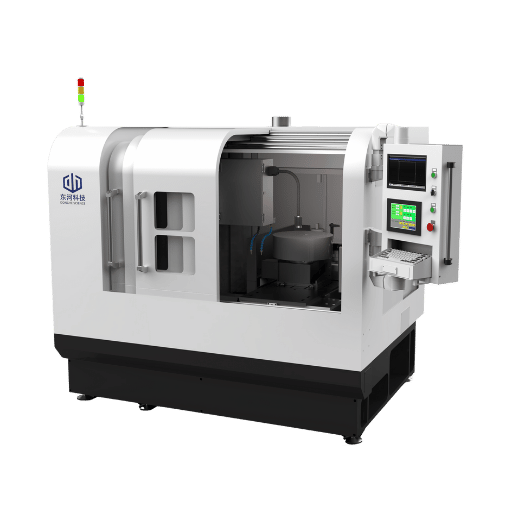
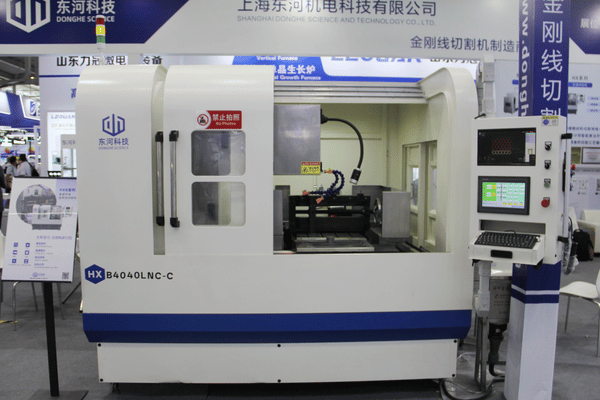
A precision diamond wire saw is a unique cutting system on the market today which uses a fine steel wire embedded with industrial diamond abrasives. It is highly effective in cutting brittle, and valuable objects without the loss of detail.
Core Components of an Industrial Diamond Wire Saw
An 0.08-0.50 mm diameter high-tensile steel core wire bonded with diamond abrasives through electroplating, resin or brazing.
Uses a servo motor and an encoder to adjust wire speeds in a controlled fashion within a range of 0.1-25m/s.
Closed loop control system maintains equilibrium tension (15-45N) to ensure straight cuts without deviation.
Linear stages with sub-micron resolution are used to achieve a high accuracy in sample movement.
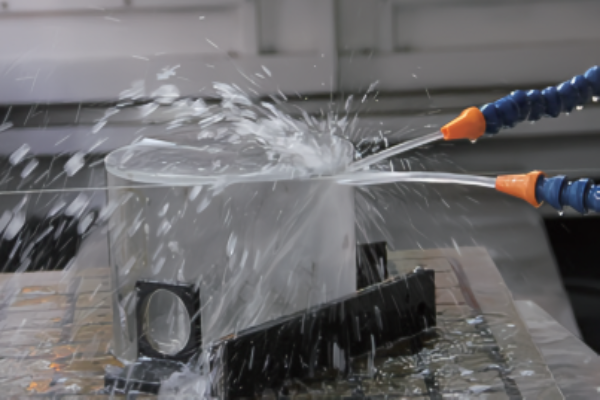
Uses precision nozzles to deliver water or oil-based coolant to control temperature and remove debris.
Microprocessor or CNC Control System stores recipes, monitors the process, and logs data.
🎯
Sub-Micron Positioning
Within 1 micron (.001 mm) accuracy
📏
Ultra-Fine Wire
0.08-0.50mm diameter minimal kerf
⚙️
Advanced Process Control
Real-time monitoring and data logging
🔬
Research-Grade
Surface Ra <0.3μm, damage <5μm
Why Precision
The precision diamond wire saw is not to be confused with industrial wire saws. While industrial systems prioritize cutting speed for high-volume production, precision wire saws focus on applications like TEM sample preparation, R&D, and failure analysis where positioning accuracy (±0.001mm) and surface quality (Ra < 0.3μm) are crucial.
Precision Diamond Wire Saw Features & Capabilities
What makes a precision diamond wire saw different from regular wire cutting tools? These custom built machines have special features made for the most sophisticated labs and research:
Sub-Micron Positioning
Linear stages with ±0.001mm accuracy and 0.1μm resolution for perfect cut placement in crystallography and failure analysis.
Integrated Microscopes
Digital and optical microscopes to confirm alignment and let the user see the cut in real time.
Goniometer Capability
Pairs with angular positioning stages for off-axis crystal cutting and other orientated crystallography applications
Recipes And Automation
Users can upload sets of cutting parameters to the machines for different materials to achieve consistent cutting.
Process Data Logging
Documenting wire tension and cutting parameters for traceability and documentation.
Wire Break Detection
Automatically stops the machine and breaks the wire to save fragile samples from losing unfinished cuts and machine damage.
Diamond Wire Saw Cutting Principle
To get the most out of your cutting and set the most optimal cutting parameters, it is essential to know the diamond wire precision cutting technology and how it works. This technology works differently than how a traditional saw would work. The diamond wire saw works through the removal of substrate materials by means of a controlled and precise rubbing abrasion. With the wire moving at a controlled speed across the workpiece, individual diamond particles erase tiny portions of the workpiece by forming micro scratches on the surface. This smoothing action through rubbing is what sets this technology apart from traditional sawing methods and it prevents the cutting surface from becoming damaged subsurfacely.
The cutting process involves two coordinated motions:
Get Instant Quote
Wire Motion:
The diamond wire is able to go back and forth in a reciprocating motion or in a single continuous one-directional motion and there is a precise control of the speed of the wire in this action.
Feed Motion:
The workpiece or wire assembly is controlled in the rate of the movement. The rate is usually measured in micro meters per minute, or millimeters per minute if it is a normal precision application.
Critical Process Parameters
In regards to the precision diamond wire saw, there are interdependent parameters that are required to be controlled in order to get the best outcomes:
🔄
Speed of the Wire
In precise applications, the wire speed is between 0.5 and 15m/s. Lower speeds increase the surface quality, whereas, at higher speeds, the productivity or throughput of the application is increased
📐
Tension of the Wire
Tension on the wire increases the quality of the cut, and wire diameter can influence the required tension to be between 15 and 45N.
⬇️
Feed rate
0.01-5 mm/min. When a slow feed is being used, a better surface finish is visible. However, a faster feed allows a job to be done more quickly.
💧
Coolant Flow
Water or oil-based. It is essential to use a coolant in order to remove debris, lubricate, and avoid thermal damage.
Precision Diamond Wire Saw Applications By Industry
The precision diamond wire saw provides the most exact key value of the industry whether working in manufacturing or research, where accuracy, repeatibility, and sample integrity become a basic requirement.
Materials Research & TEM Preparation
- TEM sample preparation with minimal artifacts
- SEM cross-section sample cutting
- Metallographic specimen sectioning
- Crystal orientation cutting
- Thin film substrate preparation
Semiconductor Manufacturing
- Silicon wafer slicing from ingots
- Silicon carbide (SiC) wafer cutting
- Gallium arsenide (GaAs) processing
- Gallium nitride (GaN) substrates
- Compound semiconductor materials
Failure Analysis & Quality Control
- IC package decapsulation
- PCB cross-sectioning
- Solder joint analysis
- Component failure investigation
- Incoming material inspection

Optical & Advanced Materials
- Sapphire substrate cutting
- Optical glass and quartz processing
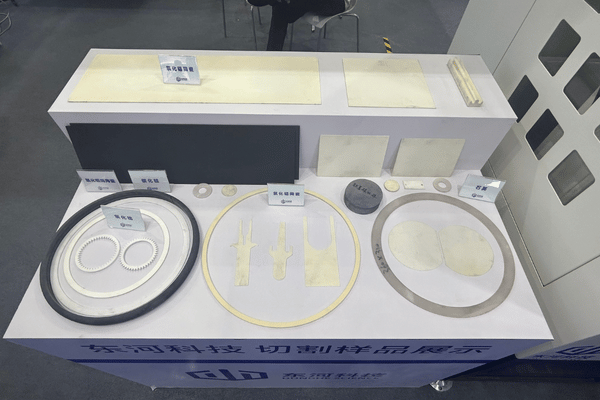
- Ceramic component sectioning
- Graphite electrode cutting
- Composite material analysis
Precision Diamond Wire Saw Technical Specifications
Technical specifications are just as important a necessity for ensuring the correct precision diamond wire sawmat cutters are chosen to fit your needs.
Specification
Description
Lab Grade
Research Grade
Cutting Capacity
Maximum workpiece size
25-75mm
100-150mm
Positioning Accuracy
Sample positioning precision
±0.01mm
±0.001mm
Cutting Straightness
Deviation over cut length
≤20μm/50mm
≤5μm/50mm
Wire Speed Range
Linear velocity control
0.5-10 m/s
0.1-15 m/s
Wire Diameter Range
Compatible wire sizes
0.15-0.40mm
0.08-0.50mm
Feed Rate Range
Workpiece feed control
0.05-5 mm/min
0.001-5 mm/min
Surface Roughness
Achievable Ra value
0.4-1.0μm
0.2-0.5μm
Kerf Width
Material removed per cut
0.18-0.45mm
0.10-0.25mm
Common Precision Diamond Wire Saw Challenges & Solutions
Recognizing challenges operators may encounter with precision diamond wire saw equipment can better understand process optimization and aid with equipment selection. Here, we identify and analyze the most significant challenges with proven solutions.
Challenge
Painted Surface Parasites
Post cut surfaces exhibit excessive roughness and scratches which may lead to a visible saw mark, hence requiring additional polishing or outright rejection.
Solution
Surface Improvement
On your precision diamond wire saw, slow wire speed to less than 2 m/s for the cut, 20-40 μm finer grit selection, and maintain a consistent coolant flow to ensure wire tension is kept at optimal levels throughout the cut.
Challenge
Over Kerf Loss
Wide cuts translate to a substantial amount of cost-imminent material waste and contributes to decreased yields and increasing the cost of each individual defective part, which is especially critical for the likes of SiC and GaN.
Solution
Kerf Minimization
Using a precision diamond wire saw, choose thinner wire 0.15-0.20mm. Use diamond distributions and/or implement vibration dampening with adjustments required to guide roller alignment.
Challenge
Sub-Surface Damage
Micro-cracks and crystal lattice damage buried with the cut surfaces can lead to device downgrading and/or even costly extensive post-processing.
Solution
Damage Avoidance
To enter a ductile-mode cut, slow your feed rate. Optimize precision diamond wire saw tension settings. Use the appropriate coolant chemistry. Consider a multi-step cut sequence, with the final cut being a light pass.
Challenge
Wire Breakage
In precision diamond wire saw cutting, wire breakage is a significant risk that interrupts operations, wastes consumables, and may lead to damage of expensive workpieces.
Solution
Breakage Prevention
The wear on guide rollers should be replaced without delay. The tension system should be calibrated for optimal performance in intervals. Implement wire wear monitoring. Track usage and replace before system failure. Reducing speed for hard materials can also be beneficial.
Challenge
Cutting Efficiency Issues
In cutting processes, inefficient slow speeds worsen throughput, rendering production plans and research schedules unachievable.
Solution
Efficiency Improvement
In selecting for a given material type, wire diameter and grit should be optimal. To improve brook flow on lower material volume processing, endless loop precision diamond wire saw can be used.
Challenge
Equipment Selection Confusion
Selecting the most appropriate precision diamond wire saw configuration, along with specs and options for particular use cases, can be a challenge.
Solution
Guided Selection
The following are material type and sample size, precision requirements, intended production volume, and then the total cost of ownership after which sample cutting demonstrations can be evaluated.
Precision Diamond Wire Saw Vs Other Cutting Methods
How does ultra-precision diamond wire sawing compare with alternative technologies? In this exhaustive comparison, you would get essential insights regarding circumstances when wire sawing would be your right bet:
| Capability | Precision Diamond Wire Saw | Diamond Blade Saw | Slurry Wire Saw | Laser Cutting |
|---|---|---|---|---|
| Kerf Loss | 0.10-0.20mm ✓ | 0.5-1.2mm | 0.15-0.30mm | 0.05-0.15mm |
| Surface Quality (Ra) | 0.2-0.5μm ✓ | 1.0-4.0μm | 0.5-1.2μm | Variable |
| Subsurface Damage | <5μm ✓ | 20-50μm | 5-15μm | Heat-affected zone |
| Hard Materials | Excellent | Good | Good | Limited |
| Brittle Materials | Excellent ✓ | Risk of chipping | Good | Poor |
| Thermal Damage | None ✓ | Possible | None | Significant |
| Shape Flexibility | Good (contour capable) | Straight cuts only | Good | Excellent |
| Operating Cost | Moderate | Low | High (slurry) | High |
| Environmental Impact | Low (water coolant) ✓ | Low | High (slurry disposal) | Moderate (fumes) |
💡 When To Choose Precision Diamond Wire Saw
Precision diamond wire saws are your top choice for: minimum kerf loss when cutting expensive materials, excellent surface finish, reducing polishing times, low subsurface damage for analysis purposes, destruction-free cutting of brittle materials, and environmental power.
Materials Suitable For Precision Diamond Wire Saw Cutting
The flexibility of precision diamond wire saw technology is among its biggest benefits. The diamond abrasive can slice through practically any material besides diamond itself which covers a range of industrial and research materials.
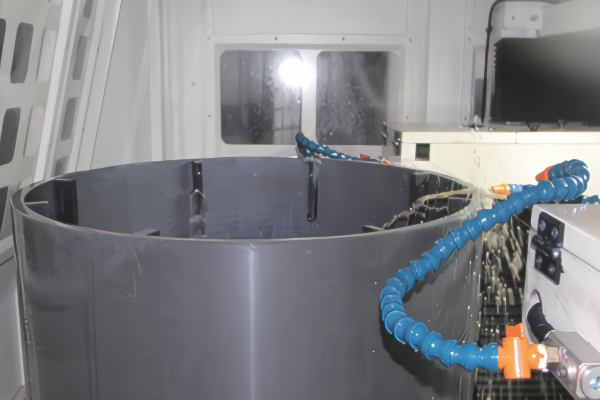
Semiconductors and Electronic Materials
Silicon (Si) — Monocrystalline and polycrystalline, the most typical use
Silicon Carbide (SiC) — 4H-SiC, 6H-SiC for high-power applications
Gallium Arsenide (GaAs) — RF, optoelectronic devices
Gallium Nitride (GaN) — LEDs, power devices
Indium Phosphide (InP) — Fiber optics, high-speed electronics
Germanium (Ge) — Infrared optics, solar cells
Lithium Niobate (LiNbO₃) — Optical modulators, SAW devices
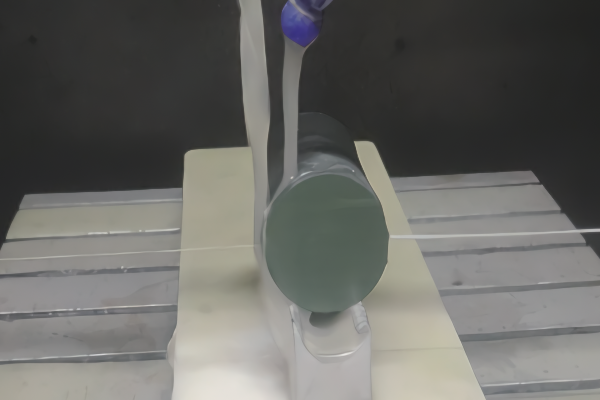
Optical and Crystalline Materials
Sapphire (Al₂O₃) — LED substrates, optical windows, watch crystals
Quartz (SiO₂) — Fused silica, crystal oscillators
Calcium Fluoride (CaF₂) — UV optics
Optical Glass — BK7, SF glasses, crown/flint types

Ceramics and Technical Materials
Alumina (Al₂O₃) — 96% and 99.5% purity grades
Zirconia (ZrO₂) — Dental, industrial applications
Silicon Nitride (Si₃N₄) — High-performance ceramics
Aluminum Nitride (AlN) — Thermal management
Piezoelectric Ceramics (PZT) — Sensors, actuators
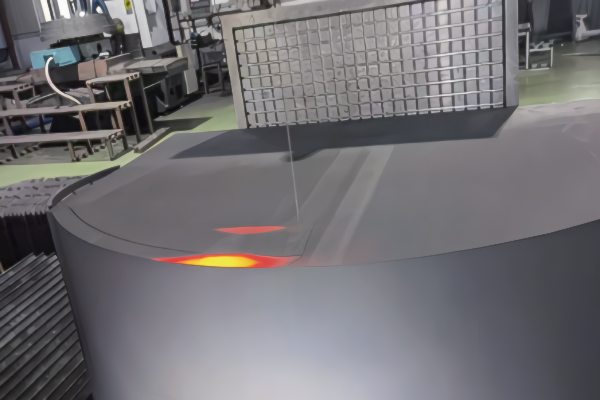
Other Materials for Precision Diamond Wire Saw
Graphite — Battery electrodes, EDM electrodes
Ferrites — Magnetic components
Carbon Fiber Composites (CFRP) — Aerospace structures
Rare Earth Magnets — NdFeB, SmCo
Superalloys — Inconel, Hastelloy for aerospace
How to Select the Right Precision Diamond Wire Saw Cutting Machine
Determining the best precision diamond wire saw for you is a multi-step process in evaluating your personal and company requirements. This is the best way to move forward:
Step 1
Define Your Requirements
📋 Key Questions to Answer
What material are you cutting? (brittleness, and hardness)
What is the max and min sized sample?
What is the level of accuracy required in the positioning?
What surface finish quality do you want (is there a specific Ra value needed)?
What is the expected daily production volume (samples/day)?
Are there additional specific features needed (e.g. goniometer, and microscope)?
What is your budget?
Step 2
Match Machine Type to Application
Application
Recommended Machine
Key Features Required
TEM Sample Preparation
Research-Grade Precision Saw
±0.001mm accuracy, microscope, goniometer
Quality Control Lab
Lab-Grade Precision Saw
Easy to use, high operational repeatability, recipe storage, and retrieval
Semiconductor R&D
Advanced Research Saw
High volume capability, data logging, clean room compatible
Failure Analysis
Research-Grade Precision Saw
Precise positioning, minimal damage, and includes a microscope
Education/Training
Desktop Lab Saw
Has safety features, easy to use, and is economical
Step 3
Evaluate Total Cost of Ownership
In assignment of the total cost of ownership of your precision diamond wire saw, in addition to the purchase price of the saw, consider the following:
Equipment Cost
Total price of the initial equipment purchase.
Consumables
Diamond wire, coolant, replacement parts (estimate annual usage).
Maintenance
Service contracts, calibration, spare parts
Training
Training and certification of the operator.
Utilities
Utilities include the consumption of energy and the use of water and/or coolant.
Utilities
Utilities involve the connection of services and the preparation of the site for installation.
Precision Diamond Wire Saw Price and ROI Cost Analysis
Precisely investing in a diamond wire saw leads to profits, obtained through material savings, labor efficiency, and productivity of a higher-graded quality:
Material Cost Savings
In real terms, a diamond wire saw, operating with a minuscule kerf loss, causes unconsciously created savings to material:
Material
Cost ($/kg)
Blade Saw Kerf
Wire Saw Kerf
Savings per Cut
Silicon (Semiconductor)
$80-150
0.8mm
0.15mm
~80% less waste
Silicon Carbide (SiC)
$400-800
1.0mm
0.20mm
~80% less waste
Sapphire
$300-600
0.9mm
0.25mm
~72% less waste
Gallium Any way
$500-1000
. 7mm
0.12mm
~83% less waste
Labor & Time Savings
Less polishing time
Improved surface quality = 40-60% less post-processing
Reduced reject samples
Consistency in finish quality means less rework
Speedier setup
Recipe storage necessitates quick changeover
Less supervision
Automated functions reduce the operator’s attention to a minimum
Interactive Tool Suite
Precision Diamond Wire Saw Tools
Use our interactive calculators to select the right equipment, optimize cutting parameters, and minimize material waste.
Get Instant QuoteDiamond Wire Saw Equipment Selector
Answer a few questions to find the ideal wire saw system for your needs
1
2
3
4
5
Select Your Primary Application
Primary Material to Cut
Maximum Sample Size
Required Precision Level
Production Volume
—
—
Price Range
—
Accuracy
—
Wire Speed
—
Best For
—
Cutting Parameter Calculator
Get optimized cutting parameters based on your material and requirements
Input Parameters
Recommended Settings
Wire Speed
— m/s
Feed Rate
— mm/min
Wire Tension
— N
Est. Kerf
— μm
Cut Time
— min
Surface (Ra)
— μm
Quality Score
–%
Optimization Tips
- Select a material to see specific tips
Select material and click Calculate to see recommended parameters
Kerf Loss & Material Waste Calculator
Calculate material waste and compare with alternative cutting methods
Workpiece & Wire Parameters
Waste Analysis Results
Kerf per Cut
— μm
Total Slices
—
Material Wasted
— mm
Waste %
–%
Volume Lost
— mm³
Slice Pattern Visualization
Usable Slice
Kerf Loss
Comparison with Other Methods
Diamond Wire Saw
—
ID Saw
—
Blade Saw
—
Enter parameters and click Calculate to see waste analysis
Ready to Optimize Your Cutting Process?
Get personalized recommendations and pricing for your specific application from our engineering team.
Get Instant QuotePrecision Diamond Wire Saw: Customer Case Studies & Success Stories
Case Study 1: Semiconductor Research and Development: Cutting Silicon Wafers
Customer Information
- Industry: Semiconductor Industry
- Organization: University Research Lab (Top 10 Engineering School in the U.S.)
- Material: Silicon Wafers
- Location: California, USA
The Problem
The microelectronics research center is currently facing major issues with their existing workflow in the cutting of silicon wafers. Their aging blade saw system is causing the following state:
- Factors with Excessive Kerf: Impacts 0.8-1.0 mm of a cut, leading to wastage of upwards towards 15% of invaluable high-purity silicon material.
- Surface Roughness (Ra): 2.5 um, requiring vast absorbing then polishing.
- Subsurface Damage: Extending 50 to 80 um, compromising device operation.
- Heat Zone Damage: Subdivides cutting crystals leading to damage.
- Wafer Thickness: Unattainable below 200 um advanced architectural specifications.
Our Result: DWS-3500 Implementation
A thorough evaluation led to the implementation of the DWS-3500 Precision Diamond Wire Saw system specifically configured for cutting silicon wafers.
| Parameter | Specification |
|---|---|
| Diamond Wire Diameter | 0.25mm diamond wire, electroplated |
| Diamond Grit Size | 40-60μm (silicon optimized) |
| Wire Speed | 1.5-2.0 m/s (with reciprocating) |
| Wire Tension | 18-22N (servomotor tension regulation) |
| Feed Rate | 0.8-1.2 mm/min (gravity-assisted with servo) |
| Coolant System | Water soluble, 2L/min coolants |
| Max Sample Size | Allows 200 mm Diameter (Ingot) |
Process of Implementation
- Pre-Installation Consultation: Manufacturer׳s application engineering team spent two days onsite, reviewing sample materials.
- Custom Configuration: Equipment configured to include application-specific cutting of silicon fixtures and precise control of alignment.
- Training Program: 3-day complete training on process steps, parameter setting, and maintenance.
- Process Development: Application-specific cutting recipes developed for various silicon grades.
Measured Achievements
Comparing Before (Blade Saw) vs. After (Precision Diamond Wire Saw)
| Metrics | Impact | Before | After |
|---|---|---|---|
| Kerf Loss (mm) | Material lost | 0.8 – 1.0 | 0.30 (63% less loss) |
| Surface Roughness (Ra) | Surface finish | >2.5 | < 0.4 |
| Subsurface Damage | Damage below surface | 50 – 80 | < 10 |
| Wafer Thickness | Achievable thickness | 350 | 100 achievable |
| Post-Processing Time | Wasted processing time | 4+ hours/wafer | < 1 hour/wafer |
| Material Yield | Usable portion | 85% | 97% |
The precision diamond wire saw has changed the game. We can now make device-quality wafers in house, previously requiring outsourcing to costly specialized wafer production facilities. The surface and subsurface roughness and damage 63% less kerf loss, has technically saved us over $40,000/year. The installation and process optimization technical support was superb.
Case Study 2: Processing of Silicon Carbide (SiC) Substrates
Client Profile
- Sector: Compound Semiconductors / Power Electronics
- Organization: Tier-1 Power Device Manufacturer
- Use Case: SiC Wafer Production for Power Modules in EVs
- Region: North Carolina, USA
The Problem
Growing issues due to extreme hardness (Mohs 9-9.5) and brittleness of SiC:
- Excessive diamond wire wear (15-20 cut lifespan).
- Edge damage resulting in a 12% high chipping rate.
- Microcracking impacting overheating reliability.
- Low processing rate (8 wafers/hour).
- High total cost of ownership.
Our Proposal: SiC-Optimized Production Series DWS-5000
| Parameter | SiC-Optimized Specification |
|---|---|
| Diamond Wire Type | Resin-bonded diamond wire (extended life) |
| Wire Diameter | 0.35mm (optimal strength-to-kerf ratio) |
| Concentration | High (25-30%) for improved efficiency |
| Wire Speed | 0.8-1.2 m/s (reduced for heat management) |
| Feed Rate | 0.3-0.5 mm/min (precision servo control) |
| Tension Control | Adaptive tension system with real-time monitoring |
Key Technology Features
- Adaptive Tension Control: Wireless system extends wire life by 40%.
- Vibration Dampening System: Roller system guides reduce wire edge chipping.
- Process Monitoring Software: Real-time logging for quality control.
Results Achieved
| Metric | Before | After |
|---|---|---|
| Wire Life (cuts/wire) | 15-20 cuts | 45-55 cuts (180% improvement) |
| Edge Chipping Rate | 12% | < 2% |
| Surface Roughness (Ra) | 1.8μm | < 0.8μm |
| Throughput | 8 wafers/hour | 14 wafers/hour |
| Consumables Cost/Wafer | $12.50 | $5.80 (54% improvement) |
| Overall Yield | 88% | 98% |
Hardness of the materials has always made SiC processing our greatest manufacturing challenge. For many years we have struggled with problems that have been resolved with the precision diamond wire saw. Adaptive tension control along with optimized wire configurations have improved our yield markedly while also reducing the cost of consumables by 50%. This investment has recovered the initial cost in 8 months.
Case Study 3: TEM Sample Preparation
The Client
- Industry: Research of Materials Science
- Type: Research National Laboratory
- Use Case: Preparation of nano-structural TEM specimens
- Location: Maryland (USA)
The Problem
Realization of high quality TEM specimens faces challenges including:
- Need to micromachine samples to precise regions of interest.
- Need for very thin sections (< 100 microns) to reduce ion milling time.
- Handling fragile materials (ceramics, intermetallics, thin films).
- Avoiding alteration of sample attributes.
- Samples are extremely valuable and scarce.
Our Solution: DWS 2000 Laboratory Precision Saw
| Parameters | Specifications |
|---|---|
| Diamond Wire Diameter | Ultra-fine 0.10mm wire (lowest kerf) |
| Positioning Accuracy | ±1 μm (precision servo stages) |
| Minimum Sample Thickness | 30 μm achievable |
| Wire Speed | 0.3 – 0.8 m/s (ultra-gentle cutting) |
| Feed Rate | 0.1 – 0.3mm/min (harm free processing) |
| Sample Mounting | Multi-axis goniometer for targeted orientation |
| Observation System | 50 x integrated microscope |
Application – Specific Features
- Goniometer Sample Stage: Enables precise alignment of crystallographic orientation.
- Programmable Cut Sequences: Automatic multi-cut configurations.
- Low – Force Cutting Mode: Specialized settings for delicate materials.
Achieved Results
| Achievement | Result |
|---|---|
| Positional Accuracy | < ±2 μm verified across all axes |
| Thinnest Section Achieved | Non-fractured 35 μm |
| Kerf Loss | Reduced to 0.15 mm with negligible waste |
| Surface Condition | (SEM) No visible mechanical damage |
| Ion Milling Time | TEM prep workflow 60% faster |
| Sample Success Rate | 95% (up from 70%) |
The preparation of TEM samples is an art form backed by science. One of the main tools in the sample prep lab is a precision diamond wire saw. The ability to cut samples within 2 microns of the target location with smooth surfaces has given us better Images. We’ve been able to cut our TEM prep workflow time by 60%. Now we’re able to more samples and speed up the research we’re able to produce.
Frequently Asked Questions (FAQs)
Q: How does a precision diamond wire saw differ from traditional saws?
A: A precision diamond wire saw has diamond wires or fine wires mixed with diamond abrasives on an endless wire loop that slices workpieces with minimal material loss and great surface quality. Unlike standard glued saw blades, cutting with a wire involves moving and tensioning, resulting in decreased deformation, more precise control of cutting depth, and greater productivity on more brittle or dense materials.
Q: What is the role of wire tension and roller adjustment in diamond wire cutting?
A: Maintaining wire tension and roller angling is important for uniform cutting rates and less skipping. Engineers fine-tune the position of the rollers and drums along with the wire tension to control the diameter of the path the wire will cut, avoid wire breakage, and allow for a very smooth surface. More stable tension improves surface finish and adds to the lifespan of fine wires in diamond wire saws.
Q: Is it possible for a slab master diamond wire saw to make thin slices for use in material science sample analysis?
A: Yes, slab master precision wire saws can slice thin slabs, often to a few hundred micrometers, for laboratory purposes. technicians can optimize for operating conditions like cutting speed, abrasive slurry, cutting depth, etc to yield five or more pre-polished slabs, or slabs with very thin material loss, for use in material science or crystal analysis, etc.
Q: What diamond wire parameters affect the surface roughness and cutting quality?
A: surface roughness is a function of diamond wire specs, wire motion (stroke and speed), cutting method, and workpiece hardness and workpiece density. surface roughness can be controlled to a few microns depending on the cutting parameters and workpiece material. Minimizing sample deformation or displacement is also very important for sensitive workpieces.
Q: How do you choose a wire for diamonds for brittle and ductile materials?
A: Validation depends on the thickness and the required cut surfaces of the material. For crystals that are brittle, less chipping and finer diamond wires that are in small grit do the job for clean sliced edges. Thicker or tougher workpieces, on the other hand, prefer more coarse diamond wires with faster wire moves and controlled cutting speeds. Optimal combinations of wire diameter, abrasive slurry and cutting depth are found with sample tests by engineers.
Q: What are some recommended safety and maintenance practices for a precision diamond wire saw?
A: Check wire tension, roller misalignment, drum condition, endless wire path and other maintenance issues. Dull diamond wires need to be replaced. Also, keep your power supply and motion sensors operational. to keep your material from being cut lost in the process, stable orientation of the axis with proper cooling or abrasive slurry to minimize heat and follow safety standards of the lab to protect operators.
Q: How Fast Can a Precision Diamond Wire Saw Cut And What Affects Cutting Speed?
A: Diamond wire specifications, wire movement, feed rate, and thickness of the workpiece impact cutting speed. Speeds vary, depending on the material and the type of finish required. Rapid cutting speeds can enhance productivity, however, surface roughness and material deformation may occur. Engineers are required to make tradeoffs, balancing cutting speeds and specifying parameters, for example, [xx] mm depth per pass and concentration of the abrasive slurry, to achieve the best quality cut.
Q: Is Precision Diamond Wire Cutting Of Slabs Suitable For Quality Polishing?
A:Yes. Slabs are master outputs of thin slices and precision diamond wire saws cut thicknesses of 5 mm downsized and upwards depending on the machine specification. With the best parameters assigned, five slices or pre-polished slabs and thin slabs ready for final polishing can be obtained from high-value crystals and valuable samples; material loss can be reduced and yield is improved.
Trending Blogs

![Polysilicon Material: Properties, Grades & Uses [Guide]](https://wiresawcutter.com/wp-content/uploads/2026/08/polysilicon-material-featured-150x150.webp)