
Get in touch with DONGHE Company
-
Phone: +86 181-1645-5490
-
Email: Sales18@DongheScience.com

Glass Cutting Wire Saw
Precision Glass Cutting Wire Saw for Industrial Excellence
Become a master of diamond wire saw technology for precise glass cutting. Through accuracy of ±0.03mm, expert solutions are offered for semiconductor wafer processing, optical glass manufacturing, and industrial applications.
±0.03mm
Cutting Precision
60%
Less Kerf Loss
3-4x
Faster than ID Saw
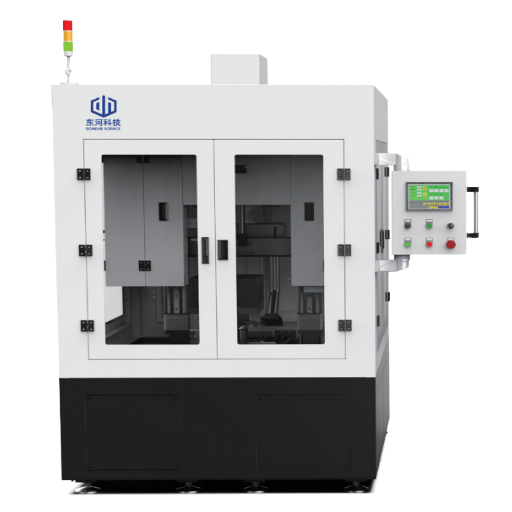
What is a Glass Cutting Wire Saw?
To meticulously cut glass rolls, a diamond wire saw for such purposes is the top end line of the industry that uses a very thin diamond wire for the slicing reason. The continuous or oscillating diamond wire generates friction which not only cuts but also makes the glass very smooth and this is achieved even with the hardest glass materials compared to traditional cutting to blades.
💡
Key Insight
Contemporary CNC glass cutting wire saw systems have the capability of realizing tolerances as tight as ±0.03mm while simultaneously keeping the surface roughness below 3.0μm Ra – thus making them fit for optical-grade applications where precision is an absolute necessity.
±0.03mm
Tolerance
3.0μm
Surface Ra
The glass cutting wire saw that works with diamond has brought about a complete change in the manufacturing of optical components, semiconductor substrates, solar panels, and high-tech display glass. The slicing technology has several benefits over the conventional cutting methods such as less material waste, better surface quality, and the possibility of cutting complicated shapes with little or no post-processing at all.
How Does Diamond Wire Saw Cutting Work?
The diamond wire cutting procedure is composed of several important parts that harmoniously operate:
1
Diamond Wire
A thin steel wire (usually 0.15mm-0.50mm in diameter) that is coated with industrial diamond particles either by electroplating or resin bonding techniques
2
Wire Guidance System
Special precision pulleys that ensure wire tension and alignment are maintained during the cutting process
3
Feed Mechanism
An accurately controlled movement that allows the workpiece to come in contact with the wire at the best possible pressure
4
Coolant System
Deionized water or a special coolant that both removes the cutting debris and prevents overheating
5
CNC Control
Computer numerical control that allows for setting and automating the cutting paths and operations
CNC Glass Cutting Wire Saw
Market Analysis: CNC Diamond Wire Technology & Industrial Applications
Semiconductor • Photovoltaic • Optical • Precision CNC
CNC Market Overview
The global market for wire saws is growing substantially. Precision cutting tools are being demanded more in semiconductor manufacturing, solar photovoltaic production, glass processing, and construction.
Diamond wire saw technology is recognized as the best option for cutting brittle materials with unrivaled precision.
CNC Wire Saw Market Size
$1.32B
2023 Size
$4.22B
2030 Proj.
Growth Analysis
CAGR 2024-2030
10.14%
Saw Wire CAGR
23.3%
High growth driven by demands in semiconductor and PV sectors.
Regional Share
62%
Asia-Pacific
80%
China Prod.
CNC Saw Wire Market Projection (2023-2032)
$31.5B by 2032
Diamond Wire Saw for Glass: Technology Explained
Diamond wire cutting technology is a remarkable leap forward compared to the glass cutting techniques of the past. In this section modern precision glass cutting operations are explained by the cutting mechanism, wire construction, and optimization parameters.
How the Diamond Wire Saw for Glass Works
Step 01
Abrasive Cutting
Glass material is progressively abraded by the diamond particles on the wire surface.
Step 02
Micro-Fracturing
Controlled micro-fractures are created and propagate in front of the cutting zone.
Step 03
Material Removal
The cooling water system rinses away the produced debris effectively.
Step 04
Surface Generation
The cutting action creates a smooth surface that needs only slight post-processing.
Electroplated vs Resin Bond Diamond Wire
Determining whether to use electroplated diamond wire or resin bond diamond wire will greatly influence cutting performance, wire life, and surface quality:
Characteristic
Electroplated Wire
Resin Bond Wire
Diamond Bonding
Single layer, nickel plating
Multi-layer, resin matrix
Cutting Speed
Higher initial speed
Consistent throughout life
Surface Finish
Good (Ra 0.6-1.0μm)
Excellent (Ra 0.3-0.6μm)
Wire Lifespan
Shorter (diamonds don’t regenerate)
Longer (self-sharpening effect)
Best Applications
High-volume production, hard materials
Precision optics, semiconductor wafers
Cost per Meter
Lower initial cost
Higher but better value long-term
Optimizing Glass Diamond Wire Saw Parameters
To attain the best results from glass cutting wire saw equipment, one has to conduct parameter optimization with utmost care:
Wire Speed Optimization
The cutting speed of wire saw usually varies from 10 to 40 m/s. Higher speeds boost the cutting rate but may degrade the quality of the surface. For optical glass cutting, 15-25 m/s is the speed range which usually gives the optimal trade-off between productivity and quality.
Wire Tension Settings
Incorrect wire tension may lead to wire breakage while cutting inaccuracies are equally undesirable. Requirements for tension are determined by such factors as wire thickness, material hardness, and cutting length. Most CNC glass cutting wire saws come with automatic tension control systems.
Feed Rate Control
The interplay of cutting speed and surface quality is a decisive factor. Slower feed rates yield better surface finish but also lower throughput. Advanced controls modify the feed rate according to the cutting resistance in real time.
✓ Pro Tip
Kerf Loss Optimization
The determination of kerf loss in diamond wire cutting is a matter of material efficiency. The modern 0.35 mm diameter wires generate kerf widths of less than 0.5 mm—up to 60% lower than the conventional methods. For costly materials like optical glass and semiconductor wafers this means significant cost savings.
Comparing Different Types of Wire Saw Machine for Glass Cutting
There are many types of wire saw glass cutting line configurations available in the market, each of which has its own intended applications and production requirements. Knowing the differences between them will help you choose the perfect fit for your organization, specific application, or project.
What’s the difference between a wire saw, band saw, and ring saw for glass cutting? The key factors are precision, flexibility, and operating cost:
| Feature | Diamond Wire Saw | Band Saw | Ring Saw |
|---|---|---|---|
| Kerf Width | 0.4-0.8mm (the smallest) | 1.5-3.0mm | 2.0-4.0mm |
| Cut Direction | Any direction; Prototyping straight cuts | Multi-directional | Several straight cuts or very limited curves |
| Precision | ±0.03mm(largest) | ±0.5mm | ±0.3mm |
| For | Best optics; Semiconductor components (optics) | Rough cuts for volume purposes | Conceptual; For stained glass or art work |
| Material Waste | Minimal | Moderate | Higher |
Endless Loop vs Reciprocating Wire Saw
The Endless Loop Wire Saw, sometimes referred to as Endless Diamond Wire Saw, uses a continuous wire loop running in a single direction while reciprocation systems move the wire to and fro. The endless loop designs are more frequently installed in industrial applications because of:
- Greater speeds and cutting output
- More consistent surface finish
- Greater propensity for automation
- Lower use of wire per cut
CNC Glass Cutting Wire Saw Systems
CNC Glass Cutting Wire Saws give programming control of all cutting parameters to permit complex contouring cuts and automatic production. Key features include-
- Multi-Axis Control for Cutting Complex Shapes
- Automatic Tension Adjustments for the Wire
- Recipe Storage for Repeated Runs
- Real-Time Monitoring of Cutting Parameters
- Capability of Integration into Factory Automation Systems
Multi-Wire Saw Systems
For high output series production of semiconductor and solar glass wafers, the system runs on multi-wire saw technology enabling multiple wafer cutting simultaneously. This leads to a very high-speed production without any sacrifice in slice perfection.
Ready to optimize your glass cutting production?
Get Instant Quote
Free Engineering Tool
Glass Cutting Parameter Calculator
Get optimized cutting parameters for your diamond wire saw based on material type, thickness, and quality requirements. Data derived from industry standards and real-world testing.
Input Parameters
Glass Material Type
Material Thickness
mm
Required Surface Quality
Production Volume
1
Select Material
Choose your glass type from the dropdown
2
Enter Dimensions
Input material thickness
3
Set Quality
Specify surface finish needs
4
Get Results
Receive optimized parameters
Industrial Applications Optical Glass Cutting Machines
The introduction of diamond wire saw technology has revolutionized the process of cutting glass with high precision in various industries. To mention a few, glass cutting wire saws are used in these primary areas where they provide excellent benefits:
Primary Application Areas
Semiconductor Glass Wafer Cutting
Semiconductor glass wafer cutting needs very high accuracy. Wire saws provide clean cuts on glass substrates for MEMS devices, display panels, and advanced packaging applications, etc., with little subsurface damage.
Optical Glass Processing
Optical glass cutting machines that utilize diamond wire technology produce precision blanks for lenses, prisms, and mirrors. One of the major benefits is that polishing time is reduced and the quality of the optics improved due to the excellent surface quality.
Solar Panel Glass Cutting
Solar panel glass cutting is done at a very high rate and with very little waste. Wire saws make it possible to work on large sheets of glass for solar applications, fully utilizing the material in the process.
Automotive Glass Manufacturing
Automotive glass cutting wire saws cut windshields, sunroofs, and side windows so accurately that the rigorous dimensional tolerances imposed by car manufacturers are easily met.
Stained Glass & Art Glass
Stained glass wire saws allow artists to perform intricate curved cuts and inside cuts that are not possible with traditional scoring techniques. The edgeless cuts also reduce grinding time considerably.
Laboratory Sample Preparation
Laboratory wire saws cut glass samples to exact dimensions and deliver them with minimum sample damage ready for microscopy, spectroscopy, and materials analysis.
Material-Specific Applications
Cutting Borosilicate Glass
Cutting borosilicate glass by wire saw technology means considering the material's thermal properties. The low thermal expansion of borosilicate renders it susceptible to heat-induced stress. However, proper cooling and the use of optimized cutting parameters avoid thermal shock damage.
Fused Silica and Quartz Glass
Fused silica platinum and quartz glass wire saw cutting are frequent in high-purity applications. These materials' hardness (Mohs 7) requires top-quality diamond wire and better tension settings.
Sapphire Glass Processing
Sapphire glass cutting wire saws are used in making watch crystals, smartphone displays, and LED substrates. Sapphire's extreme hardness (Mohs 9) necessitates tailor-made diamond wire and slower feed rates.
Diamond Wire Saw For Glass Common Challenges & Pain Points
Despite the use of state-of-the-art diamond wire saw technology, operators are still confronted by a number of problems that will reduce the effectiveness of their work, impair the quality of the product, and raise costs.
Glass Edge Chipping
Chipping of the edges of glass during cutting lowers the yield and necessitates finishing work. Glass chips are clearly seen at entrance and exit points due to micro-fractures.
Diamond Wire Breakage
Breakage results in expensive idle machinery and safety hazards. Causes include improper tension, worn-out guide wheels, and contaminated cooling water.
Premature Wire Wear
Premature wear leads to lower cut quality and higher operating costs. Reasons include incorrect cutting parameters, inadequate cooling, and material contamination.
Dimensional Accuracy
Precision dimensions are demanding due to wire deflection, thermal expansion, and mechanical wear. Constant monitoring and adjustments are essential.
Excessive Kerf Loss
Material loss affects profitability, especially with specialty glass. One must strike a balance between wire thickness and cut quality to minimize kerf loss.
Equipment Selection
It is very difficult to pick the correct machine from many options. There is a wide range of differences in specifications, prices, and capabilities.
Uneven Cutting Quality
Inconsistent surfaces require additional processing. Misalignment of guides, tension variations, and worn-out components are typical causes.
Maintenance Complexity
Proper maintenance requires specialized knowledge. Neglect leads to declined performance, rising costs, and decreased equipment lifespan.
Expert Solutions & Best Practices
The highlighted challenges can be addressed with tried and tested solutions formulated through years of experience. The following practices improve your diamond wire saw operations for maximum efficiency.
Preventing Glass Edge Chipping
- At entry and exit points, reduce the feed rate by 30-50%.
- Tension on the wire has to be at an optimum level – too much tension increases chipping risk.
- For chip-sensitive materials, diamond wire with finer grit can be used.
- Provide support to exit edges by using sacrificial backing material.
- Make sure to cool enough to avoid thermal stress.
- Maintain a sharp diamond wire; worn-out wire needs more pressure.
Preventing Diamond Wire Breakage
- Calibrate tensions regularly – both under and over-tension cause failures.
- Proactively inspect guide wheels for wear and replace if necessary.
- Filter the cooling water so that abrasive particles are removed.
- Keep an eye on wire condition and replace before critical wear.
- When cutting, don't make sudden changes in parameters.
- Once a week check alignment of all pulleys and guides.
Extending Diamond Wire Lifespan
- Use the wire at the best speed for your material (usually 15-25 m/s for glass).
- Tension has to be uniform throughout the cutting cycle.
- Proper break-in procedure has to be used for new wire.
- Cooling water must be good quality – pH balanced, filtered, proper flow.
- Hardness of the material has to match the wire specification.
- Maintain wire suitability when not in use to avoid corrosion.
Wire Saw Maintenance Best Practices
- Daily: Check wire condition, coolant level, and clean the area around the workpiece of debris.
- Weekly: Inspect guide wheels, pulleys, and verify mechanical alignments.
Glass Cutting Wire Saw Equipment Selection Guide
To select the appropriate glass wire saw machine, it is necessary to compare your personal requirements with the capabilities of the different machines on the market. This guide will facilitate your decision making and also support you financially by the right purchase.
Key Specifications to Evaluate
📏 Maximum Capacity
Take into account both existing and prospective demands. The machine has to be able to cut your biggest workpieces with plenty of room for enlarging the capacity.
🎯 Positioning Accuracy
If it is precision glass cutting, then go for positioning accuracy of ±0.01mm or better. CNC saws with closed-loop systems provide the best accuracy.
⚡ Wire Speed Range
Machines with higher versatility allow adjustable wire saw cutting speed from 5-40 m/s accommodating different materials and applications.
🤖 Automation
Analyze automatic functions like automatic wire tensioning, program storage, recipe management, and interlinking with material handling systems.
Equipment Categories by Application
| Category | Typical Price Range | Best For | Key Features |
|---|---|---|---|
| Benchtop Wire Saw | $5,000 - $30,000 | Labs, prototyping, small production | Compact, manual or semi-auto |
| Industrial Single-Wire | $30,000 - $150,000 | Production cutting, R&D | Full automation, high precision |
| CNC Contour Cutting | $80,000 - $250,000 | Complex shapes, custom parts | Multi-axis, programmable paths |
| Multi-Wire Production | $200,000+ | High-volume wafer production | Multiple simultaneous cuts |
Evaluating Diamond Wire Saw Manufacturers
Company Capabilities
- Duration of being in the industry and specialization in glass cutting applications
- Customers in your industry who are willing to act as references
- Warranty and service contract options
- Test cutting service to confirm performance before buying
Support & Training
- Technical support service availability and response time
- Operator and maintenance staff training
- Accessories availability and delivery times
⚠️
Important Consideration
Always ask for sample cuts on your materials before buying. The manufacturer’s performance claims may not hold true for your specific glass types and thicknesses. Test cutting services are going to be offered by reliable manufacturers to showcase their capabilities.
Glass Cutting Wire Saw Customer Success Stories
Read what top manufacturers in semiconductor, optical, LED, and photovoltaic sectors say after reshaping their precision cutting processes with our diamond wire saw cutting machines.
Achieving 45% Reduction in Material Costs for Silicon Wafers
The Challenge
One of the largest American semiconductor manufacturers encountered substantial obstacles in silicon wafer cutting operations. The ID inner diameter saw lines were losing too much material and couldn't keep pace with advanced chip manufacturing demands.
- Massive waste of silicon (1.8mm kerf).
- Subsurface damage requiring 3 extra polishing steps.
- Limited production: 800 wafers per line.
- High operation costs due to frequent blade replacement.
Our Solution
We implemented four DWS-600 Endless Diamond Wire Saw Cutting Machines, engineered tailored towards the client.
- CNC control and real-time tension monitoring.
- Custom electroplated diamond wire (0.12mm).
- Integrated coolant system with ±1°C control.
- Automated wire management for 72h uninterrupted operation.
| Parameters | Before (ID Saw) | After (Diamond Wire Saw) |
|---|---|---|
| Kerf Loss | 1.8mm | 0.35mm |
| Surface Roughness (Ra) | 2.5μm | 0.5μm |
| Min Wafer Thickness | 200μm | 100μm |
| Cutting Speed | 15mm/min | 45mm/min |
45%
Reduction of Material Cost
3.2x
Increase of Production Capacity
78%
Reduction in Post-Processing
14 mo
Payback Period of ROI
"The switch to diamond wire saw technology was revolutionary for our wafer production. We are saving more than $2.8 million in raw silicon costs every year due to less kerf loss. The surface quality was improved and two grinding steps were eliminated."
Precision Optical Glass Cutting for Defense-Grade Optics
The Challenge
Europe’s leading manufacturer of defense optical components faced high rejection rates (35%) on fused silica components due to micro-cracks. They struggled to meet the required surface flatness of λ/10 and faced high scrap costs from premium materials.
Our Solution
Deployed the OPT-400 Optical Glass Cutting Machine with ultra-fine diamond wires (0.08 mm) and vibration-isolated granite base.
- Precision graded diamond particles (2-4 microns).
- Closed control system with tension maintained ±0.05N.
- Custom fixture for unique optical blank geometries.
| Parameter | Before | After (OPT-400) |
|---|---|---|
| Surface Roughness (Ra) | 1.8μm | 0.35μm |
| Subsurface Damage | 25-40μm | 2-5μm |
| Kerf Loss | 1.2mm | 0.15mm |
| Tolerance | ±0.1mm | ±0.02mm |
92%
Reduction in Rejection Rate
€1.2M
Annual Material Savings
60%
Faster Processing Time
λ/10
Surface Flatness Achieved
"The OPT-400 has changed the game for us. The near-net-shape cutting capabilities allow us to remove 80% more material during post-processing. We've virtually entirely eliminated grinding from the process."
Scaling Sapphire Substrate Production for High-Brightness LED
The Challenge
The client needed a massive increase in sapphire substrate production. Current single-wire systems were limited to 500 wafers/day, and sapphire's extreme hardness (Mohs 9) caused rapid wire degradation costing $180,000/month.
Our Solution
Implemented 8 units of SAP-800 Multi-Wire Diamond Saw systems with over 1000 wire capability per system.
- Sapphire-optimized diamond wire with enhanced bonding.
- Smart wire speed adjustment with real-time force supervision.
- Auto loading/unloading for continuous run.
| Parameter | Old System | SAP-800 Multi-Wire |
|---|---|---|
| Wafers per Cut Cycle | 1 | 200+ |
| Kerf Loss | 0.45mm | 0.25mm |
| TTV | 15μm | 5μm |
| Wire Consump./Wafer | 2.5m | 0.6m |
400%
Increase in Production Capacity
68%
Decrease in Wire Costs
44%
Increase in Wafers per Ingot
99.2%
Epitaxy-Ready Yield
"The SAP-800 multi-wire system improved our capacity to satisfy customer demand. The improved TTV and reduced subsurface damage have dramatically improved our downstream epitaxy yields."
Optimizing Silicon Ingot Slicing for Next-Gen Solar Cells
The Challenge
Facing demand for thinner wafers (180μm target) and larger formats (210mm). Existing slurry-based saws had high breakage rates (8%) and environmental concerns. The production target was 10 million wafers per month.
Our Solution
Deployed 12 PV-1200 High-Throughput Diamond Wire Slicing Systems.
- Ultra-thin diamond wire (0.052 mm).
- Advanced wire system removing wire marks.
- Water-based coolant system with 95% recycling capability.
- AI process control for optimal parameters.
| Parameters | Slurry Wire Saw | PV-1200 Diamond Wire |
|---|---|---|
| Kerf Loss | 0.18 mm | 0.065 mm |
| Min Wafer Thickness | 200μm | 180μm |
| Breakage Rate | 8% | 0.8% |
31%
More Wafers per Ingot
0.8%
Record Low Breakage Rate
2.7x
Faster Throughput
$0.003
Cost Reduction per Watt
"The PV-1200 diamond wire system enabled us to achieve ultra-thin wafer production goals while improving yield. The silicon savings alone represent over $15 million annually."
Ready to achieve similar results in your production line?
Get Instant Quote
Glass Cutting Wire Saw FAQs
To perform precision cutting a diamond wire saw is a machine that cuts through hard materials such as optical glass, wafers, and substrates by using a continuous loop or wire loop whose surface is coated with diamond particles to make the cut extremely fine and less than a traditional band saw. The cutting of a diamond wire saw is not a solid blade like a toothed metal blade or a band saw, but an abrasive action of a thin wire which results in a thinner kerf, less material loss, more accurate cutting, and the ability to make intricate and fine cutting lines on fragile materials.
Wire saws employ diamond dusted wire which operates at set speeds while the workpiece is fed against it. With glass and optical glass cutting the diamond wire cutting process that produces a cutting slurry gently grinds away a material allowing for cutting with a high level of precision of hard and brittle materials without causing cracks. A smooth cutting surface, little chipping, and the ability to cut through thin wafers and delicate optical parts are the main features of the cutting process.
Yes, numerous diamond wire saw machines and wire saw apparatus are compatible with CNC, thus providing automated management of the cutting rates, wire speed, tension, and paths. A CNC machine for cutting enhances the precision of cutting, the reproducibility, and the cutting productivity for intricate forms, wafer singulation, or high-precision optical glass cutting operations.
A diamond wire cuts continuously, which is a very important quality that increases cutting productivity and assures uniform cutting quality for wafer and substrate slicing. The benefits of this method are the use of a very thin kerf leading to less wastage of the material, high-precision slicing of thin wafers, cutting speeds that are faster than some traditional techniques, and better management of cutting slurry to help wire life and keep the ability to cut for long runs of production.
The life of the wire varies depending on factors like diamond particle quality, wire tension, cutting speed, slurry quality, and the hardness of the workpiece. Daily maintenance includes checking wire tension, changing worn wire loops, cleaning the cutting slurry system, and inspecting guides and rollers, and Calibrating CNC controls. Good maintenance practices will prolong the life of the wire and also keep cutting accuracy and efficiency intact.
Diamond wire saws are multipurpose tools: they are used not only in the industrial applications of wafer slicing and manufacturing of optical parts but also in art glass and stained glass cutting where they need accurate and delicate cutting. The use of diamond wire cutting in art glass gives very precise edges and complicated forms with less chipping compared to the use of habitual cutting tools.
Safety measures in operating a wire saw machine include the installation of guards around the wire loop, training of operators, and implementing available methods for slurry containment and filtration to avoid environmental contamination. It is important to take care of the cooling and cutting slurry and to use personal protective equipment, and to refer to the manufacturer’s instructions for safe operation and maintenance in order to reduce the risks and to prolong the lifespan of the cutting system.
Diamonds saw cutting and laser cutting are two different applications. Diamond saws have the upper hand in cutting wafers, glass, and other substrates with precision, while in some cases laser cutting can get non-contact cutting and be faster for thin materials. For the fragile hard materials that need low heat input and minimum micro-cracking, diamond wire saws are usually the best choice for a cutting method and surface quality.
Cutting accuracy is influenced by: wire quality (diamond particles and coating), wire tension, feed rate, machine stiffness, cutting slurry, and calibration of CNC control. To reach optimum performance, it is necessary to use high-precision equipment, keep wire tensions stable, pick the proper cutting parameters for the material, make sure that the filtration of slurry is done well, do regular maintenance, and think about using advanced cutting technologies or modals (e.g., new omni-2 plus style systems) for enhancing cutting ability and faster cutting speed.
Trending Blogs

![Polysilicon Material: Properties, Grades & Uses [Guide]](https://wiresawcutter.com/wp-content/uploads/2026/08/polysilicon-material-featured-150x150.webp)