Get in touch with DONGHE Company
-
Phone: +86 181-1645-5490
-
Email: Sales18@DongheScience.com

Gantry diamond wire saw
Gantry Diamond Wire Saw: Precision Cutting Technology
The main tool for Silicon Wafer Slicing, Optical Glass Processing, Ceramic Cutting, and Advanced Materials Cutting by Gantry Diamond Wire Saw Machines. Continuous Diamond wire saw technology offers far greater accuracy while requiring only the minimum kerf loss.
$2.77B
Market Size by 2033
7.3%
Annual Growth Rate
50%+
Lower Kerf Loss
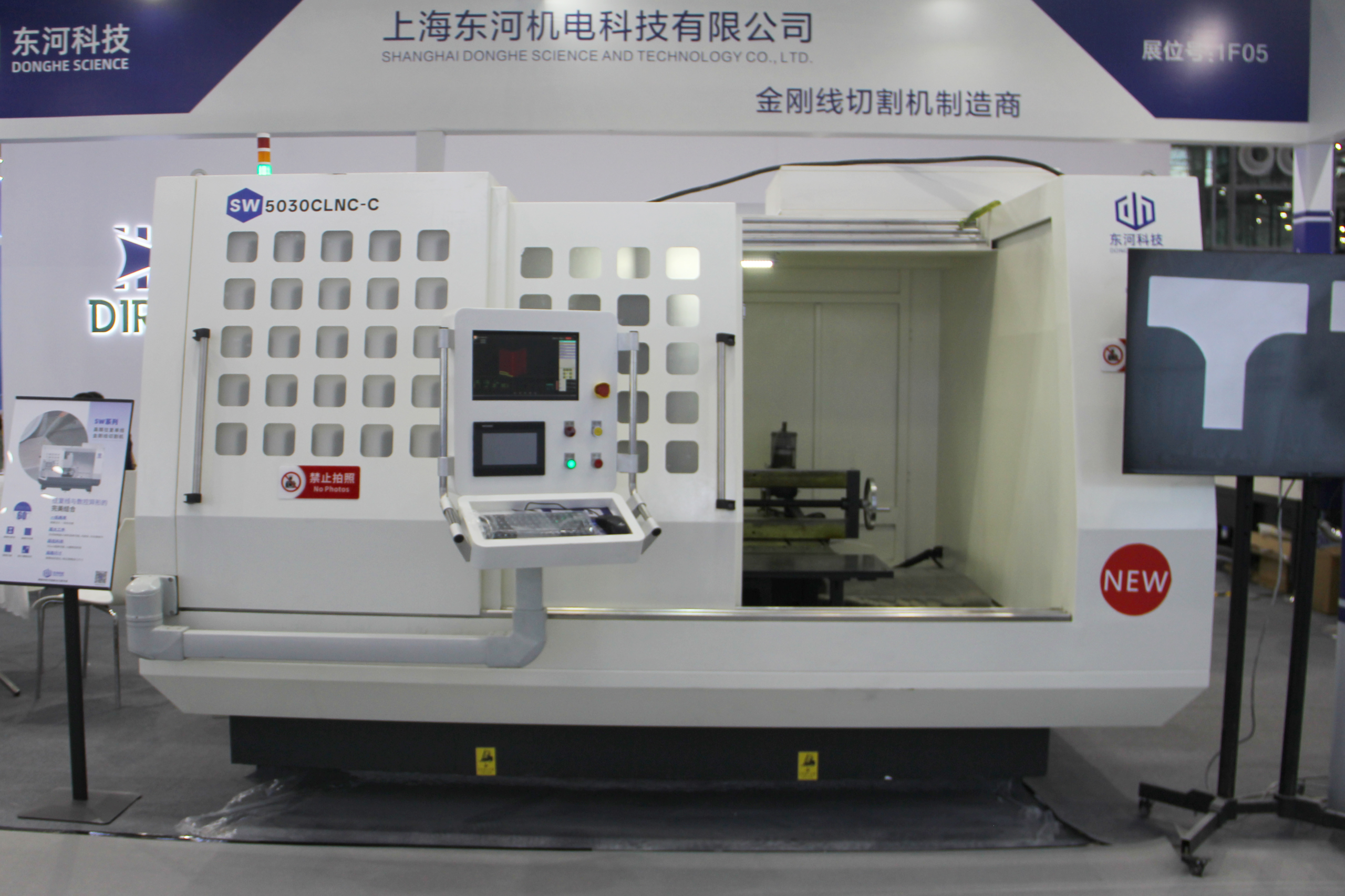
What is a Gantry Diamond Wire Saw?
A gantry diamond wire saw is a sophisticated cutting machine which一)uses a portal frame (gantry) structure to carry and guide a diamond wire for cutting hard and brittle materials. It is a major leap-forward cutting technology in the field of diamond-coated wire saw machines that are no longer using teeth to rip through materials but rather via abrasion, leading to not only much less kerf loss but also better surface quality.
To make the most of their excellent stability, large, complex geometries and the gantry configuration cutting devices has opened up new applications in semiconductor manufacturers and stone quarries as they are the major users of diamond wire saw machines.
💡 Key Advantage
The diamond wire saw cutting machine has come to a point where it can achieve kerf thicknesses that are as narrow as 0.3-0.4mm while traditional cutting tools take up to 1.0-2.0mm. This means that there will be less wasted material, particularly when very valuable materials such as silicon wafers or sapphire crystals are being processed.
Core Components of a Gantry Diamond Wire Saw
Choosing and handling of wire saw cutting equipment properly requires knowing its major components:
🏗️
Gantry Frame
Strong portal-frame structure gives stability and supports multi-axis movement for the operations of precision cutting.
💎
Diamond Wire
High-tensile steel wire covered with diamond abrasive particles (electroplated, resin-bonded, or brazed).
⚙️
Guide Wheels
Pulleys of precise construction which ensure the wire is along the ripping path and tension of the wire is correct during the operation.
📊
Tension Control
Automated system keeping the wire tension optimal to stop it from breaking and at the same time cutting quality being uniform.
💧
Coolant System
Water-based cooling and lubrication system that removes debris and prevents overheating during cutting.
🖥️
CNC Controller
Computer numerical control unit for programming cutting parameters and automating complex cutting operations.
How Does a Diamond Wire Saw Cutting Machine Work?
The diamond wire cutting method is entirely different from the conventional sawing method. The diamond wire saw does not use saw teeth, but instead utilizes diamond abrasive particles that are attached to a thin steel wire to grind the materials. This process of grinding cuts hard and brittle materials very precisely, so they do not get fractured or destroyed as they would with regular cutting methods.
Operational Mechanics
In such a gantry diamond wire-type saw, the diamond wire runs at very high linear speeds (usually 10-80 m/s) while the workpiece is slid into the cutting area. The gantry construction makes it possible for the cutting head to move along the Y-axis and Z-axis, thus allowing automatic feeding and precise depth control. In the case of endless diamond wire saw systems, the continuous loop goes in one direction only, thus maximizing the cutting efficiency.
Step 01
Workpiece Preparation
The workpiece is held on the table with suitable fixtures. It is essential to do proper fixation to avoid the workpiece getting moved during the cutting process and to maintain its accuracy in dimensions.
Step 02
Wire Tension
The tension of the diamond wire loop is set according to the type of material and diameter of the wire. The best possible tension is that which does not lead to the wire breaking and at the same time ensures effective cutting.
Step 03
Parameter Setting
The CNC controller receives the key settings for the wire speed, feed rate, and cutting depth as per the material being cut and the desired surface quality.
Step 04
Cutting Execution
The cutting cycle starts with the coolant flow being turned on. The wire saw cuts the material while the gantry system accurately controls its position and feed.
Step 05
Quality Inspection
After the cutting procedure, the workpieces are subjected to inspection regarding surface quality, dimensional accuracy, TTV (Total Thickness Variation), and possible subsurface damage.
Wire Speed
The cutting efficiency is improved with higher speeds but at the same time more heat is generated.
Feed Rate
If the rate is too high, the wire will be bowed and will break; if too low, productivity will be reduced.
Wire Tension
It has to be adjusted for each material, so that neither slack nor overstress is created.
Classification
Types of Gantry diamond wire saw
Knowing the various kinds of diamond wire saw machines will enable you to choose the perfect solution that meets your needs exactly.
Endless Loop Wire Saw
Continuous diamond wire loop for fast cutting
up to 80 m/s wire speed
cuts in one direction only
very high cutting efficiency
large workpieces are no problem
cost per cut is lower
Best for:
Optical glass, ceramics, graphite, magnetic materials
Spool Wire Saw (Reciprocating)
Wire on reels with back-and-forth movement
very good control of precision
better surface quality
very low TTV values
thin wafer cutting is suitable
multiple cuts per wire load
Best for:
Silicon wafers, sapphire, precision optics
Vertical Gantry Wire Saw
cutting from above downwards
gravity makes chip removal easier
large cutting power
good for cutting blocks
easy loading of workpiece
cutting force is stable
Best for:
Large blocks, stone, silicon ingots
Horizontal Gantry Wire Saw
cutting motion from side to side
ideal for cutting thin slices
machine is lower in height
compact area occupancy
good production of slabs
parallel cutting is possible
Best for:
Wafer slicing, thin sheet production
💡 Wire Type Selection Guide
Electroplated Diamond Wire
Fast cutting, shorter life, best for harder materials.
Resin-Bonded Wire
Longer life, smoother finish, ideal for precision applications.
Brazed Diamond Wire
Maximum diamond exposure, highest cutting efficiency, premium price point.
Applications
Precision Diamond Wire Saw Materials & Industry Applications
Gantry diamond wire saws are the best for the hard and brittle materials cutting in multiple industries.
Optical Glass
AR/VR lenses, camera optics, precision prisms

Silicon & Semiconductors
Wafer slicing, SiC/GaN, IC substrates
Sapphire & Crystals
LED substrates, watch crystals, gemstones

Advanced Ceramics
Alumina, zirconia, silicon carbide
Graphite & Carbon
Electrodes, battery materials, composites

Magnetic Materials
NdFeB, ferrite, SmCo magnets

Hard Alloy
Tungsten carbide, cemented carbide, tool materials

Stone & Construction
Marble, granite, concrete cutting
Why Diamond Wire Cutting for These Materials?
The hard and brittle materials cutting problems are hard for the traditional methods and such challenges cannot be addressed effectively.
Optical Glass Cutting
Is the process involved gets the edges without cracks and sub-micron surface finish for the lens applications. With the diamond wire, the surface roughness is Ra 0.4-0.8μm, and there is no edge chipping.
Silicon Wafer Manufacturing
It is a process that demands little kerf loss (material wastage). Our diamond wire loop cutting achieves 1mm for a traditional blade saw.
Ceramic Processing
Due to high hardness (HV 1500+) the use of diamond abrasives is necessary. The endless wire also prevents thermal damage that may crack ceramics.
Magnetic Material Cutting
It is a process that requires the preserves of the magnetic properties. The cold cutting process with diamond wire prevents demagnetization due to heat.
Diamond Wire Saw ROI Calculator
Calculate your potential material savings and return on investment when switching from traditional cutting methods to diamond wire saw technology.
Configure Your Parameters
mm
mm
cuts/yr
$/cm³
Kerf Loss Comparison
| Cutting Method | Typical Kerf | Efficiency |
|---|---|---|
| Diamond Wire Saw | 0.15-0.30 mm | Best |
| ID Saw | 0.30-0.45 mm | 2x loss |
| Diamond Blade Saw | 1.5-3.0 mm | 10x loss |
| Slurry Wire Saw | 0.18-0.25 mm | Good |
| Gang Saw (Stone) | 5-7 mm | 35x loss |
📚 Data Sources
Kerf loss data based on industry benchmarks from SEMI (Semiconductor Equipment and Materials International), PV Tech reports, and manufacturer specifications. Material costs are market averages from 2024-2025 industry data.
--
Kerf Reduction
--
Annual Material Savings
--
Payback Period
--
3-Year ROI
Material Loss Comparison (per cut)
Cumulative Savings Over Time
Ready to Maximize Your Material Efficiency?
Get a customized quote based on your specific requirements and start saving today.
Expert Solutions
Diamond Wire Saw Machine Common Challenges & Our Solutions
The selection and operation of diamond wire saw equipment present customers with certain pain points which, once understood, allow us to come up with better solutions.
Common Challenges
Our Solutions
01
Challenge
High Initial Investment Cost
The cost of the diamond wire saw machines is so high that calculating the return on investment is very important for the decision concerning purchasing to be made.
01
Solution
ROI-Focused Consultation
We perform detailed TCO analysis that shows the savings resulting from less kerf loss, upgraded productivity, and payback calculations which usually indicate a 12-18 month ROI for the company.
02
Challenge
Wire Breakage Issues
Production delays due to frequent wire breaks, higher costs of consumables and possible damage to workpieces are the main impacts of this problem.
02
Solution
Advanced Tension Control
The breakage in our adaptive tension control systems is reduced by as much as 80% in comparison to manual systems because they automatically change with the material's variation.
03
Challenge
Difficulty Selecting Right Machine
It is quite difficult to pick the right type and configuration of machine for a particular application as there are so many types of wire saw cutting machines in the market.
03
Solution
Application Engineering Support
Our engineers will understand the specific materials, dimensions, and quality requirements of your application and they will suggest the best gantry wire saw setup.
04
Challenge
Inconsistent Cutting Quality
The variations in the surface roughness, TTV, and dimensional accuracy affect the downstream processes and product yields.
04
Solution
Process Optimization
We assist with optimization of cutting parameters, training, and continuous support so that the quality output is always consistent and meets your required specifications.
05
Challenge
High Consumable Costs
Regular replacements of diamond wire and guide wheels are required, thus affecting the total cost of ownership.
05
Solution
Long-Life Consumables
With our premium diamond wire and hardened guide wheels, you get a 30-50% longer service life which means that the cost per cut is reduced significantly.
06
Challenge
Lack of Technical Support
The operation of specialized precision cutting equipment typically requires expertise that may not be readily available in-house.
06
Solution
Comprehensive Training & Service
The combination of on-site installation, operator training, preventive maintenance programs, and 24/7 technical support maximizes uptime.
Analysis
Gantry Wire Saw vs Other Cutting Methods
In order to find the most suitable method for your application, it is advisable to weigh the pros and cons of the diamond wire saw cutting against the other technologies.
| Feature | Gantry Diamond Wire Saw | ID (Inner Diameter) Saw Small Precision | Band Saw Traditional | Laser Cutting High-Tech |
|---|---|---|---|---|
| Kerf Loss | 0.3-0.5mm ✓ | 0.8-1.5mm | 1.0-2.0mm | Minimal ✓ |
| Maximum Cutting Size | >1500mm ✓ | Limited | Medium | Limited |
| Heat Affected Zone | Minimal ✓ | Minimal ✓ | Low | |
| Surface Quality | ✓ | ✓ | ||
| Hard Material Capability | ✓ | |||
| Initial Cost | $$$ | $$ | $ ✓ | $$$$ |
| Operating Cost | Moderate | Moderate | Low ✓ | |
| Ideal Applications | Large hard materials | Small precision wafers | Soft materials | Thin films |
Gantry Diamond Wire Saw should be chosen when:
Cutting large workpieces (>300mm) where ID saws cannot be used.
Processing of costly materials where it is important to keep kerf loss at minimum.
Cutting of super hard materials (sapphire, SiC, technical ceramics).
Applications that demand zero heat-affected zone.
Production of high-volume with uniform quality being the requirement.
Expert Advice
How to Choose the Right Gantry Diamond Wire Saw
Adhere to our tested choosing procedure to spot the perfect diamond wire saw machine tailored to your needs.
1
Define Requirements
Specify the nature of the material, the biggest size, the accuracy required, and the amount of production.
2
Select Configuration
Make a choice between the endless loop and the spool wire, and between the vertical and the horizontal orientation.
3
Evaluate Suppliers
Evaluate their technical skill, how long they have been in the industry, their service network and find out the opinions of their past customers.
4
Calculate TCO
Add up the purchase price of the equipment, the cost of the materials used, the cost of maintenance, the cost of training, and the expected ROI.
Customer Success Stories
Results & Achievements
Results & Achievements
Gantry diamond wire saw Customer Success Stories
Real-world case studies demonstrating how our gantry diamond wire saw solutions deliver measurable results across industries.
CASE 01
📍 Taiwan, Asia-Pacific
Semiconductor Wafer Manufacturing
Challenge
- Achieving ultra-thin wafer cutting at 120 micrometers thickness.
- Reducing kerf loss from 180 μm to under 130 μm.
- Improving surface roughness to Ra < 0.3μm.
- Minimizing Total Thickness Variation (TTV) to < 3 μm.
- Increasing daily production capacity by 25%.
Our Solution
- Wire: 0.12mm electroplated diamond wire (15-20μm grain).
- Speed: Optimized at 18-22 m/s with variable control.
- Tension: Precision control maintaining 25-30N.
- Feed: Adaptive rate (0.3 - 0.8 mm/min).
- Coolant: Closed-loop DI water at 15-18°C (±0.5°C).
| Metric | Before | After |
|---|---|---|
| Kerf Loss | 180 μm | 125 μm (-30.6%) |
| Surface Roughness (Ra) | 0.45 μm | 0.25 μm (-44.4%) |
| Total Thickness Variation | 5.2 μm | 2.3 μm (-55.8%) |
| Daily Production | 1,600 wafers | 2,150 wafers (+34.4%) |
"The GDW-8000 gantry diamond wire saw has been instrumental... The ROI was achieved in 14 months. The precision cutting technology combined with the adaptive feed rate system has exceeded our expectations."
CASE 02
📍 Jiangsu, China
Solar Panel Manufacturing Excellence
Challenge
- Processing 210mm large format silicon wafers.
- Extracting higher silicon yields from ingots.
- Targeting consistent 150μm wafer thickness.
- Integrating equipment into Industry 4.0 smart systems.
- Scaling production for global renewable demand.
Our Solution
- Arrangement: 3600 cutting wires operating simultaneously.
- Wire: 55μm ultra-fine electroplated wire.
- Capacity: 4 ingots per cycle (850mm each).
- Automation: Full auto-loading/unloading.
- IoT: Real-time MES connection & predictive maintenance.
| Metric | Before | After |
|---|---|---|
| Wafers per Ingot | 4,200 | 5,100 (+21.4%) |
| Silicon Cost / Wafer | $0.42 | $0.31 (-26.2%) |
| Wire Usage | 2.8 m/wafer | 1.9 m/wafer (-32.1%) |
| Equipment Availability | 82% | 94% (+14.6%) |
"Reduction in silicon material wastage equated to over $15 million savings in a year. The Industry 4.0 integration competencies enabled us to achieve genuine smart manufacturing."
Industrial Diamond Wire Saw FAQs
How does a gantry diamond wire saw work, and how does the gantry structure enhance cutting operations?
A gantry diamond wire saw is a diamond wire cutting machine that uses a standing gantry structure to support and guide continuous diamond wire or wire loop cutting for heavy-duty precision cutting processes. The resistance and stability developed by the gantry give rise to high-quality and smoothness throughout, lots of precision, especially when cutting hard materials such as quartz, sapphire, ceramics, and optical glass. The rigid gantry structure has increased mechanical stability and lessened vibration to assure higher cutting surfaces with extreme cutting efficiency and cutting performance, required for many high-end cutting processes.
How Does a Wire Saw Machine Work, and What Makes the Diamond Wire Effective?
Cutting principle of a diamond wire saw: It operates by feeding a continuous loop of diamond-coated wire across the workpiece in the direction of the gantry's motion, while the gantry provides controlled movement to cause cutting into the workpiece. Tiny diamond particles impregnated in the wire work as a cutting tool to cut hard and brittle materials. Diamond wires provide a smooth cutting surface since they are water-cooled to let debris away and control temperature, ensuring a constricted kerf and high-precision cutting. Different types of diamond wire and diamond wires with different grades and concentrations are used to meet specific cutting requirements and optimize cut speed and cutting efficiency.
Why should one choose an endless diamond wire saw or an endless wire saw for cutting glass or optical glasses?
The multiple wire-cut precision saw corresponds to one of the most robust wire-cut systems on the market, alongside the single wire-cut systems. With thin parallel wires, such a system offers the ability to make multiple 30-μm slots simultaneously in a sheet without using rotation in the X- and Y-axis directions. These saws make only one pass through each slot arranged in rows, simultaneously cutting multiple slots of different depth rows on the same sample surface without any necessary tool change to reset each slot depth. Therefore, these saws are superior to the microcracks and burrs generated at edges for better sample preparation. For instance, medical devices, analytical samples, and MEM are employed to tag the required microchannels to enable a thin-row cross-sectional review that needs semiprecision milling, dicing, or sawing for further sample polishing.
Will the gantry wire saw or wire sawing machine assist you with hard-to-cut hard materials such as sapphire and ceramics?
Yes, there is a special type of diamond wire cutting machine with the ability to cut hard materials like sapphire, ceramics and other hard materials, which are used in electronics and other industries. By selecting the right kind of diamond wire, adjusting cutting speeds, using water cooling wherever required, and optimizing feeding rates, the diamond wire cutting machine is able to cut hard, brittle materials to tolerances and to give good surface polish for minimal chipping and uniform slice quality.
What are the most common applications and uses for wire-cutting or Diamond Wire-saw Machining?
Wire saw applications are vast from industry to industry, and from cutting solutions that this equipment can provide: Such cutting could include wafer cutting in semiconductors, optical glass cutting, quartz slicing, sapphire substrate production, ceramic trimming, and many other high-precision component slicing. Wire cutting equipment and slicing machines offer a porous cutting solution that can cut down large blocks, produce very thin slices, and execute horizontal cutting or vertical setup as the mechanism design allows for. Several suppliers have designed specific diamond wire saws capable of performing the necessary cutting for the intended purposes.
How do these wire saws have their functions enhanced by CNC controls and automation?
CNC incorporation and automation have provided controlled accuracy concerning feed rates, wire tension, cutting speed, and gantry movement, which provides repeatable, high-quality cutting and less need for operator intervention. CNC-controlled diamond wire saw cutting machines make cutting better, allow complex cutting geometry, and are ideal for production applications when consistent, superior cutting quality and exceptional cutting efficiency are needed. Automation allows fast setup time in transitioning from one job to another, in addition to efficient control through wire consumption management.
How will I consider a supplier for a diamond wire saw machine or an endless diamond wire saw?
Choose a provider that has experience specifically in diamond wire technology and has had a proven history of success in cutting solutions in your industry-verticals in mind (optical glass, semiconductors, ceramics, quartz, sapphire). Check for machine performance, gantry design, CNC possibilities, supply-chain of diamond wires with varied specs, as well as for the quality of service provided for warranty claims and spares. The esteemed provider should offer guidance on configuring the right diamond wire saw machine, choosing optimum cutting tools, water cooling options and training options to actualize the life and efficiency of its apparatus.
Trending Blogs

![Polysilicon Material: Properties, Grades & Uses [Guide]](https://wiresawcutter.com/wp-content/uploads/2026/08/polysilicon-material-featured-150x150.webp)