
Get in touch with DONGHE Company
-
Phone: +86 181-1645-5490
-
Email: Sales18@DongheScience.com

Best Diamond Wire Saw for Laboratory

Laboratory diamond wire saws represent the pinnacle of precision cutting technology, combining versatility, reliability, and exceptional accuracy for diverse specimen types. This comprehensive guide explores vital features, applications, and benefits of diamond wire cutting to help laboratories select the most efficient cutting tool for sample preparation, glass cutting, and semiconductor tasks while reducing rework and saving valuable time.
Understanding Laboratory Diamond Wire Saws

Diamond wire saws are specialized cutting machines engineered for precision cutting of hard materials in laboratory environments. Fine particles of engineered diamond embedded in a diamond-coated cutting wire enable smooth cuts with limited kerf loss and minimal mechanical stress. Modern wire saw machines feature high repeatability across materials and incorporate CNC systems with precision carriages, drive elements, and endless diamond configurations.
What is a Diamond Wire Saw?
A diamond wire saw is a wire-based cutting tool where a thin diamond wire, coated with precise diamond particles, moves continuously to cut materials with exceptional accuracy. The cutting force in a diamond wire saw is considerably lower than abrasive wheel cutting, enabling precise cuts and smoother surfaces on very hard materials.
Configuration Options: The cutting process can be configured as an endless diamond wire saw for maximum productivity or set up with reciprocating motion for specialized geometries. Wire saws minimize both thermal and mechanical damage, making them the perfect choice for cutting delicate and brittle specimens while maintaining dimensional fidelity.
Applications of Diamond Wire Saws in Laboratories
Laboratory wire saws serve numerous critical applications across research and quality control environments. The diamond wire rotates for sectioning objects under minimal force using dual spindle systems with controlled cooling.
Semiconductor Processing
Cutting silicon wafers and ingots with precision, preparing cross-sections on dies while eliminating microcracking for particle analysis and failure studies
Ceramic Materials
Sectioning ceramics and composite specimens for microscopic analysis with better tolerance across various research needs
Glass Cutting
Fabricating microchannel devices and optical components with precise dimensions and minimal edge damage
Thin Slice Preparation
Creating thin slices for microscopic analysis, notch cutting, and parallel slicing with reproducible outcomes for research and quality control
Key Features of Laboratory Wire Saws

Selecting a diamond-based wire saw for laboratory applications requires careful evaluation of key performance specifications that ensure precision cutting of delicate sample materials. Advanced wire saw machines integrate multiple technologies to enhance throughput and prevent damage to sensitive materials.
Essential Performance Specifications
Cutting Precision Technology
Advanced wire sawing operations in modern laboratories utilize precise diamond wire combined with feed servos to achieve clean cutting while reducing mechanical stress. The diamond-on-tension-control-loop properties maintain wire straightness, minimizing drift and allowing diamond wire saws to section in the micron range with guaranteed parallelism.
- CNC Motion Control: Stepper motors allow fracturing of structures at uniformly set traverse velocity, yielding improved finishes
- Optimized Coolant Delivery: Decreases heat formation through controlled abrasion for enhanced edge finish on hard materials
- Feed Servo Systems: Provide precise material advancement for consistent cutting depth
- Complex Geometry Capability: Efficiently handles intricate shapes without affecting dimensional tolerances
Materials Compatible with Diamond Wire Saws
Diamond wire cutters demonstrate remarkable versatility across materials commonly found in laboratory workflows. The fine kerf of this cutting tool maintains product yield while delivering precision cuts across diverse substrate types.
Material Categories and Applications:
Semiconductors:
Silicon wafers and ingots with minimal product yield loss, ideal for semiconductor research
Advanced Ceramics:
Alumina, zirconia, and other ceramics with textures that resist microcracking during cutting
Glass Materials:
Borosilicate and fused silica delivering fine surfaces for optics and microfluidic applications
Crystalline Materials:
Sapphire, quartz, and similar substrates with proper cooling management
Composite and Metal Substrates:
Various thickness materials that respond well with matched diamond grit, wire diameter, and feed parameters
Comparing Wire Saw Models for Laboratories
Evaluating laboratory wire saw models requires assessment of motion control, cutting capabilities, and total cost of ownership. Different platform configurations serve distinct operational needs and sample preparation requirements.
Platform Configuration Comparison
Key Evaluation Criteria
- CNC Capabilities: Assess programming flexibility, axis control, and automation features for precision cutting requirements
- Wire Speed Range: Verify adjustability across material types from delicate semiconductors to robust ceramics
- Automated Tensioning: Confirm real-time adjustment capabilities for maintaining consistent cutting quality
- Fastening Options: Evaluate fixtures suitable for semiconductor packages, ceramic tiles, and glass cutting applications
- Data Logging: Review recording capabilities for process validation and quality documentation
- Remote Diagnostics: Check availability of monitoring tools for proactive maintenance
- Consumable Life: Analyze diamond-coated wire longevity and replacement costs for operational efficiency
Performance Impact:
Optimizing diamond-coated wire selection combined with a stabilized frame can reduce rework issues by up to 40%, making careful model selection crucial for organizations investing in precision cutting equipment.
Advantages of Diamond Wire Saws
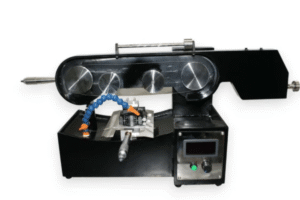
Selecting the optimal diamond wire saw machine for laboratory use delivers tangible gains in throughput, accuracy, and sample retention. Contemporary wire saws combine precision diamond particles with stabilized tension control for accurate cuts across diverse materials with minimal operator intervention.
Enhanced Efficiency for Sample Preparation
Diamond wire saw cutting achieves optimal efficiency through several key characteristics. The low kerf loss capability, enabled by minor wire diameters with uniform mass rate and aggression profiles, preserves more material compared to abrasive cutting machines.
20-35%
Scrap Reduction Through Improved Wire-Grain Development
30%
Lower Kerf Levels vs. Obsolete Cutting Designs
25%
Faster Cycle Times with Optimized Designs
Material Preservation Benefits:
- More wafer and semiconductor material preserved per cutting operation
- Sapphire-coated abrasive segments maintain quality throughout cutting process
- Properly conditioned coolant reduces chipping on hard materials
- Thin layer extraction from different materials without overcutting
- Budget control through waste reduction enables more operational trials per sample
Improved Cutting Precision
One of the major advantages of modern wire saw machines lies in precision cutting capability. Precision wire saws achieve exceptional accuracy through spaceframe loading guides with digital tension feedback coupled to servo-driven tables, delivering micron-level consistency.
Critical Precision Applications:
• Thin Glass Cutting
Micron-level consistency prevents microcracks that could distort results
• Multilayer Ceramics
Precision diamond particle distribution maintains clean cutting lanes
• Semiconductor Packages
Perfectly straight cuts with high parallelism for quality assurance
• Complex Geometries
Advanced CNC profiles with self-adjusting hardness zones maintain edge quality
These capabilities enable laboratories to achieve traceable accuracy with reproducible results across the most demanding cutting applications, particularly for glass and other sensitive materials.
Choosing the Best Diamond Wire Saw
Selecting the optimal diamond wire saw for laboratory use involves aligning instrumentation that balances performance, safety, and cost with specific cutting objectives. In laboratory settings, primary considerations include precision cutting of delicate samples on secure frames with automatic controls ensuring minimal error across various materials.
Points to Address While Selecting a Wire Saw
Recommend reading: Laboratory Diamond Wire Saw: The Complete Guide to Precision Sample Cutting
Related Posts

Trending Blogs

![Polysilicon Material: Properties, Grades & Uses [Guide]](https://wiresawcutter.com/wp-content/uploads/2026/08/polysilicon-material-featured-150x150.webp)