
Get in touch with DONGHE Company
-
Phone: +86 181-1645-5490
-
Email: Sales18@DongheScience.com

The Complete Guide to Magnetic Material Cutting Technology

Magnetic Material Cutting Technology: Complete Guide to Precision Manufacturing
Advanced Techniques, Equipment, and Best Practices for Industrial Applications
The use of Magnetic Material Cutting Technology is of considerable importance in the structural and electrical industries. There is a rising demand for the latest designs which require precise cutting techniques, therefore, this practice obliges both engineers and fabricators to understand and master the art of the same. Users will have an opportunity to study the fundamentals of cutting task magnetism and be introduced to current technological inventions as well as gleaning practical strategies useful in efficiency and waste minimization. Knowledge of the scope in further enhanced where one can make sounder decisions and remain creative whether they turn to manufacturing of new higher power motors or parts. You are assured of an understanding of magnetic material cutting concepts and awareness of such trends in manufacturing.
Understanding Magnetic Materials

A ‘magnetic material’ denotes one that has a capacity for induction of a magnetic field or interaction with one. One of the types in this classification is ferromagnetic, and the other types are paramagnetic and diamagnetic. In most ferromagnetic materials such as iron and cobalt, the magnetism is very high and as such, they are used in industries to manufacture things like motors and transformers. As in case of paramagnetic materials, examples include aluminum and platinum, where there is weak magnetism within the scope of ordinary use. In all diamagnetic materials such as copper and graphite, objects do not have a protection layer of a magnetic field which revokes their prospect effectively. The description of how these materials operate is straightforward, and the components responsible for the explanation—the atoms that make up the material, the presence of an external magnetic field, and temperature—are not many. Understanding such helps make good use of the materials for various magnetic methods and magnetic equipment without any failure.
Types of Magnet Materials
Based on the material’s properties, one can distinguish different types of magnets, which in effect gives different applicability of these materials in enhanced technology. The following sections outline five commonly represented categories of magnetic materials:
Ferromagnets
Ferromagnetic materials like iron, nickel, cobalt, and their secured alloys have very high magnetic properties resulting from the orientation of magnetic moments of quite large regions of a material known as domains. These are used in the construction of permanent magnets, focused cores of transformers, and electric motor rotors. Ferromagnetic materials have high permeability and are stable to the effects of elements manipulating the magnetic fields once the field is gone.
Ferrimagnets
Ferrimagnets are materials such as ferrites, which are iron oxides in combination with either manganese or zinc, and have a superior crystal orientation such that there are unequal opposite directions of magnetic field within these not wholly opposite walls. Their properties allow them to be very effective for use in inductors, antennas, and high transformers at great frequencies.
Paramagnetic Materials
If we consider the paramagnetic type of materials like aluminum or magnesium, they show some weak instances of attraction toward a magnetic field. This is so because there are unpaired electrons that reorient and align themselves with the applied magnetic field, and the effect of the field, even though limited, causes the deformation to go away soon. Its primary application is in magnetic cooling systems and scientific studies as these materials are not commonly used.
Diamagnetic Materials
Materials such as bismuth or copper are diamagnetic because they generate a little cage of resistance towards a magnetic field. This happens because of the circulating currents in the substance opposing the generated magnetic field. As much as this phenomenon is very insignificant, people make use of such materials in certain situations such as magnetic levitation (also superconductors) as well as other devices such as microscopes.
Antiferromagnetic Materials
Similarly, antiferromagnetic elements like magnesium oxide possess internal magnetic orientations in juxtaposition that cancel and hence bring about zero magnetization. These elements find periods in research explores, spintronics, and are incorporated into cutting-edge magnetic storage systems because they possess special inherent characteristics owing to their internal microstructures.
Understanding these classifications and their particular characteristics is necessary because not all materials are equal possibilities in modern magnetic systems, which translate to the efficient functioning of such systems and the technology to perform them.
Properties of Magnetic Materials

Magnetic Susceptibility
Since the susceptibility measures how magnetic a given material will become when exposed to an external field, it is always a positive number. When susceptibility is positive, it implies that the system becomes magnetized when placed in an external magnetic field. On the contrary, when it comes to diamagnetic materials, the negative susceptibility is close to zero.
Magnetic Hysteresis
Coercivity is a magnetic property of a material that enables a material to continue remaining magnetic after removing an external magnetic field. These materials are hard magnets or high coercivity magnets and are best for the creation of permanent magnets that have the ability to hold the magnetic impression even in the absence of a magnetic field.
Saturation Magnetization
It represents the maximum degree of magnetization which a certain material is able to reach during its magnetization in an external field. Consequently, for soft magnets, saturation of the material is realized at relatively low magnetic fields, which is not the situation in the less soft magnetic materials that demand a higher magnetic field.
Curie Temperature
This temperature is also known as the ‘Curie point’ and refers to the maximum temperature at which every magnetic material loses ferromagnetic properties and turns into a paramagnetic state of magnetism. For iron, for instance, there is a Curie Temperature of around 770°C above which the magnetic field becomes non-persistent.
Remanence
Here, this means the ability of a magnet to retain its magnetization, despite the absence of each or every source of magnetization or cause. Such an ability is very important due to the coded information which is stored within the magnets which tends to remain for a long period of time due to the increased remanence.
Applications of Magnetic Materials
Electromagnets
Electric motors used in power generation depend on magnetic components, which are almost always made from ferromagnetic materials and serve as pathways for magnetic flux, thereby amplifying it for governing the efficiency of energy conversion. For example, we can consider the transformer core made from silicon steel; Austin’s hysteresis is quite low and has a high magnetic permeability.
Data Storage
Magnetic materials are essentially used in creating hard disk drives, magnetic tapes, and magnetic stripes on credit cards. Materials with high retentivity, such as ferrite, promise that data will be stored invisibly and more durably. Recently, there has been another trend of using hybrid materials containing tiny aggregates of magnetic nanoparticles for a dramatic increase in density in data memory storage.
Electric Motors and Actuators
Small and nifty electric motors have brought about a design revolution with fast-paced electrification. These advances have revolutionized automotive technology, called upon to deliver unheard-of power and joyful light weight.
Diagnosis and Imaging
Magnetic materials are required in medical equipment, such as MRI machines. Magnificent advances in superconducting magnets have led to the generation of extremely precise magnetic fields, in turn, allowing super-resolution imaging of the body’s internal structures. These areas also await magnetic nanoparticles for possible drug delivery to a targeted point.
Magnetic Sensing and Detection
One of the most advanced examples of the use of magnetic materials by any technology involves detecting motion, position, or magnetic flow. Hall Effect sensors are the most common examples, most commonly applied to speedometer setups in automobiles and heavy machinery but are also associated with certain other types of sensors. This revolutionary sensor technology has been enabled by the application of magnetoresistive materials, which enables its service in a larger range of fields such as navigation systems, robotics, and geophysics exploration.
Magnetic Cutting Technology Overview

Magnetic cutting treatment is a technology where materials are maneuvered with ludicrous precision without direct contact of mechanical cutting tools by utilizing very strong magnetic fields. Among the chief upshots of this process is the capacity to treat in a mild manner materials when they are delicate or complex and without the risk of wear and tear on the tool, keeping to the minimum risk of degradation of the materials. Since magnetic forces finely manipulate tools, the cutting must be done to a specific cutting edge. It is employed in the preparation of thin films, cutting of delicate-to-very-brittle materials, working with silicon or even medical micro-devices or industry specific applications, opening up novel crossings across many industries.
What is Magnetic Cutting?
The magnetic cutting technique, in broad terms, requires the careful manipulation of magnetic fields. This method is intended to translate such magnetic fields into the control, assistance, or direction of cutting, and to do that in a very delicate and controlled way. By either manifesting magnetics in tool-control or materials manipulation, cutting and machining are now recognized to utilize the response needed for tiny foreign trigger and to program at the microscopic level requisite materials and/or tool alignment, necessary then for precision in operations and cutting processes with minimal errors.
Explained through thorough data analysis, current tendencies show that this process’s importance is steadily growing in topics of due importance to placing high precision in issues related to microelectronics, aerospace engineering, and manufacturing of medical devices. It is successfully employed for machining with magnetic agents on brittle, special-magnetic-property metals that are fragile in structure and for which conventional approaches would cause undesirable structural damage.
Benefits of Magnetic Cutting Technology
Extremely Accurate and Precise
Magnetic cutting technology stands as the most precise method, revealing a tolerance as low as ±0.001 inches. We need that border of accuracy in industries such as microelectronics and medical device manufacturing where even the smallest deviations will cause the entire system to quit functioning.
Reduced Structural Damage
In magnetic cutting, damage to the face end is kept at a minimum: Minimum heat and mechanical stress are generated during operation, lessening the chances of a piece warping or cracking. This fact is very suitable for use on working materials like ceramics, exotic alloy arrangements, and composite materials.
Material Efficiency
One of the main operations of these kinds of advanced engineering machines is represented by an extremely narrow tolerance for part removal from nearly all work materials at the start of the process from virgin material into any parts since scrap ultimately decreases to relative datum. The seldom-produced waste while cutting material increases the sustainability of manufacturing.
Material Multifunctionality
Magnetic cutting methods are quite adaptable in their application to a wide variety of materials, such as metals, plastics, and ceramics, adapting the working operation as necessary for each material’s technology.
Faster Manufacture and Productivity
Magnetic cutting technology makes for fast cuts and an overall short cycle time, meaning that processes get finished soon. To further add life-cycle value, this approach generally gives good production in the form of a win-win situation, both for mass production and for aerospace or automobile uses.
Comparison with Traditional Cutting Methods
With full cutting and drilling, magnetic-based cutting technology dominates traditional techniques in terms of precision, efficiency, material diversity, safety, and waste management. A short comparison of some of these important benchmarks is given below:
| Parameter | Magnetic Cutting | Traditional Methods |
|---|---|---|
| Precision | High | Moderate to Low |
| Efficiency | Rapid | Slower |
| Versatility | Wide Material Range | Limited Materials |
| Safety | Enhanced | Lower |
| Waste | Minimal | Significant |
Magnetic cutting solutions enable precise operations with high efficiency and are more forgiving of a wide range of material characteristics. The technology offers a less dangerous cutting operation, with minimal material penetration, in comparison to slicing and thermal cutting, which implies less material to be wasted. Judged by their combined benefit, this new technology could be taken as a source of continuity, exploration, and consideration against conventional techniques in numerous applications across various industries.
Magnetic Drilling Equipment

There is something special about magnetic drills, which can offer precision drilling over the metal surface. The whole machine is borne strictly due to the extreme attraction of the magnet established on top of it, freeing the operator from picking it up. Therefore, it is always dependable in the process of every operation. For drilling through thick steel beams, steel plates, or steel pipes, it gives pinpoint accuracy. In addition, as an important tool for many of their needs, the magnetic drill is saving both time and energy in between working construction and industrial sectors.
Types of Magnetic Drills
Portable Magnetic Drillers
The compactness of these portable magnetic drillers makes them easy to transport from one place to another, or even from the ground to the top of the structure and back again. The machine can be operated even where there is limited working space above and is very easy to transport to places where it will be needed without affecting the level of performance achieved. Most of these drills are designed for drilling small-sized holes and find application in repair work or construction on a very small scale.
Stationary Magnetic Drills
Stationary or benchtop type magnetic drills are lighter having this type of construction and can be relaxed for use to improve accuracy in stone or any other hard material excavation. In an industrial workplace, there are already some of these machines because their purpose is allegedly bulk drilling with larger diameters or even difficult hard steel cutting.
Magnetic Drill Run by Cords
Magnetic Material Cutting Technology is further enhanced by the application of electric magnetic drills. Magnetic drills cut material through the use of magnetic force. One uses an electric cable and electricity on it, therefore it is designed to work at high performance continuously. They are the best devices for tough and long-term activities either in the office or industry as for them “power issues is never a headache”.
Cordless Magnetic Drills
These magnetic cut motors are also cordless. With this facility, they are portable and can be used on site away from power supply. These examples of magnetic drills are more convenient for jobs with minimal loads where some movement is needed.
Specialized Magnetic Drills
A new type of drills which can work comfortably in areas such as where there is a possibility of fire outbreaks and underwater environments. With this, it can be used for oil, gas, shipbuilding, underwater construction and other similar industries, for it performs well and is safe.
How to Choose a Magnetic Drill
The right magnetic drill for your needs might not be that easy to choose, because there are quite a few constraints which depend on the purpose and on the working conditions. If we take into account the latest findings and trends, the following appear to be the most significant aspects:
Key Selection Criteria
- Materials To Be Drilled And Diameters: Think about what kind of material you shall be drilling and how large the holes shall be. When working with very hard materials like stainless or hardened carbon steels, choose a magnetic drill that has high torque with cutting capacity. Ensure that the models have such capabilities and that they can offer cutting dimensions as needed.
- Type of Drill and Source of Energy: Consider also the appropriate type of magnetic drill specific to your work setting. Electric models are suitable for almost any purpose and these are most common, but if the purpose of the operation in a hazardous area, pneumatic type of drill will be suitable. Hydraulic drills are used for water bodies and dangerous productions which require only hydraulic devices. The power source should be that which ensures efficiency in particular circumstances.
- Magnetic Base Holding Force: It is essential to have a base with the ability to measure force for proper performance, especially in the case of vertical or ceiling drilling and other related activities. Choose drills that have higher degrees of holding capability than those responsible for standard performance.
- Weight and Portability: Such conditions are called for in great majority of cases regarding the work that is performed outdoors and in places where mobility is required. These kinds of designs are needed especially in the open and in closed places because of their function providing power without sacrificing operator performance.
- Additional Features: Recent Magnetic Material Cutting Technology appear generally with variable speed, cooling inbuilt, and automatic feed. Such improvements may include operational comfort enhancements, improving precision and as a result, reducing wear especially during prolonged use or any other repetitive work.
Taking into account such parameters and their compatibility with requirements may assist in selecting a magnetic drill that would be the most optimal in terms of efficiency, accuracy, and safety. One should also remember brand reliability and if any history of use is available to guarantee and build confidence in the same.
Features of CNC Magnetic Drills
When it comes to metal working, CNC magnetic drills are efficient in helping one achieve goals of functionality and accuracy as there are elements incorporated in them to make a metal working operation effective. Five of such considerations are described herein:
1. Fully Automatic Drilling Cycles
With the modern design of CNC magnetic drills, one advantage that the progress has offered is that the end user can opt for fully automatic cycles, helping increase the production process. There are no manual needs of stopping the drill when it reaches the pre-set drilling depth or the speed or feed rate since these are set much earlier and therefore give no such problems when it comes to mass production of one product.
2. Touch Control Stations
In most CNC magnetic drills, touch screens are incorporated for simple and effective control of the functionality of the drill. Such screens also serve the purpose of providing displays of the speed of the spindle, number of holes drilled, among other machine parameters.
3. Varying Speed Operation
Variable speed functionality helps a drill adjust rotational speed when dealing with different materials and applications. When cutting metals of various compositions, this is achieved by selecting appropriate cutting tool revolutions to reduce parameters that spoil the cutting tips.
4. Improved Safety Measures
Overload protection for the motor’s drive mechanism as well as shut down sensors and magnetic adhesion sensors are all some of the safety features in current CNC magnetic drills that go a long way in ensuring safety to whoever or whatever device is in use in such a manner.
5. Operating a Machine Remotely
CNC magnetic drills in some cases can be used with the help of some remote devices so that an operator has control over the drill from another location. This is particularly applicable in situations filled with danger or limited space, as there is no need to operate the machine from near which would risk users’ safety.
All these put together make CNC magnetic drills functional and instrumental in precision manufacturing which enhances efficiency in high standards of production.
Using a Magnetic Drill Press

Please put the magnetic drill press on an extended metallic surface which is clean and flat. And then turn on the electromagnet feature so that the machine remains secure in its place while work is done. Inspect the material to be perforated and shaft the appropriate drill bit in the chuck ensuring that it is tight in the chuck. Position the drill over the vertical and then gently lower the drill with an even speed and begin to cut. Never keep the drill in one position while excessive force is applied on the workpiece, and good drilling lubricant should be used in order to cool down the cutting tool and avoid tear and wear of the cutting tip. Once the hole is drilled, turn off the motor, retract the drill and release the magnet to effectively lift the drill press. Magnetic Material Cutting Technology involves awareness to avoid any kind of harm while operating such devices and hence keeping such equipment serviced is of importance.
Setting Up the Drill Press
Ensure efficiency of a drill press by starting with fixing it on the table since this evades vibrations ensuring accuracy and preciseness of cuts. Place and insert the necessary drill bit into the chuck and tighten the chuck completely to make sure it does not spin on its axis. Adjust the height of the Drill Press Table while considering the thinnest material to be drilled as well as the angulation of movement that is to be achieved with the bit. Put aside or use a clamp or hold the drilled surface in place as it is being worked on so that it does not move. Adjust the spindle speed as getting the correct speed for an individual is very important as they are of different types or hardness, and it is important to note that slower speeds are best for hard substances such as steel, while faster speeds are best for soft substances such as wood. Comprehend the speed limits and instructions as there are written by the manufacturer of the product.
The drill press is important because it optimizes the drilling process and reduces the risk of injury. Afterwards, such safety measures and systems should be applied because they allow for speedy accurate and reliable drilling within the various levels of the application. Furthermore, insure the health and safety of personnel by using such systems for cutting especially when cutting Magnetic Material Cutting Technology.
Safety Protocols for Magnetic Drill Press Usage
In practices involving Magnetic Material Cutting Technology, the work base is cleared from any dirt and obstructions so that the magnet can position the drill in place. Ensure that the drill bit is well anchored and also check for any wear and tear on the same. For it is common knowledge that flying solid particles pose a danger and dictates that the wearer of protective glasses and other clothing materials be very cautious. Moreover, ensure that there is no dangling cord and the range of speed maintains the thickness of the workpiece being drilled. Conforming to the aforementioned safety measures aids in doing the job safely and efficiently.
Common Issues and Troubleshooting
The use of the machine tools or equipment normally presents limitations. Below are some of the most common examples of occurring problems and their possible fixing strategies:
1. Blunt Drill Bit
A dull drill bit is inefficient in that it is likely to cut holes with uneven depths and causes excessive vibration of the machine. Always check the condition of the drill bits and substitute them as applicable whenever signs of wear are observed. For aggressive cutters or in high use, high-speed steel (HSS) and carbide-tipped instruments are preferable.
2. Heating Up the Drill
Several causes usually account for such concerns including overworking within short breaks as well as lacking lubricant. Let’s say, let us take metal drilling as an instance, cutting fluids will be used. It is not recommendable to push too much using the workpiece or the equipment itself.
3. Getting Frozen or Stuck in the Drill
It happens in most cases because of dense materials or incorrect speed settings. As a remedy, set the speed that is suitable for the type of material being used and the type of drill bit in use. Help can also be sought in cases where the drill gets out and rips everything on the way and does not come back in because it binds.
4. Differently Aligned Holes
Misalignment also stems from failings to check accuracy of marks or internal structure of material before drilling. The project must be clamped tightly and a center punch used to ensure that the drill has a point to enter.
5. Chuck is Getting Loose
When the drilling chuck gets loose, the stability in drilling is compromised and a weak chuck indeed becomes a hazard. Inspect for correct tightness by pulling on the handle and ensuring that the drill bit enters the surrounding work area preferably to drilling.
All these troubleshooting procedures combined with good preventive maintenance goes a long way in improving the performance as well as service life of all equipment and basis for safe economic production even in extreme circumstances within machine tools assisted by Magnetic Material Cutting Technology.
Advanced Techniques in Magnetic Cutting
To ensure against uneven magnetic material cutting performance, it is essential to stabilize the magnetic base as much as possible. This assumption includes removing any debris or paint from the cutting surfaces and cleaning the elements. When the surface available is not flat or is coated with paint, it is advisable to buy a magnetic base with extendable legs or certain magnetic patches in order to increase the pulling force.
Drill Selection
The suitable drill should be found and that should depend on the material to be drilled. For hard metals, tungsten carbide tipped cutters are a must whereas high speed steel cutters can be used when cutting soft metals. You should have the right size and depth of cut of the drill bit to carry out the task, otherwise you may end up overwriting the material leading to breakage or buckling.
Controls of the Feeding Velocity
Keeping a steady, timely feed rate helps avoid most cases where heat builds up or one of the edges goes blunt. Too high of a feed rate does not allow the cut to be neat whereas there is too low of a feed rate which results in accumulation of waste heat hence reduces the service life of the tool in question.
Best Practices in Lubricating the Machine
Proper lubrication practiced in cutting operations has the influence of lowering the frictional resistance which occurs within the cutting tower, thereby improving the movement and longevity of the cutter. In doing so, preference should be given to pre-wet the working field with neat and qualified cutting liquid before taking efforts on tough materials or during prolonged cutting tasks.
Including new technologies, there are various versions of the Magnetic Material Cutting Technology which includes burr removing which enables the operator to enhance precision, improve efficiency, and prolong the cutting process of tools.
CNC Programming for Magnetic Cutting
Computer Numerical Control coding needed depends on designing tight tool paths that provide better cutting quality while minimizing the amount of materials wasted. Correct determination of coordinates is necessary in the process of controlling speed and feed rate modifications according to particular material specifications of different natures; the control is performed by the spindle. Commands are applied for programming the machine through G-codes and M-codes for better efficiency and space utilization. The program is to include slots for continuous provision of lubricants and while doing so, activating the coolant system to avoid damaging heat-sensitive materials while resisting friction. Before being released for the actual operation, the program must be proved by simulation so as to unearth any errors and ensure safe operations. The most basic structure program that is to be compiled can harmonize with the control unit.
Enhancing Tool Life in Magnetic Cutting
There is a lot that comes into play when it comes to Magnetic Material Cutting Technology. Very many discoveries and technologies are emerging every single moment to ensure that this aim is met. For example, the use of certain coatings on tools like TiN or DLC reduces friction and tear and therefore making high speeds useful. Inclination angles, round edges and chamfering the edges of certain materials are just some of the designs that help ensure the functional maintenance of the equipment.
Secondly, some of the machining strategies which use real-time changes have been developed to adapt actively. For example, in cases where there arises high forces during machining, cutting tools that are equipped with sensors measuring force vibrations, temperature and other factors promote altering the feed rates and spindle speeds when appropriate so as to avoid breakages of tools. Also, the work advocates to use high pressure coolants or MQL which is effective in cooling as well as keeping chips on the tool.
To sum up, frequent cutting tool replacements and re-sharpening are required measures such as duly scheduled maintenance can be effectively maintained as performance of cutting and other processes. Under normal working conditions, operators must inspect the excesses of the stress regions in the tool, evaluate its efficiency, or adjust the programs to prevent overloading of the recommended tool components. These measures ensure that magnetic material cutting technology can be used effectively, economically for a long time and achieve maximization of production topics of efficiency and economy.
Understanding Magnetization Techniques
Magnetization is the process of transforming a material to a stronger state of magnetism by arranging the nanoscale magnetic blocks in fewer directions. Typically, brute force methods such as the use of a coil or an electromagnet to create magnetic field gradients inside the sample to be magnetized are used to align the domains. The simplest form of this is constant magnetic field, known as DC magnetization, because this can easily be achieved and controlled. This is particularly applicable in case of permanent magnets that are to be magnetized directly or even through air. In particular, the inventions such as Magnetic Material Cutting Technology and electric drills which can be categorized as solid state techniques are not possible without the use of electromagnets.
Frequently Asked Questions (FAQ)
1. Can You Explain The Reasons For Challenges Experienced In Cutting Magnetic Materials?
Cutting may be such a challenge to achieve in some industries since the materials are magnetic. That is because although these types of magnets comprise NdFeB and SmCo, they fall under what is termed sintered hard magnets. These materials are primarily hard and brittle. This means that sintered hard magnets embrace wear and damage pressing. Also, those kinds of properties associated with magnets themselves are not welcome in this case; for example, magnetic chips might adhere to a tool or parts, abrading their surfaces and causing the tool to fail before its useful life. Some materials can experience demagnetization from components’ high temperatures while performing aggressive cutting.
2. Which Techniques are Applied in the Machining of the Sintered Hard Magnets?
Since these materials have the required hardness and brittleness, abrasive cutting is the most common technology.
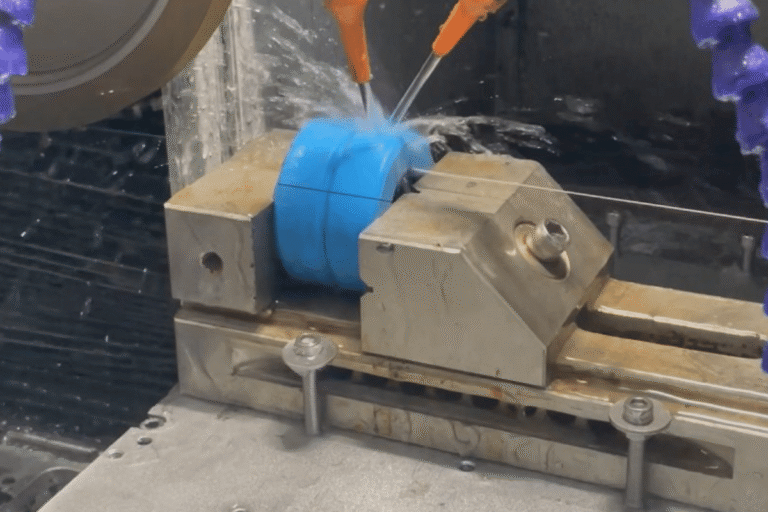
Diamond Wire Sawing: It is a suitable method for achieving very precise cuts according to the required pattern and without any damages. Even the particles in diamond wire cuts to the material and cut it away without needing a kerf, heat stress, or micro cracks. This cutting method is routinely applied in manufacturing magnet blocks out of very thin wafers or compounded geometries.
Abrasive Grinding: The application of diamond grinding wheels allows for the processing of the actual shaping of the magnets and the grinding for reasons specified in dimensional tolerances. In this case, any grinding must be very precisely carried out almost to a level of strict machines as any surface must not be exposed to even the minutest scratch.
Abrasive Waterjet Cutting: This reduces heavy magnets into small pieces without heating demagnetization otherwise possible because the cutting is achieved without the use of heat. Despite this, whilst the surface is performed using only water jets, it is noticeable that the surface finish obtained is naturally rougher than that accomplished by diamond saws.
3. Can Laser Cutting Be Applied in the Processing of Magnet Materials?
Laser Technology has been used in cutting extensively but as in all things, has its weakness too. So, this technology is employed in cutting relatively thin sheets of polymer bonded magnets, or in scribing very hard magnetic materials. The laser light contains a lot of energy which later on is converted into heat on sintered magnets impact. This alters their magnetic nature which eventually cracks due to tensile stresses. This, therefore, makes such undertakings like laser assisted processing of hard magnets a very rare phenomenon.
4. What Is the Role of Using Coolant During a Machining Operation?
According to three primary reasons, it is crucial to utilize coolants during machining of magnetic material cuts. To begin with, the high friction between the diamond fitment and the hard material generates immense heat, which as a consequence leads to thermal shock, and in extreme circumstances, demagnetization of the magnetic materials and this heat is actively removed using coolants. Further, it serves as an effective lubricant, reducing cutting forces and increasing tool life. Finally, and most importantly, it is a flushing medium that is instrumental in continuous removal of abrasive swarf from the area being cut. Suffice it to say that swarf control in the absence of swarf control leads to needless additional wear from scratching of body surfaces due to magnetic particle deposit on the surfaces.
5. How Come Materials Are Not Magnetized During Processing?
Practically, all shaping and machining processes of magnetic materials must be done without magnetizing them. This is because working on a magnetized piece is a more intricate exercise because the workpieces and even machines with tools and components easily get stuck to each other due to the strong magnetic field. It results in easy wearing out of the tool, reduction of the quality of the machined surface or breaking down of machine spindles and guides. Consequently, magnetization is included at the very last step of mechanic processing.
6. What Are the Tools That Can Be Used to Cut Magnets?
It is imperative to consider the type of the tool to use. Regarding mechanical cutting, the technique is rather impossible to execute without the use of diamond abrasives.
Diamond Types and Concentrations: There are both a diamond type (poly or monocrystalline) and a concentration of diamond in the tool bond which is predetermined by the magnetic material.
The Bond Structure: Existence of such elements greatly affect both the tool effectiveness and the durability of the cutting tool particularly the type of bonding element (resinoid, metallic and vital) that holds the abrasive diamond in the mass. In low volume production fairly coarse facing resinoid bonds are mainly utilized.
Grain Size: The coarser, tougher cutting-action engaging diamond grains will allow the operator to cut the material relatively quickly, but as to the degree even cut and smooth fine ones are preferred.
Reference Sources
- •Guide to Magnet Material Contour Cutting and Customizing Magnet Shapes – The Chapter Explores Appropriate Magnet cutting Techniques of Different Types of Magnets.
- •Magnet Drilling: Tapping and Drilling Using Steelmax DeWALT Core Drills, and Perimeter Saws – The Chapter Detailed Analyzed the Use of Essential Drills for Drilling Magnetic Materials.
- •Magnetic Material Cutting Technology – Features such commonly used tools for cutting and finishing of magnetic materials, such as tangential drag knives. Recommend reading: Diamond Wire Saw Cutting Machine for Magnetic Materials: The Complete Guide
Related Posts


Trending Blogs

![Polysilicon Material: Properties, Grades & Uses [Guide]](https://wiresawcutter.com/wp-content/uploads/2026/08/polysilicon-material-featured-150x150.webp)