Get in touch with DONGHE Company
-
Phone: +86 181-1645-5490
-
Email: Sales18@DongheScience.com

How Diamond Wire Sawing Works: Technical Deep Dive

The diamond wire saw technology has been a major factor in the precision cutting of all industries that count on it for reliability, speed, and almost no waste. not only tells but also assists you with the cutting principle by providing that the right cutting tools are selected, cutting process optimized, and project risk minimized.
Managing concrete cutting in demolitions, slicing silicon wafer ingots, or hard material processing in manufacturing will all be easy and mastering applications with diamond wire saws will lead to quality elevations, cost controls, and repeatable, high precision results.
Understanding the Diamond Wire Saw Cutting Principle
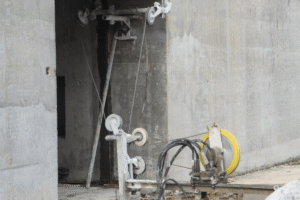
A diamond wire saw performance is based on the principle which suggests a metal wire with diamond abrasive is embedded and moving at high speeds so as to grind rather than shear the material. The cutting mechanism changes diamond hardness into continuous micro-chipping at the interface, thus providing precision cutting with low kerf and less heat.
The wire saw machine takes care of the continuous loop and guides it over a pulley array, applying tension and feeding the workpiece to control the cut. When compared with the traditional cutting methods, diamond wire cutting bears more accurate, less damage on the surface, and more productive results.
What is a Diamond Wire Saw?
A diamond wire saw is defined as a cutting machine which utilizes a steel wire or metal wire with diamond grit or beads for cutting hard materials such as concrete, stone, and silicon. The working of the wire saw is in a continuous loop which the pulleys in a wire saw machine guide, thus making a stable thread path and uniform tension.
The sawing uses diamond abrasive to grind materials with high precision. Today’s diamond wire saw machines are coming with precise drives, coolant or slurry delivery, and safety measures to bring a change in the cutting techniques for the hardest materials.
Key Materials Cut by Diamond Wire Saws:
- ✓Concrete and reinforced concrete structures
- ✓Natural stone and dimensional blocks
- ✓Silicon wafer ingots for semiconductors
- ✓Ceramics and composite materials
How Diamond Wires Cut
The method of diamond wires cutting is by abrasion: every diamond particle interacts with the surface and takes off micro-fragments that are in proportion to the particle’s exposure, bond, and load. When the reciprocating effect and the high speeds of the wire combine, the cutting method keeps a steady chip formation while the bond re-cycles the dull grit.
The cutting process relies on controlled tension to produce the pulling of the wire, and the precise alignment of the pulleys and the use of the right coolant or slurry to clear the debris and reduce the heat. With diamond wire saw cutting, different applications for diamond wire get precision cutting, longer tool life, and stable material removal rates.
The Cutting Process Explained
Rigging the continuous loop over the pulley system, setting wire tension, and aligning the machine to the cut line are the first steps of the cutting process. The workpiece feed rate, wire speed, and coolant flow are set to the firmness and structure of the material.
Step-by-Step Cutting Process:
- Setup Phase: Rig the continuous loop over the pulley system and set wire tension
- Alignment: Align the machine precisely to the cut line
- Parameter Configuration: Set workpiece feed rate, wire speed, and coolant flow based on material properties
- Cutting Execution: Diamond abrasive grinds through aggregates and steel reinforcement with minimal vibration
When the diamond abrasive comes into contact with the surface, it grinds through the aggregates and steel reinforcement, thus making concrete cutting or silicon wafer slicing possible with very little vibration. The diamond wire cutting technique has the potency of delivering efficient and predictable cuts not only for demolition, quarrying, and manufacturing, but also based on optimal diamond selection, slurry chemistry, and machine parameters.
Applications for Diamond Wire Saw Cutting
The diamond wire saw cutting, with its various applications, is used in construction, mining, and manufacturing areas, where the hardest materials need precision cutting and minimum waste. The cutting principle applies a metal wire embedded with diamonds, which is then driven by the wire saw machine at high speeds, allowing diamond abrasive to grind instead of shear.
The cutting mechanism creates less heat, vibration, and kerf and provides the possibility of making very difficult controlled cuts in reinforced concrete, natural stone, and silicon wafer substrates. At Goldsupplier.com, the specialists from our side assist the customers in selecting the right cutting tools, slurry, and machine parameters for every application so that diamond wire saw technology results in measurable increases in productivity and quality.
Common Applications in Construction
In the area of construction, diamond wire saws are used for the cutting of reinforced concrete, bridge decks, piers, and thick walls, which are either demolished or structurally modified. The wire saw functioning is like a never-ending loop going around a pulley system, so by keeping the tension stable the diamond wire can grind through rebar and aggregates with high precision.
Compared with traditional cutting methods, the new method does not create microcracks, noise, and dust and adjacent structures are better preserved. Contractors use the diamond wire for openings, controlled dismantling, underwater concrete cutting, and mass foundation segmenting, with the machine making sure that the thread is tracked accurately and the slurry is flushed consistently for the safe and fast results.
Construction Applications Include:
- Structural Demolition: Bridge decks, piers, and thick walls
- Controlled Dismantling: Precise openings and modifications
- Underwater Cutting: Submerged concrete structures
- Foundation Segmenting: Mass foundation division
Mining Industry Utilization
Mining activities depend on diamonds wire cutting to the extraction of the dimensional stone and optimally block yield in the quarries. The wire saw machine that uses a steel wire or metal wire embedded with diamond runs at high speeds allowing the diamond abrasive to grind granites, marbles, and quartzites efficiently.
This cutting process is waste-reducing, increases block geometry, and requires less energy per cubic meter, compared to blasting. The machines’ pulley alignment and the stability of its reciprocate motion promote long cuts, while the slurry helps in chip evacuation. For deep slots and primary block separation diamond wire saw machines enhance safety and productivity, transform bench planning, and stabilize downstream processing.
| Stone Type | Cutting Benefits | Key Advantages |
|---|---|---|
| Granite | Efficient grinding at high speeds | Reduced waste, improved block geometry |
| Marble | Precise cutting with minimal fractures | Enhanced safety, better yield |
| Quartzite | Low energy per cubic meter | Stable downstream processing |
Manufacturing Uses of Diamond Wire Saws
Manufacturing industries incorporate diamond wire saws for slicing the silicon wafer ingots, ceramics, and composite hard materials, where the surface integrity is of utmost importance. The diamond saw wire or the steel wire with diamond beads or diamond grit embedded provides uniform material removal, tight tolerances, and low subsurface damage.
The technology of cutting supports the high-precision throughput for the photovoltaics and semiconductor lines, where the cutting process is a mixture of the wire speed, tension, and slurry chemistry. The machine guarantees a correct continuous loop path and precise thread control thus permitting thinner kerfs, and reduced consumable costs, and providing improved yields compared to traditional methods and legacy cutting techniques.
Manufacturing Applications:
- Silicon wafer ingot slicing for semiconductors
- Ceramic material processing with tight tolerances
- Composite hard materials cutting
- Photovoltaic cell production
- High-precision throughput manufacturing
Diamond Wire Cutting Method Advantages

Diamond wire cutting advantages are due to the operation’s principle of the diamond wire saw: a metal wire with diamond abrasive grinds hard materials instead of shearing them. This cutting mechanism leads to reduced forces, less heat, and indeed cutting not only through but also over demolition, construction, and manufacturing.
Customers say they experience faster cycle times, cleaner surfaces, and less need for post-processing when compared to the old cutting. Thanks to perfectly timed slurry delivery and control over wire tension, a wire saw machine is capable of producing quality outputs, longer lifespan of the tool, and predictability of the production rate, thereby enabling the cutting method to be standardized at scale.
Cutting Efficiency and Precision
Cutting efficiency and precision are obtained when diamond wires are looped continuously and run at high speeds while stable tension is maintained. The process of diamond cutting allows for each diamond grit to grind the surface to micro-chips which thus enabling the cutting process to maintain tight tolerances and smooth finishes.
The wire saw also works with very little vibration which in turn reduces dimensional deviations and microcracks to a great extent. A cutting machine keeps uniform material removal by adjusting the hardness to the wire embedded with diamond specifications and calibrating the pulley alignment, feeding, and slurry flow.
Field Performance Results
30-50%
Rework Reduction
Faster
Project Schedules
From our field experience, this cutting method has been able to cut the rework by 30–50% and is also able to speed up the schedules without safety being compromised.
Comparison to Conventional Cutting Techniques
When compared with blades and also thermal or impact-based cutting technologies, diamond wire cutting has a lower-force abrasive interaction which keeps the surface intact. On the other hand, traditional cutting methods cause more damage by making a wider kerf, causing a rise in temperature, and also putting stress on the structure especially for reinforced concrete or brittle silicon wafer materials.
| Factor | Diamond Wire Cutting | Traditional Methods |
|---|---|---|
| Kerf Width | Narrow, minimal material loss | Wider, more waste |
| Heat Generation | Low heat via slurry dissipation | Higher temperature rise |
| Surface Damage | Clean edge geometry, intact surface | Structural stress, more defects |
| Noise & Dust | Reduced levels, safer conditions | Higher noise and dust production |
| Precision | High precision, tight tolerances | Lower precision levels |
| Cost Per Cut | Lower overall cost | Higher operational costs |
A diamond saw operated by a wire saw machine not only keeps a slender kerf but also has clean edge geometry while the cutting principle dissipates the heat via slurry. This process leads to a reduction in the number of defects, and noise and dust, and also makes working conditions safer. For high precision use cases, diamond wire saw technology is always ahead of the pack when it comes to speed, finish quality, and cost per cut compared to legacy cutting techniques.
Related Posts

Trending Blogs

![Polysilicon Material: Properties, Grades & Uses [Guide]](https://wiresawcutter.com/wp-content/uploads/2026/08/polysilicon-material-featured-150x150.webp)