
Get in touch with DONGHE Company
-
Phone: +86 181-1645-5490
-
Email: Sales18@DongheScience.com

Gantry Diamond Wire Saw: Ultimate Buying Guide

Picking out a diamond wire saw that suits your work starts with recognizing your cutting requirements and properly matching them with the capabilities of diamond tools and machines. This comprehensive guide covers everything from basic concepts and cutting machines to rope construction, speed optimization, and diamond grinding behavior. You’ll learn how to comfortably link equipment to materials such as granite, marble, concrete, and other hard substrates while maximizing production, safety, and cost-effectiveness.
Understanding Diamond Wire Saw Technology
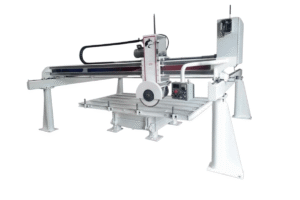
Diamond wire saws are sophisticated cutting machines that rely on a flexible wire saw with diamond bead segments as the main tool to make very controlled, high-efficient cuts in every material at a wide range. The wire saw technology uses a continuous loop of wire fitted with highly abrasive diamond materials to serve for the purpose of cutting hard and brittle substances with high precision.
What is a Diamond Wire Saw?
A diamond wire saw is a cutting tool that uses a wire or cable continuously fitted with diamond segments sintered or bonded by braze to cut very accurately through stone, concrete, and metals. The diamond-coated wire comprises diamond beads set at regular distances along the cutting wire. Through the reinforcement of diamond, the loop saw operates flexible wires; its thinness and flexion enable materials to feel minimal mechanical stress during the cutting process.
Essential Components of Diamond Wire Saw Systems
⚙️ Diamond Wire/Cable
Flexible wire with diamond beads for abrasive cutting action
🔗 Bond Connections
Sintered or brazed diamond attachment with matrix bonding
🎛️ Control Systems
CNC or programmable interfaces for precision control
⚡ Drive System
Variable-speed drives with guided pulleys and drums
💧 Coolant System
Cooling flow management with proper slot nozzles
🛡️ Safety Features
Guards, wire storage drums, and laser alignment gauges
How Diamond Wire Technology Works
The diamond onto the wire helps in cutting through friction rather than tooth-based cutting, which would damage the material’s surface. When the wire makes a cut, it produces a clean and controlled groove. A modern diamond wire saw cutting machine moves wire along guided pulleys at set tension and speed to cut the material. This diamond-coated wire has good cutting action that is consistently abrasive with high precision.
Diamond wire machining removes material by microgrinding rather than by shearing. The cutting machine takes a steel or metal wire (usually bead-embedded diamond-impregnated) and drives it through pulleys, forming a continuous loop. It engages with the surface for cutting due to diamond abrasives, carrying away the swarf with a cooling substance to prevent overheating.
Primary Applications and Uses
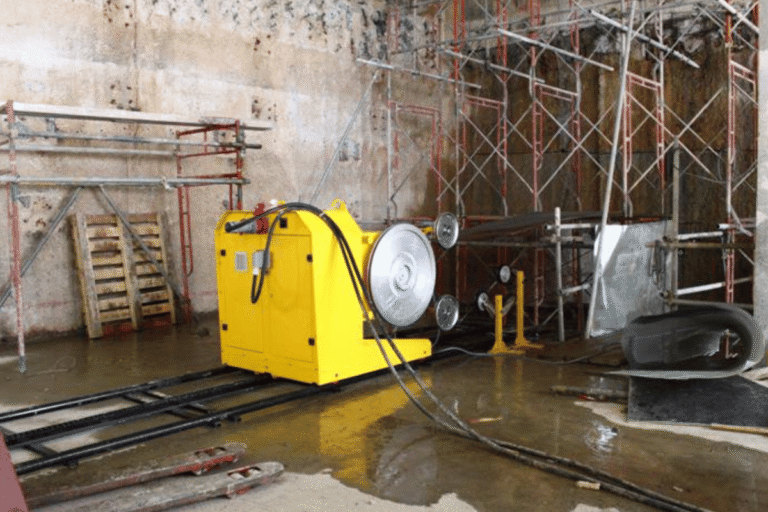
Machines for diamond wire saws are used across multiple industries wherever reliability and precision matters come into play. In construction, a concrete wire saw cuts concrete walls, foundations, and bridge segments with less vibration. In mining and quarrying, diamond wire cutting handles marble and granite blocks swiftly and nicely. Stone fabrication shops deploy these machines to execute complex profiles with CNC accuracy.
Key Benefits and Advantages
The main benefit consists of high cutting speed, less material loss due to the kerf, and better surface quality in comparison with many traditional systems. Its amazing efficiency includes the reduction of kerf loss by 30% to 50% compared to conventional methods. The lessened vibrations greatly help delicate assemblies, leading to a high level of precision and reducing hand finishing requirements.
Top Performance Advantages
⚡
High Cutting Speed
Faster processing times with consistent performance
📉
30-50% Less Kerf Loss
Minimal material waste maximizes yield
✨
Superior Surface Quality
Clean cuts reduce post-processing needs
🔇
Low Vibration
Protects delicate assemblies and structures
💡
Energy Efficient
Lower power consumption reduces costs
🔄
Extended Tool Life
Microscopic cracks expose fresh cutting edges
Critical Factors to Consider When Choosing
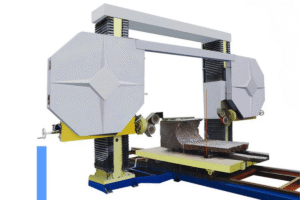
The first step in choosing a diamond wire saw is fully understanding your cutting needs and the operation’s performance indicators. Professionals should assess material hardness, which can range from granite and reinforced concrete to specialized metals, and accordingly select between diamond abrasive types and the two bond types used in diamond beads: sintered or brazed.
Identifying Your Specific Cutting Needs
Identify and map your wire saw requirements in order of their full range: the material, thickness, shape and tolerances for each cutting task. A diamond wire saw cutting machine with uniformly high linear speed, stable torque and a diamond abrasive blend tuned to the hardness and abrasiveness of the substrate is necessary for cutting such hard materials as granite or dense concrete.
📋 Complete Requirements Assessment Checklist
- Material Identification: Determine hardness, abrasiveness, grain structure, and composition of all substrates you’ll be cutting regularly
- Thickness Requirements: Measure typical and maximum cutting depths, including any deep-section or cross-sectional cutting needs
- Shape Complexity: Evaluate whether operations require straight cuts, curves, tight radii, or intricate contoured profiles
- Tolerance Specifications: Define acceptable dimensional accuracy, surface finish standards, and edge quality requirements
- Production Volume: Calculate daily, weekly, and monthly throughput requirements for accurate capacity planning
- Budget Parameters: Set realistic cost per cut targets, ROI expectations, and total cost of ownership considerations
Understanding Different Diamond Wire Saw Types
Different types of wire saws are suitable for different uses and depend on the machines’ design. Accurate stationary wire saws for cutting excel in applications due to their compact design, precise motion, and effective control of coolant. The quarry and building cable saw systems emphasize power, larger pulley sizes, and greater safety features for block extraction and controlled demolitions.
Wire Diameter, Bead Spacing, and Bond Selection
Cutting speed, the thickness of the wire, and the structure of the sawing rope play critical roles in determining kerf, surface finish, and lifespan of the tool. Go for sinter-bonded beads if wear resistance is your main requirement, and choose braze-bonded ones for aggressive starts, observing at the same time the compatibility of the machine and the availability of service support.
Fixed sharp diamond facets lining the wire loop enable the machine to maintain close proximity and apply constant pressure for a stable and precise cut using lower extrusion forces. The cutting tool then reduces vibration and improves the edge factor compared with traditional saws. Using diamond wire tends to prolong tool life quite a bit since microscopic cracks in the diamond open up fresh cutting edges that diamond mostly keeps polished for use.
Bond Type Comparison Guide
Optimizing Cutting Speed and Performance
The diamond wire performance depends on matching the cutting speed, feed rate and tension to the material and bead specification. A surface speed that is too high can cause glazing of the diamond while a very low one causes increases in friction and wear of the bond. Advanced machinery enables stabilization of torque and maintenance of tension in the wire at a steady level sufficient to suppress vibrations that cause destruction of the diamond bead.
Keep a close eye on power consumption, coolant circulation, and removal of swarf to ensure the cutting tool remains in its most efficient zone. Take advantage of manufacturer-recommended parameters backed by Research and Development studies to reduce cutting times and extend wire life.
Recommend reading: Gantry Diamond Wire Saw: Precision Cutting Technology
⚠️ Critical Performance Warning Signs
-
- Glazing Effect: Diamond surface appears smooth and shiny — Action: Reduce RPM immediately to prevent further glazing
- Excessive Friction: Increased heat and resistance during cutting — Action: Increase feed rate gradually and verify coolant flow
- Vibration Issues: Noticeable shaking or unstable cutting — Action: Check and adjust tension settings, inspect pulley alignment
- Rising Amperage: Power consumption increasing over time — Action: Inspect for misalignment, check wire condition immediately
Related Posts
Trending Blogs

![Polysilicon Material: Properties, Grades & Uses [Guide]](https://wiresawcutter.com/wp-content/uploads/2026/08/polysilicon-material-featured-150x150.webp)