Get in touch with DONGHE Company


How Does a Multi Wire Saw Work? From Wire Tension to Finished Slabs
📐 Multi Wire Saw — Quick Specs
| Parameter | Stone Processing | Semiconductor |
|---|---|---|
| Wire Count | 20–80+ parallel wires | 500–2,000+ |
| Wire Diameter | 0.35 mm | 0.06–0.12 mm |
| Kerf Width | 0.5 mm | 0.15–0.26 mm |
| Cutting Speed | 40–60 cm/h | Varies by material |
| Thickness Tolerance | ±0.2 mm | ±0.02–0.05 mm |
| Power | 110 kW typical | Varies by configuration |
What Is a Multi Wire Saw?
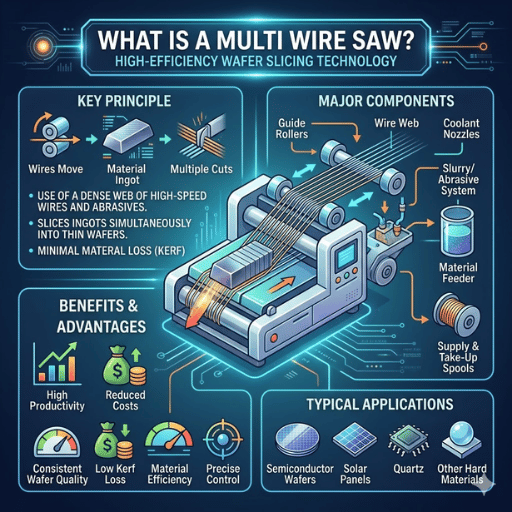
A multi wire saw is a piece of equipment to cut one block of material into dozens or even hundreds of thin slabs at once – by passing a web of dozens or hundreds of parallel wires, each coated with abrasive diamonds, across the workpiece. A single wire saw passes individual wires across the workpiece, making a single cut; a multi wire saw uses dozens of wires simultaneously, producing finished slabs in a single pass.
The concept of wire saw technology is simple: thin wires held under precisely controlled tension span one or more workpieces, and abrasive particles attached to the wire cut through the material. A multi wire saw completes this work by stretching dozens or hundreds of finer-than-hair wires in parallel, speeding up the cutting process by orders of magnitude.
In the production of stone for construction and sculpture, production equipment often slices dozens of wires simultaneously, bringing the total number of diamond sawing wires to 20, 40, 60 and beyond, depending on machine complexity. In semiconductor manufacturing, even more: up to 500–2,000 wires may be employed at once in a single machine, simultaneously slicing monocrystalline silicon ingots into wafers. As Wiley Advanced Materials Technologies (2025) describes it, the processing of 300 mm wafers from crystal to finished device with high throughput is now standard industrial practice for high-volume solar wafer production.
One of the greatest competitive advantages of diamond wire sawing over traditional grinding wheels is the efficiency of a wide wire web: the multitude of fine wires remove substantially less material during sawing than a blade of comparable width. A 0.35 mm wide diamond wire produces a kerf of 0.5 mm, while in conventional stone processing, kerfs range from 3-5 mm, representing a 15-30% gain in total recovered finished material.
Key Point: Multi wire saws replace cutting one at a time with continuous rapid simultaneous segment separation, and dramatically increase wafer surface output per cycle.
Key Components of a Multi Wire Saw Machine

As in any multi wire saw machine, six fundamental subsystems operate together to control the process and keep the web of diamond wires in precise parallel alignment. Having familiarity with their function reveals one technological advantage of wire sawing over other cutting techniques.
Wire Guides and Pulleys
Guided grooved rollers (wire guides) constantly regulate the out-of-plane and in-plane spacing of wires in the parallel wire web. Groove pitch defines the final wafer or finished stone slabs thickness, and is consciously larger than the demanding dimension that results under closed loop automation. target in semi-conductor wire saw applications – in stone, guide spacing may be 20-30 mm. For solar wafer production, groove pitch drops well under 200 μm because the gap width directly impacts final wafer surface quality. A series of pulleys mixed and matches the wire web and forces it to make U-turns, pass through guides and run return paths along the machine.
Wire Web
The array of closely spaced diamond wire saws forms the guide-pulley “needle” bed of the wire saw: the wire web. Each wire in the web must keep the others in equally strong tension, regardless of bending along the span of the cut. That way every wire slices material away at the exact same cut depth in perfect harmony. It is the cutting interface through the machine.
Tension System
Fastidious wire tension control sustains the web in ideal condition. Too slack, and the wire flattens mid-cut; too tight, and the wire tears apart. Beyond simply setting the tension at the beginning of a cycle, modern machines employ adjustable pneumatic or servo-pressure mechanisms able to fluctuate force on each wire dynamically. Target tension ranges from 20-40 N for each wire in manufacturing the panels silicon company utilizes.
Feed Mechanism
Feed systems push the work piece into the moving wire web at a specified rate of 40-60 centimeters per hour for stones. Consistent, uniform pressure must be maintained. Any thickening will result in inconsistent thickness between the slabs.
Coolant System
Coolant has three functions: lubricating the cut, cooling the wire and work piece interface, and removing the excess heat from the wire. Typical coolants for diamond wire saws are water based. Without adequate coolant flow, the wire can overheat — degrading cut quality and shortening wire life when cutting hard materials.
Drive System
The drive system moves the wire web either in a reciprocating (i.e. rocking back and forth) or a continuous loop motion. Rocking mode is commonly used on stone machines: as explained in Frontiers in Mechanical Engineering (2022), reciprocating modes are one of the primary modes of multi wire stone cutting, where wire moves back and forth across the workpiece.
📐 Engineering Note: Wire Bead Construction
Diamond wire is available in two types based on how the diamond grit bonds to the wire. Sintered beads bonds the diamond grit to the wire by fusing them into a metal matrix under high pressure- these have increased durability and are the dominant type of bead for the stone and construction workers. Electroplated beads include a single layer of very fine diamond grit adhered to the wire surface- these provide a finer cut that are dominant for the semiconductor applications. In most cases, about 40-60 mesh diamond grit is used in the stone wire, whereas about 2000+ mesh grit is used in the semiconductor wire. This follows what is conventionally used in diamond tool manufacturing.
The tension system and the wire guides form the ‘precision backbone’ of the saw–they determine whether the slabs come out at a 0.2 mm or a 2 mm tolerance.
How Does Multi Wire Saw Cutting Work? Step-by-Step Process
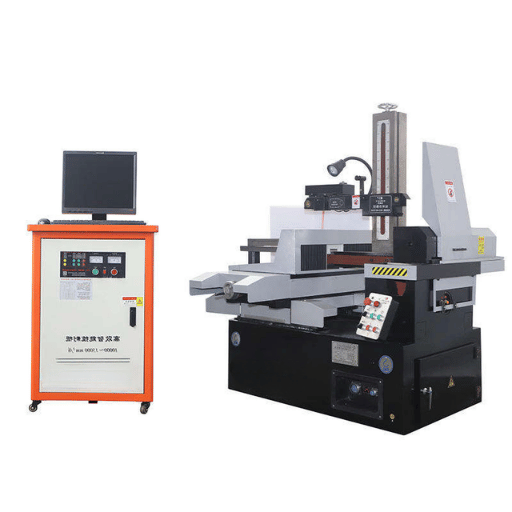
The multi wire saw operates through a series of steps that begin with mounting a block and end with separating slabs into thin sheets. Execution of these steps requires faultless attention to detail: a diamond wire saw works by abrasion (not cogs or teeth) and the optimization of its fundamental mechanism requires constant management of tension, speed, and coolant flow throughout the cycle.
- Block Mounting and Alignment
The raw block or ingot is mounted on the feed table and carefully aligned to be parallel to the wire web. Any taper in the slabs it produces will cause them to be outside the thick ness tolerance. Prior to starting the cut, the operator manually verifies the block alignment and objective tolerance with the wire web plane. - Wire Web Tensioning
All parallel wires are tensioned at once to the target force, with the tensioning system simply bring each wire to a discrete force value. Nominal cross-web wire tension is typically 20-40N per wire for stone applications. Uneven tension, caused by incompatible web tension or tension differences between the individual wires, creates thickness imperfections between the individual slabs. - Wire Motion Initiated —
Drive systems set the position of the wire web- rocking wire drive in a reciprocating motions, and continuous loop wire drive in a simple linear motion. Effective wire speed and travel distance in one cut (how long it may run before rebounding) are set according to material being cut. - Controlled Feed Into the Wire Web
The work piece is translated through the wire web at a specified feeding rate, 40-60cm/hr in the case of stones. Feeding rate is the primary dimension adjusted by the operator when working with different materials- too high and the wire will go out. - Abrasive Cutting Action
Diamond particles on each wire surface act to grind the material as the wire (held in tension) moves back and forth over it. This grinding action is known as two-body abrasion – the fixed diamond grit on the wire surface have a working surface against the work piece. (In abrasive slurry cutting systems, loose particles induce three-body abrasion.9) This grinding action in stone production results in a very narrow kerf of only 0.5 mm. - Coolant flushing runs continuously throughout the cut.
Throughout the process, coolant water is used to liberate debris from the stone and to cool the wire and stone surfaces. Without proper coolant flow, wire damage becomes an issue. - Once the entire height of the block has been cut, the semi-complete slab is dropped onto a resting table.
Once the entire height of the block has been cut, the semi-complete slab is dropped onto a resting table. A 44-wire machine produces 45 slabs from a single block of stone in one cycle. Each wire saw cuts through the entire block width without stopping, and finished slabs are removed for inspection at the end of the run.
In addition to reference. variables such as abrasive grit size and ruby size; factors such as feed speed and wire length will have a variable yet significant impact on diamond wire sawing during multi-wire rocking sawing, according to Frontiers in Mechanical Engineering (2022). The variation of these factors is key to optimizing wire life and cutting precision in all future multi-wire sawing undertakings.
Key takeaway: The specific cutting action is based on abrasive abrasion, instead of abrasive saw teeth. Diamond particles fixed to the wire surface grind through material under limited tension – this is the fundamental principle behind every multi wire saw.
Diamond Wire vs. Abrasive Slurry — Two Multi Wire Saw Types
Multi wire saws can be divided into two types by its method of deliver abrasive to the cutting site. Fixed abrasive diamond wire saws carry diamond segments embedded with diamond grit directly bonded to the wire. Loose abrasive slurry wire saws use a plain metal wire from which silicon carbide particles are carried by slurry. Choosing between these two designs influences everything from kerf width to environmental protection.
| Feature | Fixed Abrasive (Diamond Wire) | Loose Abrasive (Slurry Wire) |
|---|---|---|
| Cutting Mechanism | Two-body abrasion — diamond particles fixed on wire grind material directly | Three-body abrasion — loose SiC particles roll between plain wire and material |
| Wire Diameter | 0.06–0.35 mm | 0.10–0.16 mm (core wire) |
| Typical Kerf | 0.15–0.50 mm | <0.200 mm |
| Surface Result | Smooth parallel grooves | Micro-cracking pattern |
| Coolant | Water-based | SiC slurry (polyethylene glycol + silicon carbide) |
| Environmental Impact | Lower — water-based coolant, less hazardous waste | Higher — SiC slurry requires specialized disposal |
| Primary Use | Stone processing, modern semiconductor | Legacy semiconductor (being phased out) |
The process for turning to silicon wafers from ingots has already evolved – with the adoption of diamond wire technology surpassing slurry sawing, as reported by ScienceDirect Procedia Manufacturing (2018). When the potential for this low waste, environmentally friendly manufacturing method was identified a decade ago it was felt that no-one could have foreseen technology such as diamond wire sawing overtaking traditional slurry systems as the method of choice for brittle material cutting. Slurry methods could not even compete with the surface quality achievable at similar cutting speeds.
Slurry systems have historically been king in the stone industry. Not any more. Fixed abrasive diamond wire sawing removes any associated cost or environmental hazards with slurry. Further advantages are at the minimum cost per diem cycle time, as sintered diamond beads last much longer than the continuous wire used within slurry systems.
Researchers are now making subtle advancements – with an eye towards kerf widths below 50 μm, down from the current ~70 μm used in thin wafer semiconductor cutting, according to Wiley Advanced Materials Technologies (2025). This will require an even thinner, more tightly tensioned diamond wire to be used.
Summary: Usage of diamond wire (fixed abrasive) is quickly replacing slurry wire (loose abrasive) in all multi-wire processes. The 2-Body abrasion process offers enhanced finish qualities and environmentally friendly waste byproducts.
What Can Multi Wire Saws Cut? Applications by Industry

Multi wire saws are capable of cutting virtually any material in which diamond abrasive is harder than the workpiece. This opens a broad spectrum of cutting applications, from quarry sourced marble blocks to 300 mm diameter silicon ingots used in the semiconductor industry.
| Industry | Materials | Typical Specs | Standard / Reference |
|---|---|---|---|
| Stone Processing | Marble, granite, limestone, quartz | 20–80 wires, 0.35 mm wire, ±0.2 mm tolerance | T/CMES 41001-2025 |
| Semiconductor | Monocrystalline silicon (up to 300 mm) | 500–2,000+ wires, 160–180 μm wafer thickness | SEMI M1-0924 |
| Photovoltaic (Solar) | Polycrystalline and monocrystalline silicon | 160–180 μm wafer, minimal kerf loss | — |
| Advanced Ceramics | Silicon carbide (SiC), sapphire, gallium nitride (GaN) | Ultra-fine diamond wire, 0.06–0.12 mm diameter | — |
| Construction | Reinforced concrete, steel structures | Larger diameter wire, field-deployed | — |
In the stone industry in particular, wire saw machines currently lead the unit market share. One multi wire saw for stone processing can produce 40+ final granite/slab stones out of a single quarry sourced marble or granite block in a single batch. As per Stone World (2014), multi-wire saws offer industries much higher processing efficiencies than traditional cutting methods used in gang saw technologies.
Semiconductor applications are pushing the technology at its limits. As stated in Wiley Advanced Materials Technologies (2025), there are still issues with surface waviness when slicing 300 mm monocrystalline silicon wafers with industrial diamond wire technology. Wafer waviness is an even more critical parameter when sliced at 160–180 μm wafer thicknesses. This dimension can only be achieved when tension is closely controlled across hundreds of parallel wires.
Across the construction industry, wire saw machines operate on a different scale. Cutting reinforced concrete for bridge demolition or new building construction is completed on a larger scale, but the technology is the same. Larger diameter diamonds and larger diameter beads are used to cut through varying steel and reinforcement materials underneath the concrete’s surface.
The market for harder materials such as SiC and sapphire continues to expand. These materials are simply too brittle for mechanical blade cutting; to produce the tiny amount of damage necessary for final diode chips, diamond wire precision cutting can cut through hard materials with minimal damage to the crystal structure, making it the only practical slicing solution at production volumes.
Summary: Any application where the material is below the hardness of diamond and multiple parallel slices or wafers are being processed can be best handled by multi wire saw machines.
Multi Wire Saw vs. Gang Saw vs. Single Wire Saw

The simple comparison table below offers a definitive comparison of a multi wire saw against the alternatives of gang saw and single wire saw. It applies real production statistics – not widely used but inaccurate subjective qualitative rankings – so end-users can select the best slicing technology to suit their production output parameters.
| Metric | Multi Wire Saw | Gang Saw | Single Wire Saw |
|---|---|---|---|
| Production Rate | 79.2 m²/h (44 wires) | 48 m²/h | 1 cut at a time |
| Power Consumption | 110 kW / 1.38 kW per m² | 160 kW / 3.33 kW per m² | 15–37 kW |
| Blade/Wire Thickness | 0.35 mm | 1.8 mm | 0.35–5.3 mm |
| Kerf Loss | 0.5 mm | 3–5 mm | 0.5–7 mm |
| Thickness Tolerance | ±0.2 mm | ±2 mm | ±0.2 mm |
| Material Yield | 85–95% | 60–75% | 85–95% |
| Best For | High-volume slab production | Large blocks, legacy installations | Quarry work, irregular shapes, profiling |
The comparison is very clear: the multi wire saw machine produces 65% more slab area per hour than a gang saw and consumes 59% less electricity per square meter. Material yield improves from 3-5 mm kerf to 0.5 mm (15-30%) – a significant difference that really impacts on the bottom line once marble and granite blocks are processed, reducing both material waste and labor costs per finished slab.
Should I buy a gang saw? Are they no longer relevant? No. They are still worth considering where the equipment has been paid for (amortized) and the production schedule warrants the machine’s power and throughput. Investing in new multi wires saws is theoretically a positive return, but there has to be some immediate material and energy savings to justify the capital cost of a new machine over the old. For new sites, multi wires are, on the whole, the better investment. To read a little more about the advantages of single vs. multi wire machine, you might want to check our guide: Single Wire Saw vs Multi Wire Saw: Key Differences Explained.
Single wire saws occupy a niche different from multi-wire machines. Their primary advantage is the ability to cut intricate shapes, profiles, and curves – a single wire saw can cut any shape in 2 planes regardless of the irregular block shape, while a parallel wire web cannot. Single wire saws are also the only type of machine suitable for loose, non standard quarry or construction projects that have irregular bulk shapes, and demand the highest level of flexibility.
Key take away: Multi wires take the crown in mass slab production, with 79.2 m²/h output and 0.5 mm kerf loss. Gang saws may still be operational where the equipment is paid for, but the flexible single wire saw owns the specialty niche.
Advantages and Limitations of Multi Wire Saw Technology
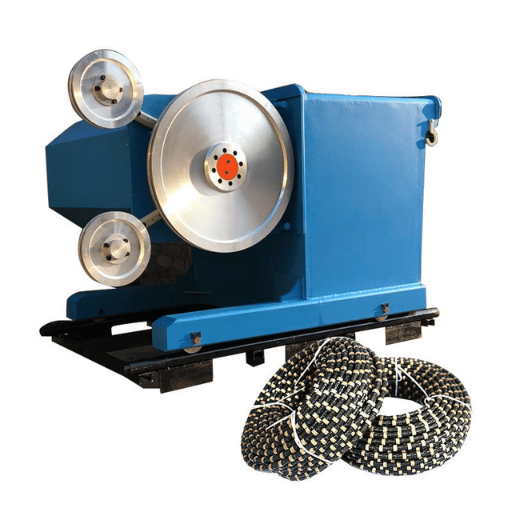
Each technology delivers improvements in throughput, efficiency and material yield. However, they do not run without some issues that buyers should understand before installing a multi wire machine. Here is a balanced rundown.
Advantages
Parallel cutting – process a whole block in one single pass, 21-81+ slabs per cycle.
Reduced kerf loss – 0.5 mm compared to 3-5 mm gang saw, providing 15-30% additional material output.
Increased accuracy – ±0.2 mm accuracy in stone processing, ±0.02 mm accuracy in silicon wafer manufacturing.
Reduced energy consumption per unit of mass produced – 1.38 kW/m² vs. 3.33 kW/m² for gang saw
Capable of processing hard materials – cutting SiC, sapphire, silicon and other brittle materials where conventional blade based cutting machines cannot operate.
Limitations
Wire breakage – a key mechanical failure, a broken wire can whip around and create damage to the adjacent wires or the workpiece.
Coolant handling – cooling fluid mixed with silicon or stone dust can solidify over a 24 hour period, leading to damage to pneumatic seals and waste systems if not removed on a daily basis.
New wire break in – a certain inherent degree of non-stability to the cutting quality of new diamond wires within the first several meters of operation.
Higher capital investment – one has to pay more for a machine of an equivalent capacity to a gang saw.
Material specific setup – wire tension, feed rate and coolant value each have to be optimized to the actual work material. There are no one size fits all settings.
Pro Tip: frequent cleaning and lubrication prevents 80% of major break down issues. Technical specialists point to silicon and sapphire chippings in the cement like slurry that forms when left over night, a parameter that is occasionally managed improperly on multi wire saws leads to seal and coolant system failures due to a hardened accumulation.
Modern commercial factories, operating multi wire saws, routinely take maintenance pauses at the change of shifts. The profit and quality increases from consistent, planned scheduled service easily outweigh the comparatively painful cost of daily cleaning cycles. Well-kept slivers will run 0.2 mm in tolerance for years; a neglected one nothing but a memory by the second year.
Bottom line: The proven benefits are measurable and tangible – but only if your team does the daily maintenance discipline the diamond wire technology requires.
Frequently Asked Questions
How does a wire saw work?
View Answer
Thin diamond abrasive coated wire moves over workpiece under tension with no cutting teeth in the way. Any abrasive rocks become grinders; multi wire saws are arrays of dozens to thousands of parallel abrasive diamond wires, cutting several slabs at a time from one block in one machine pass.
What are the limitations of a wire saw?
View Answer
Wire breakage (especially from guide wear or tension imbalance) is the leading challenge with multi wire saws. Use of coolant requires daily removal of the cut debris that quickly becomes abrasive, damaging seals and causing leaks. Diamond wire must be carefully ‘shaken out’ before first use to avoid excessive wear; new wire cuts unsteadily until it finally stabilizes.
How many slabs can a multi wire saw cut at once?
View Answer
Stone processing multi wire saws typically operate with 20-80 parallel diamond wires; in light mining or semiconductor manufacturing, diamond wire arrays comprise anywhere from 500-2,000+ individual wires. The number of strips depends on wire spacing, target slab thickness, and overall block size.
What materials can a multi wire saw cut?
View Answer
Multi wire saws handle marble, granite, limestone, quartz, and other natural stones. In high-tech manufacturing, they splice monocrystalline silicon (up to 300 mm diameter), sapphire, silicon carbide, gallium nitride, or engineered ceramics. Civil or military construction teams cut forklift- and bulldozer-grade concrete or steel via steel tie-wire multi wire saws during demolition operations. The common rule across industries: the workpiece must be softer than the diamond abrasive bond.
How long does diamond wire last on a multi wire saw?
View Answer
Diamond wire tool life is proportional to the workpiece material hardness, speed of feed, and quality of wire. In stone, one set of diamond wires will cut 200-500 meters worth of slabs before standard wear and need for replacement. Semiconductor applications use much thinner diamond wires, thus lower life per meter, but they are employed on high-value wafers where finances appreciate close monitoring of bead quality and tensions.
Is a multi wire saw better than a gang saw?
View Answer
Compared to gang saws, new multi wire saw setups develop at 79.2 m²/h output, vs. 48 m²/h; minimize kerf loss at 0.5 mm, versus 3–5 mm; and measure thickness within ±0.2 mm, vs. ±2 mm. Energy efficiency drops from 3.33 to 1.38 kW per m². Gang saws are still a cost-effective choice when equipment budget is constrained, equipment is spread across heavy-use industries, or when extra thick cuts are required. Your production rate, material type, capital costs, and maintenance culture determine the ideal mix; with high-value stone, material-saving multi wire saws pay back in less than 12-18 months after production optimisation.
Need assistance finding the most suitable multi wire saw for your production needs? DONGHE engineers provide cut process analysis, material and equipment specifications, parameter research and optimization, drawing from more than 10,000 successful stone and semiconductor cuts and 35 national patents.
📐 About This Article
Based on peer reviewed papers from Frontiers in Mechanical Engineering, ScienceDirect & Wiley Advanced Materials Technologies and specifications published by experts from industry, such as SEMI & equipment manufacturer, DONGHE has record of more than 10,000 cutting process from 2014 in semiconductor, photovoltaic & stone area. The work above is achieved based on our experience of the technical advice, because exact parameter is always a subject to your material & your machine in real, which we point out directly.
References & Sources
- Frontiers in Mechanical Engineering─”Influence of cutting parameters on wear of diamond wire during multi-wire rocking sawing” (2022) frontiersin.org
- Wiley Advanced Materials Technologies — “Crystal Damage and Surface Morphology in Industrial Diamond Wire Slicing of 300 mm Monocrystalline Silicon Wafers” (2025) wiley.com
- ScienceDirect Procedia Manufacturing‐ Industrial application of sustainable manufacturing in the production of wafers for solar silicon by diamond‐Wire sawing (Eighteenth Symposium on ZEMIC) 2018. sciencedirect.com
- GTI Technologies- ” Wire Sawing vs Other Cutting Methods” gti-usa.com
- Wikipedia — “Wire saw” wikipedia.org
- Stone World – ” Benefits to a multiple-wire saw” (2014) stone world.com
Related Articles
- Single Wire Saw vs Multi Wire Saw: Key Differences Explained
- Diamond wire saw maintenance: Daily checklist to extend maximum the life of the wire – to be published shortly
- Selecting the appropriate wire diameter for your cutting application – Will be soon
- Multi Wire Saw for Marble (vs Granite): parameters of the setup compared -coming soon
- Wire Saw Coolant Systems—these include flow rates and types—will be available later, please check back.
![SiC Wafer Multi Wire Saw Process, Parameters & Selection [Guide]](https://wiresawcutter.com/wp-content/uploads/2026/05/SiC-Wafer-Multi-Wire-Saw-Process-Parameters-Selection-Guide-768x512.webp "SiC Wafer Multi Wire Saw: Process, Parameters & Selection [Guide] 8")

![Polysilicon Material: Properties, Grades & Uses [Guide]](https://wiresawcutter.com/wp-content/uploads/2026/08/polysilicon-material-featured-150x150.webp)