Get in touch with DONGHE Company


Multi Wire Saw Machine Types: How Each Design Serves Different Industries
Quick Specs
| Wire Count Range | 4–2,000+ (varies by type) |
| Wire Diameter | 0.036–7.3 mm |
| Kerf Width | 0.055–0.5 mm |
| Materials Cut | Silicon, SiC, sapphire, granite, marble, ceramics |
| Precision (TTV) | ±0.001–±0.5 mm |
| Applications | Semiconductor, photovoltaic, stone, advanced materials |
What Is a Multi Wire Saw Machine?
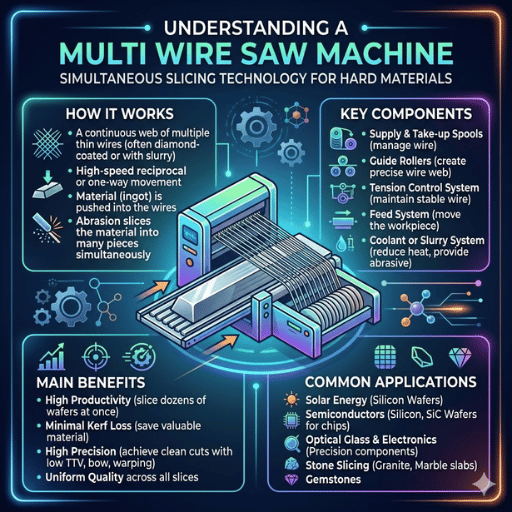
Multi wire saw is a cutting equipment for slicing a work piece into innumerable pieces in one step, by making use of multiple parallel wires at the specific intervals, generating flat and even wafers or slabs.
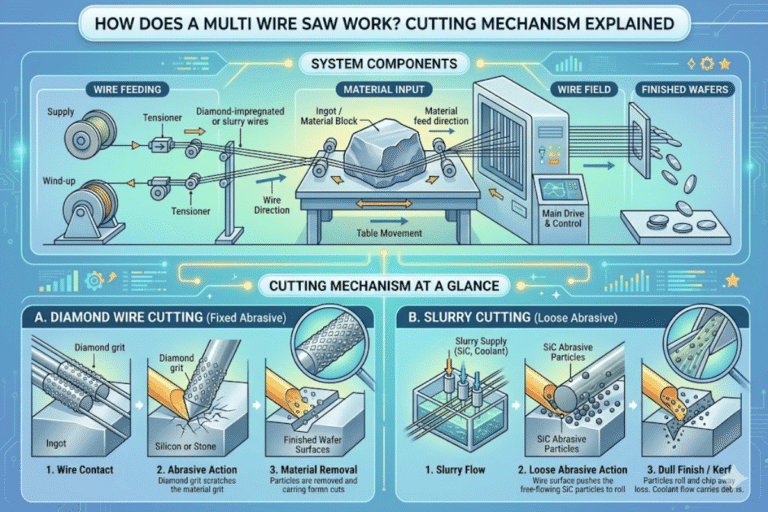
In contrast to a single wire saw tool that takes one cut at a time, multi wire saw machine achieves several hundred or even thousands of cuts simultaneously. Wire guide roller with machined grooves establishes the wire pitch that governs the slice thickness. Workpieces are fed into the wire web at a controlled rate.
Between that, there are two separate sorts of wire for the two main families of multi-wires saws:Free abrasive, slurry-based: bare steel wire. Cutting happens through the slurry of silicon carbide grit suspended in PEG (Polyethylene glycol); andFi×ed abrasive, diamond wire: granite is in the fi×ed grit (although it is actually tiny, Synthetic diamond particles) bonded directly to the wire, which is responsible for the cutting.
Both the types of blade have their own unique benefits, depending on the material being cut, level of precision needed and the volume of production. Other types of blade can be found outside of these two main categories, such as specialized options for stone block cutting, and endless loop machines for materials requiring more extreme cutting techniques. Below we break down each of the types of blade available by their mechanism of function, specifications and the industry that uses them – helping designers and buyers alike visualize which machine is suitable for the application.
Slurry-Based Multi Wire Saws
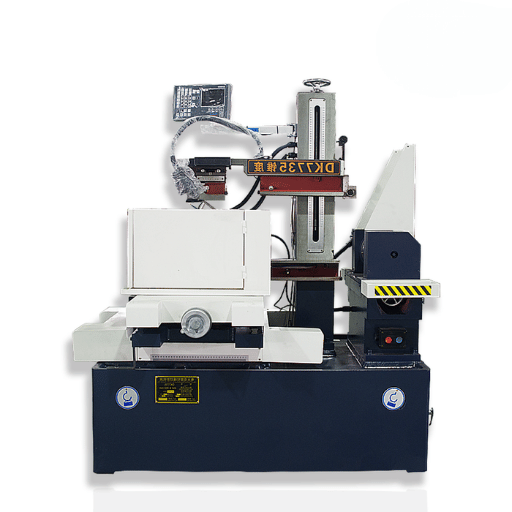
Slurry-based multi wire saws (also known as free abrasive wire saws) were the first workhorse machines of the silicon wafer industry. These machines employ bare steel wire (generally 100-160 m diameter) that is wound around guide rollers to create a wire web. Wire itself does not perform any cutting, but it instead allows a flow of slurry containing SiC abrasive particles in polyetherketone (PEG) onto the wire web.
As the wire travels at a high speed, it drags the abrasive particles across the workpiece surface. Abrasive particles do then the actual work of the material removal process using a three-body abrasion process.
Historically, slurry based- systems have been the market leader for solar cell and semiconductor wafer production. Production machine wire counts are between 1,000 to 2,000+ per machine and a single 300 mm silicon ingot can be cut into hundreds of wafers in a single run. Welds occur at a relatively low wire tension (about 20-30N per strand) and wafers possess what can be described as a “matte” appearance.
However, the kerf width of slurry-based saws is generally in the region of 200-250 m – substantially wider than a diamon wire substitute. This is important because each wafer therefor produces a larger amount of sawdust from the original raw material. Blanch et al. from the International Journal of Advanced Manufacturing Technology found that when silicon ingots are sawn into 200+ m wafer, 40-50 % of the original silicon ingot becomes sawdust.
📐 Engineering Note
Slurry composition – most monocrystalline silicon sapphires use SiC #800-#1500 suspended in PEG. Wire tension-20-30N/strand. Kerf loss (200-250 m) translates into roughly 40-50% waste of silicon ingots which becomes a main reason for the industry switching to diamond wire. The slurry should also be constantly recycled and re-supplied which makes process control and environmental requirements even more challenging.
As of today, slurry based multi wire saws are almost completely replaced by diamond wire systems in monocrystalline silicon manufacturing. they are, however, still used in some multicrystalline silicon applications and for sawing materials where the softer three body abrasion with loose abrasive in slurry causes less damage in the subsurface then direct diamond impact. The grinding/lapping action of loose abrasive may generate lower cracks depths in some brittle materials and this can be beneficial for subsequent wafer thinning and polishing.
Diamond Wire Multi Wire Saws
Although single wire cutting is still used in some industries, diamond wire multi wire sawing is the current industry standard in semiconductor and photovoltaic industry. Different from using loose abrasive in slurry, the solid abrasive that is attached to the wire is diamond particles, either through electroplating (nickel-bonded) or through resin bonding. With this long two body impact (abrasive to work piece), the cut efficiency as well as the material waste is greatly improved comparing to slurry based. Figure illustrates how the solid abrasive wire is made. Each wire is designed to directly impact into the work piece.
Market numbers are quite clear. According to Statista, more than 98% of the wafer manufacturing market share of mono crystalline silicon is now served by wire sawing technology. Global diamond wire sawing market size is valued at $1.08 billion in 2024 and expected to reach a value of $2.14 billion by 2033 with a CAGR of 8.5% owing to the rising photovoltaic cell market as well as increase in demand for silicon carbide substrates for power electronics in electric vehicles.
Wire diameter is an important parameter. Present demarcated maximum core wire diameter is at 36 m, while the effective core diameter including diamond overlay is around 50-60 m, a combination that results in around 55-80 m of kerf width, which according to the newly published PCME data, saves approximately 30 % of the cutting raw material mass (Procedia Manufacturing). 3. Conventional semiconductor wire diameters are generally larger with 100-350 m, which results in kerf widths of 150-350 m [PMC 184 (198), 201]. Savings are proportionately proportionate. (Polymer Material & Composite Engineering (PMC), Volume 107, 2006)
Sub-Types: Electroplated vs. Resin-Bonded
Electroplated diamond wire: diamond particles are electroplated onto a nickel plated steel core wire. This type of wire is more aggressive and faster since the diamond particles are more exposed. Electroplated wire is widely used in semiconductor industry where a fast cut with uniform kerf is desired. Resin-bonded diamond wire: the diamond particles are bonded in a resin matrix. It may contain one or more layer of diamond coatings. Resin bonded wire provide a slower but much longer wire life. It has seen wider use in stone processing industries.
Uses of diamond wire multi wire saws include silicon wafer slicing, SiC substrate slicing, sapphire window cutting, quartz processing and compound semiconductor wafer slicing. More progress is being made as UV assisted diamond wire cutting and sawing was proven to effectively reduce surface roughness by 4.3-29.7% in varying granularities of Kaolin compared to conventional DWS, with the joint publication provided by National Institute of Health (NIH) and Pacific Northwest National Laboratory (PNNL) in Micromachines (2023).
✔ Advantages
- Narrower kerf (55-260 m) – ~30% material savings vs. slurry
- Higher cutting speed (0.5–1.0 mm/min feed rate)
- Water-based coolant — no PEG/SiC slurry waste
- Cleaner wafer surface — reduced post-cut processing
- Lower environmental footprint per wafer
⚠ Limitations
- Higher wire cost per meter than bare steel wire
- Wire wear monitoring required – diamond loss affects cut quality
- Break-in period necessary for new wire (first 50-100 m of use)
- Surface damage pattern is different from slurry – may need tailored texturing of solar cells
📐 Engineering Note
For a typical diamond wire tension is about 20-30 N. Surface roughness (as rough as possible) 1 m with electrochemical-assisted DWS (ED-DWS). Notice, recent Springer research proved that the fixed diamond wire incurs initially higher cut force and oxidizes more until the protruded diamond particles are burnt away (about 50-100 m of use). The production technician should consider a break-in of wire.
Multi Wire Saws for Stone Block Cutting
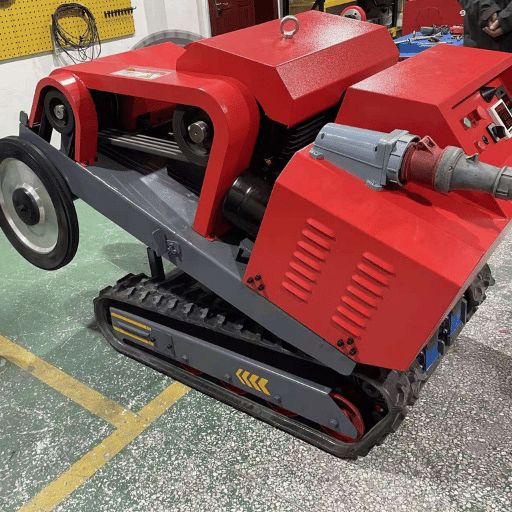
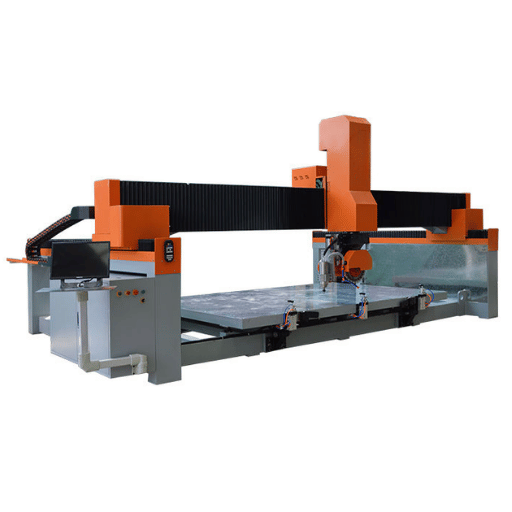
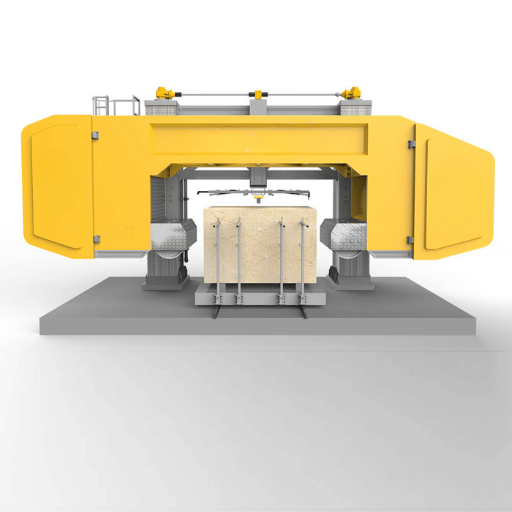
Stone block multi wires saws are heavy-duty industrial machines capable of cutting entire blocks of granite and marble into finished slabs or tiles in a single operation. Using a system of diamond bead-cables (each comprises a steel wire equipped with diamond-impregnated beads spaced at regular intervals) compared to the fine-wire diamond wire demonstrated by semiconductor processing, with diameters of 6.3-7.3 mm. Often a production machine runs 44 wires in parallel, but machine configurations can vary from 20 to 80 depending on block sizes and desired slab thicknesses.
Operating principle remains the same: parallel wires are at exactly defined distances moved through the workpiece together. However, the dimensions are just on a considerably larger scale. A multi wire cutting machine for granite can process blocks measuring 3.0 1.8 1.8 meters, producing 20+ slabs of equal thickness at each pass. Feed rate is approximately 60 cm/hr on average, but varies with the hardness of the material: granite requires slower feed rates than marble (40-50 cm/hr versus 60-80 cm/hr respectively).
Frame structures are of two basic types: double-column frames are more common and cheaper while four-column frames, used for harder materials or tighter overall thickness tolerance for slabs across the entire block can be specified.
This area has been rapidly developed into a new field: the ultra-thin diamond wire. Switching from bead cable to 0.35 mm diamond wire, the line produces slabs with as low as 3 mm thickness and a kerf of merely 0.5 mm compared to the 6-8 mm kerf of conventional bead cable lines. Why does this matter? Each block gains more finished slabs which increases production yield when using the high-value natural stone.
Power consumption of a multi wire stone saw is typically 110 kw compared to about 160 kw for a traditional gangsaw of the same diameter. Faster set-up, constant slab cross-thickness – then a multi wire has become the most popular method of quarry to finished product for big blocks of granite and marble.
📐 Engineering Note
Wire speed in cutting is normally 20-30 m/sec for stone blocks. Feed rate varies greatly: granite being slower (~ 40-50 cm/hr) than marble (~ 60-80 cm/hr); this is due to the hydroxyl hardness of the material (granite 6-7 , marble 3-4). When changing from marble to granite, wire breakage is often observed without reducing the wire tension; the difference is that marble is cut at lower tension to prevent microcracking, but for granite a higher tension needs to be used to improve the cutting process.
Endless Loop Multi Wire Saws for Precision Materials

Endless loop multi wire saws are based on a very different type of wire configuration; rather than winding the wire from one reel to another, the diamond wire is a continuous endless loop. This dramatically simplifies the diamond wire reversal and eliminates the surface imperfection caused by wire reversal. This will of course matter only for the highest surface quality end-gs where the construction of the full cutting length is maximized.
Post-processed endless loop system diameter of wire is between 0.3 to 1.0 mm with diamond particles electroplated on the surface. Wire can operate at 30-80 meters per second linear wire speed which is servo tensioning controlled at about 150-250 N. Kerf width is about 0.35 mm with normal wire life lasting anywhere from 30-100 hours depending on material cut and conditions of the coolant.
These are used for the most advanced precision cutting applications: SiC substrates for power electronics, sapphire windows for optical and defense applications, optical glass components, piezoelectric ceramics, NdFeB rare earth magnets, and compound semiconductors. Due to their continuous, one-way wire motion, surface quality is predictable and high, which minimizes or prevents the need for subsequent post-cut lapping on some materials.
Wire count on the endless loop system is less than the similar reel to reel machines – on the order of 1 – 16 wires because of the requirement to tension and guide each loop – this balances out the batch run throughput per run, with the accuracy of TTV on the order of 0. 01– 0.05 mm, far tighter than most reel to reel set ups.
High accuracy requirements of these applications are exactly what DONGHE’s loop wire cutting machines are built for, by aiming at the Semiconductor, optics and high-strength ceramics market, companies that require exactly the same surface quality on every run.
💡 Pro Tip
Select endless loop wire saws when you need uniform surface finish over the entire length of cut as the wire continuously travels and does not imprint the directional branding at wire reversal points as does reel to reel systems. This is often critical to sapphire and SiC substrates where the expense of polishing after cutting can be greater than the cost of the sawing process.
Multi Wire Saw Comparison: Specs, Kerf, and Throughput

Below is a table comparing the four major types of wire saw machines on the specifications relevant to choosing a machine: wire diameter, kerf width, precision achievable, number of wires, cutting speed and the main materials.
| Type | Wire Diameter | Kerf Width | Precision (TTV) | Typical Wire Count | Cutting Speed | Primary Materials |
|---|---|---|---|---|---|---|
| Slurry MWS | 100–160 µm | 200–250 µm | ±5–10 µm TTV | 500–2,000+ | 0.3–0.6 mm/min feed | Silicon (mono/poly) |
| Diamond Wire MWS | 36–350 µm | 55–260 µm | ±3–5 µm TTV | 500–2,000+ | 0.5–1.0 mm/min feed | Silicon, SiC, sapphire |
| Stone Block MWS | 6.3–7.3 mm cable | 0.5–8 mm | ±0.3–0.5 mm | 20–80 | 40–80 cm/hr | Granite, marble, travertine |
| Endless Loop MWS | 0.3–1.0 mm | ~0.35 mm | ±0.01–0.05 mm | 1–16 | 30–80 m/s wire speed | SiC, sapphire, ceramics |
There are few conclusions to be derived from this comparison. Slurry and diamond wire offer the largest numbers of wire (500 -2000+), and therefore are the norm for high throughput wafer manufacturing where output per run is the lead KPI. Diamond wire also matches or surpasses slurry throughput with a tighter TTV, narrower kerf, and has penetrated over 98% of the mono-c-silicon market…other than production volume it is difficult to find.
Multi wire saws for stone blocks operate on a completely different scale: fewer wire, much bigger kerf, and resolution driven by hundredths of a millimeter, not a couple microns. Constant tension systems for stone slabbing skip hundreds of wire if necessary in order to deliver consistent surface finish – this is a specialized niche for 10’s of wires which can obtain a TTV< 0.05 mm. In the end it’s the application constraints that determine which operation is “best” – no single multi wire saw machine design is suitable for all materials, precision levels, and order sizes.
How to Choose the Right Multi Wire Saw for Your Application
In making the decision to purchase a multi wire cut-off machine, ask four questions. Each one helps to quickly find the most appropriate machine configuration for your process.
Decision Framework: 4 Questions
1. What material are you cutting?
Step 1: Map your material’s Mohs hardness. Silicon (Mohs 7), SiC (Mohs 9.5), and sapphire (Mohs 9) can be cut with diamond wire or endless loop machinery, while softer and more porous ceramics may do best with slurry-based cutting. Materials like marble (Mohs 3-4) and granite (Mohs 6-7) fit stone block multi wire machines.
2. What precision do you need?
Step 2: Pinpoint the desired surface quality TTV. Wafer-grade precision (TTV 3-10 m) is reachable with diamond wire or slurry-based multi wire processes, while substrate-grade TTV (0.01-0.05 mm) can be achieved on endless loop systems. Slab-grade TTV (0.3-0.5mm) is a job for stone block technology.
3. What is your production volume?
Step 3: Determine cycle volume. Large-volume (thousands of wafers per day) continuous production lines are better served with reel-to-reel diamond wire systems, while less frequent runs of medium-sized advanced substrate wafers are tailored for endless loops with 4-16 wires. Slab size is best suited for batch cutting with cycle times of 6-12 hours per block.
4. What is your kerf budget?
Step 4: Balance cost. When raw material is very costly (like SiC at more than $500/BOE), narrower kerf justifies paying more for finer wire. When material is affordable (like stone), wider kerf and higher cutting speeds may be more cost-effective. For most advanced materials, diamond wire systems are the obvious choice – they deliver high speed with the narrowest kerf.
Selection Checklist
☐ Material hardness identified (Mohs scale)
☐ Target wafer/slab thickness and TTV tolerance defined
☐ Daily/weekly production volume calculated
☐ Kerf loss vs. raw material cost trade-off evaluated
☐ Coolant/waste handling infrastructure confirmed
☐ Wire consumable cost per cut estimated
Floor space and power supply verified for machine footprint
For manufacturers which cut multiple materials or are new to multi wires, go directly to a machine builder that can help you understand how a machine can work across several applications with application engineering experience.
Our Perspective
DONGHE has produced diamond wire saw cutting machines for over 10 years, selling to more than 300 customers around the world in semiconductor, photovoltaic, and special materials industries. This classification method is based on our engineering group’s experience of 10,000+ cutting application cases, and specs from industry references and peer reviewed papers. All references are hyperlinked so that you may access original data.
Frequently Asked Questions
What are the different types of wire cutting machines?
View Answer
4 categories of wire cutting machines in the market today: single wire saws (used to produce alternative final cuts and complex profiles), multi wire saws (for high volume simultaneous slicing), endless loop wire saws (for high quality surfaces on demanding materials), and wire ED machines (for electric conduction metals in EDM work). Multi wire saws are split into three types depending on the cutting mechanism: slurry-based (free abrasive), fixed abrasive (diamond wire), and laser, plasma or waterjet.
What is the difference between slurry and diamond wire multi wire saws?
View Answer
Slurry multi wire saws use bare steel wire with the silicon carbide abrasive itself suspended in a water-based lubricant, polyethylene glycol, and a kerf of 200-250 m. Diamond wire saws use diamond particles rather than silicon carbide glued to the wire with a kerf of just 55-80 m. The diamond wire moves faster and produces less waste; the efficiency of cutting is closer to 70% of the kerf.
A shorter water-based coolant is used instead of chemical slurry. Sliding over 98% of all the mono silicon wafers are cut with the diamond wire process.
How many wires does a multi wire saw machine use?
View Answer
Wire count depends on machine type—semiconductor wafer saws have 500 or more wires with over 2,000 is common, stone block cutters usually used on 20 to 80 wires at a time, and precision endless loop systems can have 1 to 16 wires.
What materials can a multi wire saw cut?
View Answer
Multi wire saws perform cuts on silicon ingots, silicon carbide, sapphire, gallium arsenide, quartz, optical glasses, piezoelectric ceramics, Nd Fe B, magnets, granite, marble, travertine, and graphite. As for the type of wire and arrangements of machine the materials that will be easier to handle for each system will be different.
How thick can a multi wire saw cut?
View Answer
Semiconductor Multi wire saws have the capability of producing wafers of 100 180 m. The semiconductor multi wire saws are capable of cutting stone slabs from a thickness of 3 mm ultra thin models, while the standard models are only capable of producing 30+ mm.
Is a multi wire saw better than a single wire saw?
View Answer
Multiple wire saws provide a faster slice rate, allowing hundreds of wafers or dozens of stone slabs to be sliced simultaneously, whereas single wire saws produce just a single slice at a time. Once again the advantage of single wire saws is in allowing complex 3D contoured profiles, irregular profiles and small batch prototyping if needed; whereas the multi wire saws are the usual option for production pace, parallel slicing.
References & Sources
- “Recent Developments of High-Precision Diamond Wire Cutting on Monocrystalline Silicon” – PMC/National Institute of Health (PMC 10456952)
- “Experimental Investigation into the Effect of Wire-Saw Wear on Cutting Force and Silicon Wafer Surface”—PMC/National Institutes of Health (PMC 10223077)
- “Experimental Study on Surface Integrity of Solar Cell Silicon Wafers Sliced by Electrochemical Multi-Wire Saw” — PMC/National Institutes of Health (PMC 9505672)
- “Diamond wire sawing of solar silicon wafers—a green manufacturing alternative to fresh-abrasive slurry sawing” – ScienceDirect/Procedia Manufacturing (ScienceDirect)
- “Investigation on diamond wire break-in and its effects on cutting performance in multi-wire sawing” — Springer/International Journal of Advanced Manufacturing Technology
![SiC Wafer Multi Wire Saw Process, Parameters & Selection [Guide]](https://wiresawcutter.com/wp-content/uploads/2026/05/SiC-Wafer-Multi-Wire-Saw-Process-Parameters-Selection-Guide-768x512.webp "SiC Wafer Multi Wire Saw: Process, Parameters & Selection [Guide] 8")

![Polysilicon Material: Properties, Grades & Uses [Guide]](https://wiresawcutter.com/wp-content/uploads/2026/08/polysilicon-material-featured-150x150.webp)