Get in touch with DONGHE Company


How to Choose the Right Single Wire Saw Machine for Your Cutting Needs
Quick Specs: Single Wire Saw Machines
| Wire Speed Range | 10–80 m/s (precision applications: 20–50 m/s) |
| Wire Diameter | 0.35–0.60 mm (electroplated diamond) |
| Standard Kerf Width | 0.35–0.50 mm (advanced systems: as low as 60 μm) |
| Wire Tension | 150–250 N (servo-controlled) |
| Typical Materials | Silicon, SiC, sapphire, ceramics, quartz, graphite, germanium |
| Material Loss vs Traditional | 30–40% less kerf loss than slurry-based sawing |
Choosing a single wire saw machine will ensure your slicing lines up exactly with your desired consistent accuracy or throws away wire valuable consumables producing below-par results. Unlike multi wire machines designed to produce massive quantities of wafers, a single wire saw provides you the freedom to make a modest batch of prototype parts, or accommodate complicated workpiece geometry, or choose materials where each workpiece needs special treatment as it gets sliced.
Here’s a simple guide to the seven parameters that distinguish a suitable match to a poor match: going from complex specifications and material compatibility to TCO and a decision tree based on sample selection processes, gains, and losses. If you are slicing semiconductor wafers, or appraising machinability for your research, picking among the options appropriately available from cold cutting technology will make all the difference in quality and efficiency from day one.
In This Guide
- What Is a Single Wire Saw Machine?
- Categories of single wire saw machine by application
- 7 important specs to compare before purchase
- Material Compatibility
- Total Cost of Ownership
- Safety Features and Maintenance
- Decision Framework
What Is a Single Wire Saw Machine and How Does It Work?
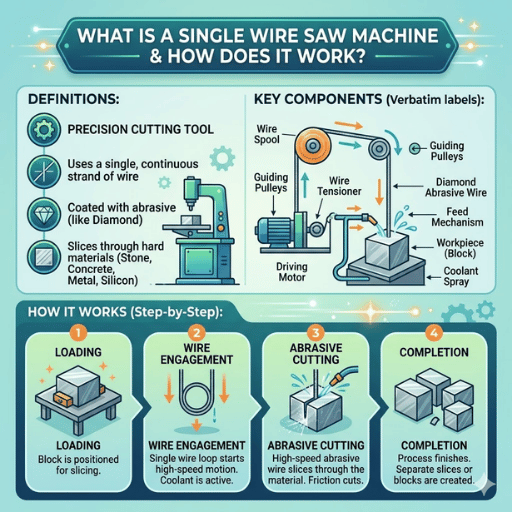
A single wire saw is a major method of cutting wafers and bulk substrates into individual parts, slabs, or film strips. The wire – usually about 0.35 mm thick but sometimes as thin as 0.20 mm – propagates at speed regulated by coolant flow and servo-controlled tensioning devices. Workpieces are mounted and consistently fed into the wire loop by a computerized wafer stage or die bonder.
Single wire sawing runs along the lines of “cold cutting” technology because the small contact patch between wire and workpiece generates less heat. A review article published in the Journal of Manufacturing Processes in 2024 cites this “low thermal load” benefit, stretching back to the earliest papers on silicon crystal slicing at the dawn of modern wafer manufacturing in the 1980s, as helping enable the “wafer crystallization remains intact” property of today’s shop production slices.
Those distinct requirements drive wire saw technology design specifications: construction-class wire saws focus on high power delivery to chew through stone while precision-class machines focus on thin kerf values, dimensional tolerances, and quality of finished surfaces when shaping high-value materials like transparent ceramics and crystals.
💡 Key Takeaway
Particularly if slicing sensitive semiconductor wafers, or representing a laboratory on a steel table, choosing a single wire saw offers a flexible, high-precision machining process where tolerances outweigh throughput.
Types of Single Wire Saw Machines by Application
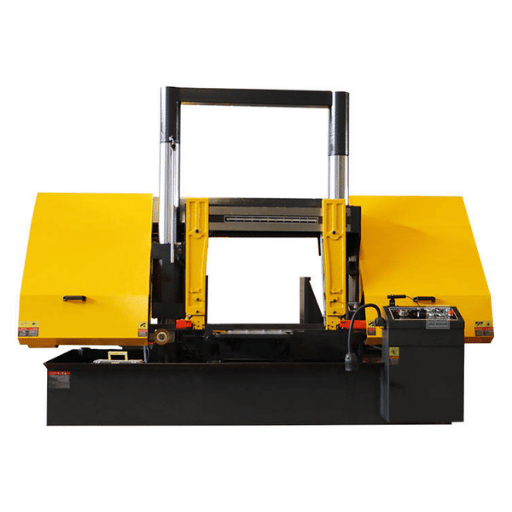
The geometry of the single wire saw machine , kinds of wire and control systems direct different machines to different expectations – some single wire saw machines purely function in the field, some ultra precision for prototype or high-value work, while others produce volume in non-precision applications.
| Application Segment | Typical Materials | Precision Range | Wire Type |
|---|---|---|---|
| Semiconductor Wafer Slicing | Silicon, SiC (4H/6H), GaAs | ±0.01–0.02 mm | Electroplated diamond, 0.35–0.40 mm |
| Optical & Crystal Processing | Sapphire, quartz, optical glass | ±0.02–0.05 mm | Electroplated diamond, 0.40–0.50 mm |
| Advanced Ceramics | Al₂O₃ (99.5%), ZrO₂, SiN | ±0.05–0.10 mm | Electroplated or sintered diamond, 0.40–0.60 mm |
| Metal Sample Preparation | Stainless steel, titanium alloys, nickel superalloys | ±0.10–0.20 mm | Sintered diamond or abrasive wire, 0.50–0.60 mm |
| Carbon & Magnetic Materials | Graphite electrodes, ferrite cores, carbon composites | ±0.05–0.15 mm | Electroplated diamond, 0.40–0.50 mm |
Based upon applications across 10,000+ cases we have collected to date, DONGHE separates single wire saw applications into five segments. Semiconductor and optical applications use wire with the smallest diameter for ultra fine tolerances, while metal sample prep tolerates wider kerf but needs formulae designed for avoiding metal smears on the diamond surface.
The first filter when selecting the right wire saw is to see that your main application segment fits the design intent of the saw. A machine built specifically for ceramic substrate cutting might not have the ultra-fine tension control needed for a semiconductor wafer saw- even though both are working with hard materials.
💡 Key Takeaway
Select then your machine category. Rather choose your wires category first according to your main usage like semiconductor, optical, ceramic, metallic or carbon materials because the different department have different systems for the wire type, tension and precision.
7 Key Specifications to Evaluate Before Buying a Wire Saw Machine

That we measure finely refers only to the wire saw machines that, if they are good, shall give you consistency of performance, and if they are bad shall give you trouble at six months after installation. These 7 parameters are the rather few measured factors where machines are most differential, and costly to correct selection error later on.
1. Wire Speed and Cutting Rate
Wire speed – expressed in meters per second (m/s) – directly affects the cutting rate of your diamond wire saw. The end user single wire saw machines found on the market will generally have a range 10m/s up to 80m/s. Precision applications such as semiconductor wafer slicing will have an optimal window between 20m/s and 50 m/s where you get the best balance between cutting rate, surface quality and cost.
A higher cutting speed increases throughput, but also speeds up diamond grit degradation. Based on real-world data from sapphire machining operations, typical feed rates at optimum wire speeds are 0.1-0.8 mm/min—a relatively narrow band that demonstrates just how difficult cutting hard crystals can be.
2. Cutting Precision and Surface Finish
Performance criterion for wire saw cutting machine is two—the accuracy of positioning which can be defined as dimensional tolerance between the machined and the programmed position, and the surface roughness value (Ra value of the cut face). High precision tungsten wire saw has a positioning accuracy of 0.01mm, and surface roughness Ra 0.8 m is obtained on silicon and sapphire for optimized cutting parameters.
3. Maximum Workpiece Dimensions
The largest workpiece dimension that a machine can machine is limited by the dimensions of the cutting chamber and the travel of the feed axis. Verify the travel of the feed axis in the X axis (cut depth), and the capacity of the mount in the Y and Z axes. Machines for 200 mm diameter silicon ingots do not necessarily have the correct hardware to handle a 300 mm boule.
4. Wire Diameter and Kerf Loss
Thinner wire – narrower kerf – means more of the expensive material can be cut instead of wasted to dust. Typical standard kerf widths are between 0.35 and 0.50 mm with normal wire diameters. Faster, more sophisticated systems utilizing 0.35 mm electroplated wire capable of kerf widths down 60 m just 0.006 mm ( 0.0002 ) can potentially reduce material losses by 30 40% compared to conventional slurry sawing using larger kerf widths.
This would make the tool cost significant less than the material costs for high value materials such as silicon carbide $ 300-800 per wafer.
5. Tension Control System
Wire tension stability relates to cut quality and flatness. Servo tension control keeps the wire tension in the range of 150 N to 250 N. The tension is read using the load-cell feedback loop and adjusted automatically as the wire gets hotter and thinner on long cuts.
Machines without closed loop tension feedback will lead to wavering dimensionality and surface roughness when cutting above 50mm in thickness.
6. Coolant and Lubrication System
The diamond wire saw cutting produces abrasion contaminant slurry of the cut material. The coolant system must supply sufficiently filtered fluid at flow rates high enough to cool the wire, flush slurry from the cut zone and keep the diamond grit free of contamination. Look for a filtration system rated at least 10 m for particle size with a flow rate in the range of 5-15 L/min that can be varied depending on your material and wire operating speed.
7. Energy Consumption and Power Requirements
Electric power consumption for diamond wire saw machines ranges from 3 kW (for laboratory single wire models) up to 15 kW (for large capacity production models). We have seen laboratory models and other machines using a single wire run as little as 3-5 k W while large, production quality units with more powerful spindle motors and active cooling draw on the order of 8-15 k W. Take energy costs into account when calculating operation / production costs – a 10 kW machine running two shifts a day will drive up your annual expenses by an measurable amount.
📐 Engineering Note
For SiC wafer cutting target the following parameters: wire speed 15-30 m/sec, wire tension 180-220 N, feed rate 0.2-0.5 mm/min, water flow 8-12 L/min. These data are based on working with 4H-SiC (Mohs 9) in a 0.35 mm electroplated diamond wire based on manufacturer research.
💡 Key Takeaway
Wire speed, cut kerf loss and tension are three parameters which most directly affect the ultimate cut quality and incurred operating cost. Prioritize the three before moving to compare other machine features.
Material Compatibility — Which Materials Can Single Wire Saws Cut?
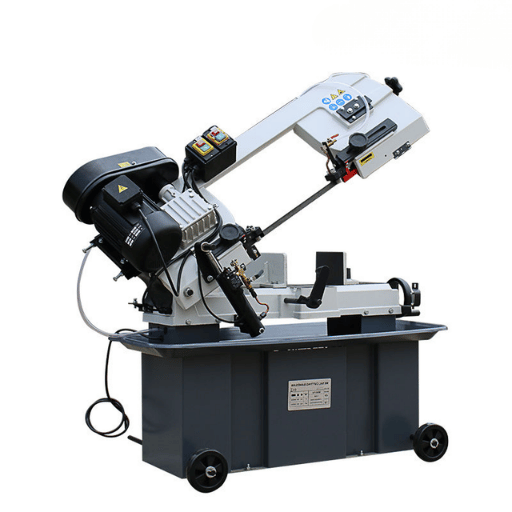
To choose an appropriate diamond wire saw machine you need to determine if it can cut your desired material range with the results you seek. Although diamond wire saws cut numerous hard and brittle materials, they tend to be highly dependent upon crystal structure as well as hardness.
| Material | Mohs Hardness | Recommended Wire | Feed Rate | Key Challenge |
|---|---|---|---|---|
| Silicon (mono/poly) | ~7 | Electroplated, 0.35–0.40 mm | 0.5–2.0 mm/min | Chipping at crystal boundaries |
| Silicon Carbide (4H/6H) | 9–9.5 | Electroplated, 0.35–0.45 mm | 0.2–0.5 mm/min | Extreme hardness accelerates wire wear |
| Sapphire (Al₂O₃ single crystal) | 9 | Electroplated, 0.40–0.50 mm | 0.1–0.8 mm/min | Anisotropic hardness varies by cut plane |
| Alumina Ceramic (Al₂O₃ 99.5%) | 9 | Sintered diamond, 0.45–0.60 mm | 0.3–1.0 mm/min | Abrasive dust clogs diamond grits |
| Quartz / Fused Silica | 7 | Electroplated, 0.40–0.50 mm | 0.5–1.5 mm/min | Brittle fracture risk at high feed rates |
| Graphite / Carbon Composites | 1–2 | Electroplated, 0.40–0.50 mm | 2.0–5.0 mm/min | Fine dust requires enhanced filtration |
| Germanium | 6 | Electroplated, 0.35–0.45 mm | 0.5–1.5 mm/min | Soft but brittle — requires low tension |
| Ferrite Cores / Magnetic Materials | 5.5–6.5 | Electroplated, 0.40–0.50 mm | 0.8–2.0 mm/min | Magnetic debris adheres to machine parts |
The pattern emerges: the higher the Mohs hardness, the lower the feed rate and the faster the wire wears. Both SiC and sapphire (Mohs 9 or above) have 3-5x more wear per cut than silicon (Mohs 7). This one factor alone can have a significant impact on operation costs.
Graphite and ferrite are softer materials but they introduce a different nightmare scenario. Sharp, friable and extremely fine conductive powder can find its way into sensitive electronic components if the machine lacks sealing shields and dedicated filtration.
⚠️ Important
Always arrange to perform a cut test on your material prior to acquiring new equipment. Published cut parameters show the capability ranges, but the interaction of a particular material grade, wire formulation and machine controls determines if you can actually meet those parameters.
Total Cost of Ownership — Beyond the Purchase Price
While the initial invoice of a diamond wire saw machine accounts for 40-60% of five year expenses, the ongoing expenses of wire consumables, maintenance, power and downtime account for the rest – and can vary to a surprising extent even for seemingly identical machines.
| Cost Category | Lab/R&D Machine | Production Machine | Notes |
|---|---|---|---|
| Machine Purchase | $15,000–$60,000 | $60,000–$250,000+ | Depends on automation level, workpiece capacity |
| Diamond Wire (annual) | $2,000–$8,000 | $10,000–$50,000+ | Largest recurring cost — varies 5x by material hardness |
| Maintenance (annual) | $1,000–$3,000 | $3,000–$10,000 | Guides, bearings, coolant system servicing |
| Energy (annual) | $800–$2,000 | $3,000–$8,000 | Based on 3–15 kW draw, single/double shift |
| Downtime Cost | Low (batch flexibility) | $500–$2,000/day | Production line dependency multiplies impact |
Per unit cost of consumables warrants additional concern. Remember that a silicon carbide (Mohs 9.5) material will require 3-5 times more diamond wire changes than silicon (Mohs 7). That alone can push operation costs by $20,000–$40,000 annually for a production machine running two shifts. According to Maximize Market Research, the global diamond wire saw market reached $1.08 billion in 2024 — with wire consumables representing a significant share of that figure.
💡 Pro Tip
Most Common Purchasing Error: Buying a machine for its sticker price alone and ignoring wire consumption costs. Buying a less expensive machine requiring expensive proprietary wire at $15/meter will ultimately cost 3 times that amount over 3 years than buying the more costly (yet general purpose) machine that runs standard wire at $5-$8/meter. Know ahead of time what the manufacturer’s recommended wire types are and shop detail pricing completely outside your purchasing scope before final decision.
A cost-effective purchasing strategy represents more than simply the invoice price you pay. It is best to consider all five cost variations to determine your maximum allowable TCO. Leading monitoring systems capable of tracking wire wear are transforming the TCO of wire saws. Based on reports from industry data evaluators, as many as 27% of the diamond wire saw systems on the shelves of competitive vendors in 2025 were incorporating real time monitoring sensors for estimating wire wear. By enabling predictive maintenance warning of means to reduce unplanned correction by more than 30%, monitoring transforms the wire break into a scheduled event quite literally creating savings in machine downtime and increasing productivity.
Safety Features and Maintenance Best Practices

A diamond wire saw machine is one in which a wire is drawn very rapidly (up to 80m/sec) under a large tension range (150-250N). When a wire breaks the energy stockpiled in the wire is suddenly and completely released: safety features are a critical design element of any machine being sold into your operation.
Safety Features to Verify Before Purchase
- ✔
Emergency stop (E-stop) with response time under 0.5 seconds - ✔
Wire break detection sensor with automatic machine halt - ✔
Fully enclosed cutting chamber (IP54 or higher protection rating) - ✔
Interlocked safety doors- machine cannot operate with doors open - ✔
Coolant level sensors and flow monitors with automatic shutdown in event of failure - ✔
CE stamped complying with OSHA 1910.213 Machinery & Machine Guarding Principles.
Maintenance Schedule for Longevity
Choose a machine that supports regular maintenance intervals to extend life while maximizing cutting efficiency. Based on our experience with installation of diamond wire saws spanning the laboratory to high volume production machining arena, the following schedule represents a potential best practice.
| Interval | Task | Purpose |
|---|---|---|
| Daily | Clean cutting chamber, check coolant level, inspect wire visually | Prevent debris buildup and early wire failure detection |
| Every 2 weeks | Inspect wire for fraying/wear, check tension calibration | Maintain cutting precision and prevent mid-cut wire breaks |
| Monthly | Inspect electrical connections, test safety sensors, check coolant pH | Prevent electrical faults and coolant degradation |
| Every 6 months | Replace wire guides, inspect bearings, replace coolant filters | Wire guides wear affects cut straightness and kerf consistency |
| Annually | Full professional inspection: motors, drives, control systems, alignment | Identify wear patterns before they cause failure |
Protect yourself while preparing for a wire change with the right PPE: safety glasses, cut-resistant gloves, and hearing protection. From the operator safety and long-term durability of your diamond wire saw system, price in the highest quality safety materials and machine components as directly affecting benefits.
💡 Key Takeaway
Wire guide replacement at 6 month intervals, and a biweekly correction for tension consistency is enough to extend cutting accuracy without needing additional maintenance.
How to Match a Single Wire Saw to Your Production Needs — A Decision Framework
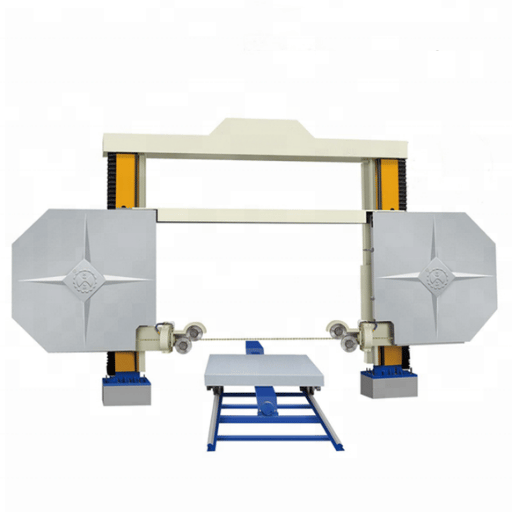
The last item in your detailed specification string is to compile all of those costs and factors into a structured selection process. The framework you see below was compiled from consulting processes across 300+ clients using diamond wire saw cutting machines for accurate applications.
5-Step Selection Methodology
- Determine your material(s) – list the primary material (and any secondary material if used), its Mohs hardness rating, the typical workpiece sizes you will be processing, and the surface specifications that will need to be achieved. This information helps allow you to determine your wire choice and class of equipment needed.
- Define your accuracy needs – state the acceptable dimensional tolerances (mm), and surface roughness (Ra values). If your accuracy needs are tight, you will limit the options to a very few machine options.
- Define your throughput needs – determine how many cuts or wafers you will need to process each day (or week). This defines your class of equipment need (class 1, 2, 3 etc) and whether a single, or multi-wire saw configuration will be necessary.
- Calculate your TCO – Build a 3-year operating cost:
machine + consumables (based on your material MOHs value) + maintenance + power + operator time investment. Collect the 2-3 best value options comparison. - Request a cut test Send your actual material samples to the machine builder for a test cut. Assess the cut surface quality, kerf dimensions, and wire usage rate in real shop conditions-not just specification sheet data.
“The cut test is where datasheets meet practice. We have encountered machines with the same datasheet specification vary in cut performance because of wire tension response, vibration absorption, and wire path geometry-not captured on the datasheet.”
— DONGHE Engineering Team, based on 10,000+ cutting case evaluations
In the case of various materials — go for the hardest one. “Any machine capable of processing the hardest material, such as SiC, will be more than capable of processing the softest material, such as silicon.”
💡 Key Takeaway
Never buy a single wire saw without testing it on your actual material. Datasheets indicate the range of parameters a machine is capable of, while a cutting test shows if that range can be achieved for your specific application.
Need help choosing the perfect single wire saw for your application and part dimensions?
View DONGHE Single Wire Saw Models →
ISO 9001:2015 – CE certified | CE marked | 35 patents | 300+ international customers
Frequently Asked Questions About Single Wire Saw Machines
Q: What is the difference between a single wire saw and a multi-wire saw?
View Answer
A single wire saw utilizes one continuous diamond wire loop, providing operators full control over each individual cut — parameters, positioning, and feed rate are all independently adjustable per workpiece. A multi-wire saw operates many parallel wires simultaneously, slicing an ingot into hundreds of wafers in one pass. Single wire machines tend to be more adaptable for varied geometries, R&D prototyping, small batch production, and situations where you switch between different materials regularly. Multi-wire systems are built for throughput: high-volume wafer production where the same cut repeats thousands of times. The trade-off comes down to flexibility versus volume. If your operation processes fewer than 50 cuts per day across different materials, a single wire system is almost always the better fit. For detailed side-by-side comparison, see our guide on single vs multi-wire saws.
Q: How fast can a single wire saw cut silicon carbide?
View Answer
Looking at silicon carbide (4H-SiC), feed rates are usually 0.2-0.5 mm/min with 0.35-0.45 mm wires traveling at 15-30 m/sec, however these figures are limited by SiC hardness, which is up to nine times harder than silicon. Attempting these feed rates can cause catastrophic damage: increasing subsurface damage, uncomfortable wire wear and breakage, poor surface finish, and limited throughput. Real feed rates depend on the SiC polytype, workpiece diameter, and machine tension control accuracy.
Q: What factors influence the cost of a diamond wire saw machine?
View Answer
Machine cost is influenced by the maximum workpiece size (bigger XY travel increases costs), precision requirements (closer tolerances require more high-quality components), level automation (manual loading is cheaper, robotic is more expensive), control platform (PLC is less expensive, CNC with program storage is more adaptable), and manufacturer/locale. Small lab equipment can be acquired for under $15,000, while highly automated production line equipment costs over $250,000. Remember to factor in wire costs, maintenance, and power usage in your acquisition analysis, since these number well surpass the initial machine investment in less than a handful of years.
Q: How often should a single wire saw be maintained?
View Answer
Daily: clean chamber, check coolant. Biweekly: inspect wire, verify tension. Monthly: electrical and coolant pH. Every six months: replace wire guides. Annually: full professional inspection.
Q: Can a single wire saw cut metal?
View Answer
Yes. Single wire saws fitted with sintered diamond or abrasive wire handle stainless steel, titanium alloys, nickel superalloys, and aluminum. Wire saw metal cutting serves primarily metallurgical labs, cross-section analysis, and precision component work where minimal heat-affected zone matters. Feed rates and wire formulations differ substantially from semiconductor or ceramic cutting — metals tend to smear onto the wire surface, requiring different diamond bonding and coolant chemistry.
Q: What is the typical kerf loss of a diamond wire saw?
View Answer
Standard diamond wire saws produce kerf widths of 0.35–0.50 mm, but ultra-thin 0.35 mm wire can achieve kerf as low as 60 μm. Compared to slurry-based sawing, diamond wire cuts material loss by 30–40%. For SiC wafers priced at $300–$800 each, that saving adds up fast across a production run.
Q: How do I evaluate wire saw cutting machine quality from different suppliers?
View Answer
Ask each supplier for three things: (1) a cutting test report on your actual material showing kerf width, surface roughness, and wire consumption rate; (2) reference contacts from customers who process similar materials; (3) quality certifications (ISO 9001, CE marking). Compare consistency across multiple test cuts from the same machine — a single good result means less than five consistent results. Also evaluate customer support responsiveness and whether they have spare parts stocked in your region or only ship from a single factory location. Check if the supplier offers application engineering support for parameter tuning on your specific material, because getting optimal parameters often takes weeks of iteration and having an experienced applications engineer cuts that timeline substantially. Finally, ask about training programs — a machine is only as productive as the operators running it, and manufacturers who invest in customer training tend to produce better long-term outcomes.
About This Analysis
This selection guide comes from the perspective of DONGHE (Shanghai Donghe Science & Technology Co., Ltd.), an ISO 9001:2015 certified manufacturer with 35 national patents in diamond wire saw cutting technology. The specification ranges, material compatibility data, and maintenance schedules referenced here draw from our database of 10,000+ cutting cases across silicon, silicon carbide, sapphire, and ceramic substrates accumulated over a decade of production and R&D. We structured this guide around objective selection criteria so it remains useful regardless of which manufacturer you ultimately choose.
References & Sources
- Diamond Wire Sawing Process for Single-Crystal Hard and Brittle Materials — A Review — Journal of Manufacturing Processes (ScienceDirect), 2024
- OSHA 1910.213 — Woodworking Machinery Requirements — U.S. Department of Labor, Occupational Safety and Health Administration
- Diamond Wire Saw Market: Global Industry Analysis and Forecast (2024–2030) — Maximize Market Research
- Saw Safety: Risk in the Real World — National Library of Medicine (PMC)
- Diamond Wire — Precision Cutting for Various Applications — UKAM Industrial Superhard Tools
Related Articles
- Single Wire vs Multi-Wire Saw: Which Do You Need? — A side-by-side comparison of single and multi-wire systems for different production scales
- How Diamond Wire Saw Works: Working Principles Explained — Technical deep dive into diamond wire cutting mechanics
- How Diamond Wire Sawing Works: Technical Deep Dive — Detailed analysis of cutting parameters and their effects on output quality
- Laboratory Wire Saw Maintenance: Best Practices Guide — Maintenance schedules for lab-scale wire saw machines
- DONGHE Single Wire Saw Product Catalog — Browse our full range of single wire saw cutting machines



![Polysilicon Material: Properties, Grades & Uses [Guide]](https://wiresawcutter.com/wp-content/uploads/2026/08/polysilicon-material-featured-150x150.webp)