Get in touch with DONGHE Company


How Single Wire Saws Deliver Precision Cutting for Hard and Brittle Materials
Quick Specs: Single Wire Saw Performance
| Wire Diameter Range | 0.12 – 0.35 mm (120 – 350 μm) |
| Cutting Speed | Up to 25 m/s (single wire); up to 80 m/s (industrial endless) |
| Indexing Accuracy | ±0.003 mm (high-precision option) |
| Surface Roughness (Ra) | 0.27 – 0.43 μm (material-dependent) |
| Kerf Width | 0.15 – 0.50 mm |
| Typical Feed Rate | 0.1 – 0.4 mm/min |
Single wire saw – single strand of diamond-impregnated wire is fed through a material that wouldfractureorces through a normal blade. (Multiwire saws, often used for 24-wafers, are designed for other applications.) a single wire saw, as opposed to a multi-wire saw, provides direct control to the operator ofup feed, thedistance ofwire, andthe angleof cut: building a… single ledge.
This instructions details the components of the cutting mechanism, compatible materials, key machine specifications, and practical selection criteria. Each technical specification or assertion has a reference to a peer-reviewed journal or manufacturer testing.
What Is a Single Wire Saw and How Does It Work?
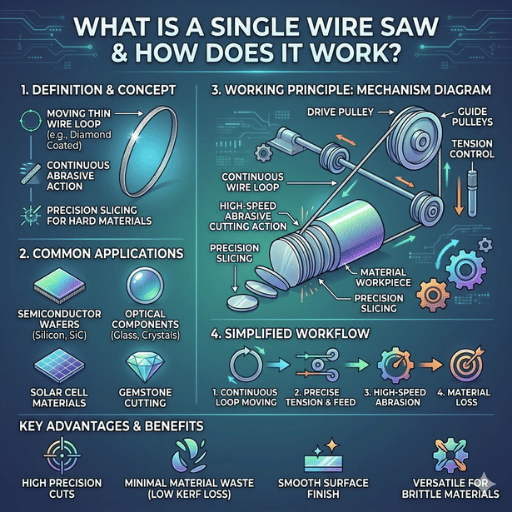
A single wire saw is a precision cutting tool that pushes a single diamond-coated wire through a work piece while under a carefully controlled tension and feed rate. As a cutting tool the single wire saw depends on abrasive removal without chip formation. This is achieved by the use of industrial grade diamond particles much like those seen in industrial grinding wheels electroplated or sintered onto a high strength steel core wire abrade the material target through three processes simultaneously: micro-cutting, micro-fracture, and micro-plowing.
The wire runs between two spools (or in the case of an endless wire loop models, the wire runs in a continuous loop), passing through guide rollers which ensures it remains aligned within tolerance of a few micrometers. The wire tension is monitored by a load-cell controlled tensioning system controlled by a PLC which maintains a steady tension, whereby typical wire tension for high, speed wire sawing ranges around 50 to 60 N for lower capacity wire saws greater than 150 N for industrial single wire saw machining. A 2024 study in the Journal of Manufacturing Processes showed that diamond wire sawing has become the dominant slice technique in the semiconductor industry owing to its ability to produce high surface quality with minimal kerf loss.
During cutting, a coolant (or cutting fluid) – typically deionized water or water-based media – is supplied to wash away chips, minimize thermal damage, and prolong life of the diamond wire. Wire diameters used in single wire saws are usually between 0.12 mm and 0.35 mm. Diamond wire used is usually thick to create a thicker cut, thus producing a wider kerf.
Wires with a thinner diameter create a more narrow kerf however the tension and feed rate has to be increased to avoid breakage.
The reciprocating drive (shown in diagram) and unidirectional drive are explained more fully in our article How diamond wire saws work.
💡 Key Takeaway
Single wire saws mill material with diamond abrasion. No cutting shear is involved. No thermal stress is generated — a cold-cutting advantage for heat-sensitive crystals and ceramics.
This characteristic makes it suitable for use on heat sensitive crystals and ceramics.
Materials You Can Slice with a Precision Wire Saw
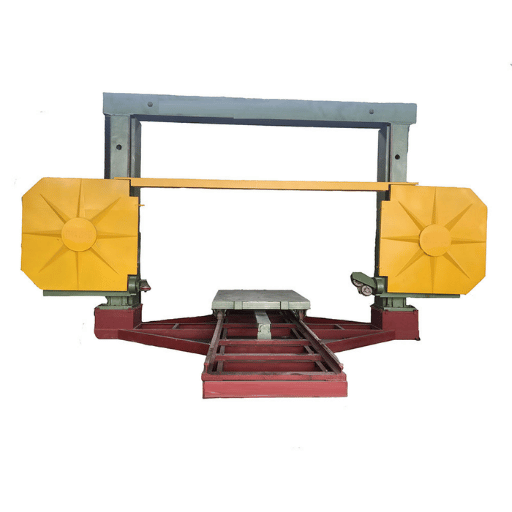
A precision wire saw will cut almost any hard and brittle material that will fracture against a traditional blade contact. Diamond wire is used as a flexible, very thin kerf cutting instrument for material research, production wafering, and specimen preparation in dozens of material families.
The following summarizes the typical materials, hardness ratings and surface roughness values attainable with today’s diamond wire saw:
| Material | Mohs Hardness | Achievable Ra (μm) | Primary Application |
|---|---|---|---|
| Silicon (mono/poly) | 6.5 | 0.35 | Silicon wafer cutting, PV cells |
| Sapphire | 9.0 | 0.38 – 0.42 | LED substrates, optical windows |
| Silicon Carbide (SiC) | 9.0 – 9.5 | 0.35 – 0.40 | SiC wafer cutting, power electronics |
| Quartz / Fused Silicon Glass | 7.0 | 0.30 – 0.38 | Optical components, resonators |
| Silicon Nitride Ceramics | 8.5 | 0.27 – 0.38 | Bearing balls, turbine parts |
| Germanium | 6.0 | 0.30 – 0.35 | IR optics, single crystal substrates |
| Graphite | 1.0 – 2.0 | 0.40 – 0.50 | EDM electrodes, fuel cells |
| NdFeB Magnets | 5.5 – 6.0 | 0.43 | Motor rotors, magnetic assemblies |
| Stainless Steel (thin sections) | 5.5 – 6.5 | 0.50 – 0.60 | Medical devices, micro-components |
The Ra (average surface roughness) values quoted in this table are obtained from a number of different journal papers: data for silicon nitride ceramics from a 2023 study published in the MDPI Micromachines journal, data for polycrystalline silicon from ScienceDirect, focusing on diamond wire sawing optimization, and data for NdFeB magnet from a 2025 Materials journal according to different process parameters.
The common denominator among these materials is all are brittle enough that typical saw blades cause cracking, chipping, or bring too much heat into the specimen. In a single wire diamond cutting operation, the abrasive rolling force is evenly distributed among thousands of diamond grains spread along the contact length of wire face to prevent binding and failure.
Key Specifications That Determine Cutting Accuracy
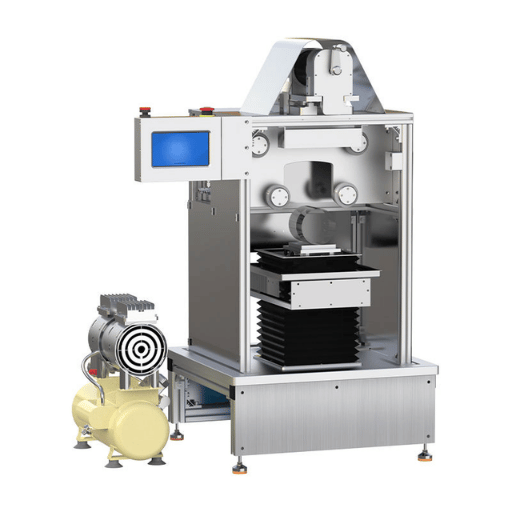
Five key parameters influence the positioning accuracy, surface quality, and repeatability of every cut produced on the same machine with a single wire saw: Knowing how they directly influence each other will help avoid trials, losses, and tragic failures during initial setup and printing operation.
Wire speed will directly influence surface finish quality. Speeding up the cutting process will presumably decrease the depth of cut into each abrasive grain and cutting zone, producing a smoother surface finish. Recent data in PMC (National Library of Medicine) have shown that increasing the wire speed from 1,000 to 1,400 meters per minute can measurably reduce the Ra on single crystal silicon. Typical single wire machines cut at 12-25 m/sec., and grown wire machines process at 80 m/sec.
Feeding rate, how quickly the wire feeds into the workpiece will also influence surface roughness quality. Air/auto feedrates of 0.1–0.4 millimeters per minute will tend to keep down the cutting force, decrease surface roughness, and run longer cycles. It must be cautioned that aggressive settings can produce subsurface micro-fracturing and failure caused by micro cracks in thin and brittle specimens, only visible after polishing-tragedies lurking in the dark that increase costs for both the operator and diamond wire.
Wire tension must be matched to wire diameter, and material hardness. Typical tension figures for most single wire saws range from 50 to 60 N. Excessively high tension on super thin sections of less than 5 mm dimension produce significant deflections and micro cracking on the exit edge of the specimen. Machines such as the SW5030CLNC-C single wire saw feature PLC-based tension control, with feedback from a load cell monitoring tension.
Indexing accuracy affects repeatability of positioning between cuts. Typical systems provide 0.050 mm., up high-draw machines reaching 0.003 mm. Critical in wafering applications with a required consistency of thickness down to 10 um or less for certain photovoltaic specifications.
Cutting fluid affects wool life and surface properties. De-ionized water is proven for use with silicon and ceramics. Tap water with unapproved filtering introduces minerals into diamond wire cutting operation, mounting on the diamond residing along the rows of units formed during cutting operating wearing the abrasive particles at a higher rate of loss: field testing has shown a 30-40% reduction in wire life when a common water tap with a carbon micro-porous filter is substituted for jet de-ionized water.
📐 Engineering Note
For specimens below 5 mm in thickness, cut setting should be greatly reduced: down to 30-40 N tension, 0.1 mm/min. feed rate, targeting 0.35 m surface roughness on silicon and SiC specimens. Finalcut parameters should correspond to specifications established in SEMI M69 requirements if determining wafer geometry.
⚠️ Common Mistake
Operators will sometimes use tap water instead of de-ionized water or cutting fluid to reduce consumption. Mineral deposits along the wire accelerate diamond wear from within the abrasive particle so that inter-grit loss is increased and overall wire life can be reduced from over 200 cuts to fewer than 120 cuts of wire per spool.
Diamond Wire vs. Abrasive Slurry Wire: Which Cutting Method Fits Your Needs?
Knowledge of the two fundamentally different approaches to wire cutting is essential: fixed-abrasive versus free-abrasive slurry, since each has quantifiable benefits and drawbacks when testing one material and critical life expectancy considerations. Data in this comparison from a study Paper in Procedia Manufacturing discussing different production techniques in diamond wire sawing of solar silicon wafers.
| Parameter | Diamond Wire (Fixed Abrasive) | Slurry Wire (Free Abrasive) |
|---|---|---|
| Kerf Width | 0.15 – 0.26 mm | 0.20 – 0.35 mm |
| Material Loss Reduction | Up to 30% less than slurry | Baseline |
| Cutting Speed | 2–3× faster at equivalent kerf | Baseline |
| Coolant Type | Water-based (recyclable) | SiC abrasive slurry (disposal required) |
| Surface Roughness (Ra) | 0.27 – 0.43 μm | 0.30 – 0.50 μm |
| Environmental Impact | Lower (no hazardous slurry waste) | Higher (slurry disposal costs) |
| Best Suited For | Silicon, SiC, sapphire wafering | Specialty crystals, oriented cuts |
✔ Diamond Wire Advantages
- 30% less material waste from narrower kerf
- 2–3× higher throughput at same quality
- Water-based coolant eliminates hazardous slurry disposal
- Better dimensional control on thin wafers (<200 μm)
⚠ Limitations to Consider
- Higher wire consumable cost per meter
- Wire wear accelerates on materials above Mohs 9 (SiC, sapphire)
- Heat buildup increases the contact length on large specimens
- Not ideal for very soft materials (polymers, rubber)
In actual application, diamond wire has mostly substituted slurry wire in silicon wafering and similar SiC wafering. According to photovoltaic industry data, slicing precision has been reported by 38% of solar cell producers, with as much as 22% of savings of raw materials/scrap after adopting fixed-abrasive diamond wire technology.However, slurry wire still keeps its position of niche for oriented crystal cutting as well as for some special uses when a certain surface pattern resulting from the lapping action of free abrasives is desired, with the reciprocating diamond wire cutting machine. The WFXV5030 reciprocating diamond wire cutting machine can operate both in the continuous and reciprocating modes to provide either approach using diamond wire.
Industry Applications: From Semiconductor Wafering to TEM Sample Prep
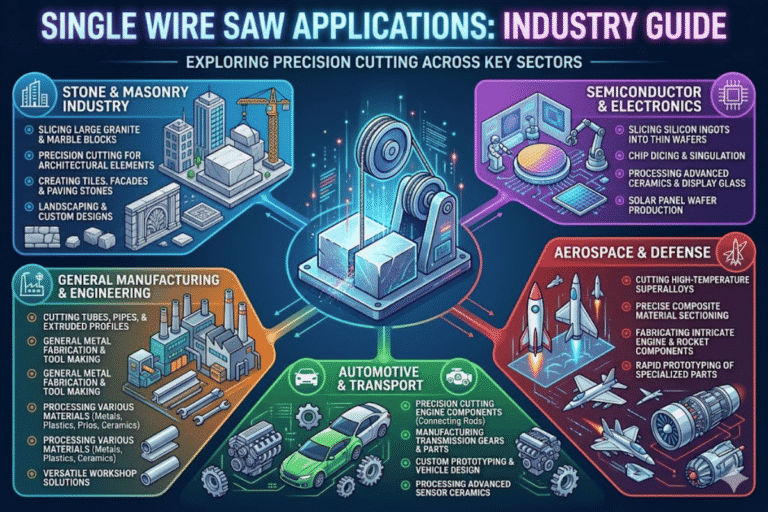
Single wire saws are designed to cater to four different industrial segments which each have differing cutting requirements and specimen handling concerns.
Semiconductor Wafering
Single wire saws are used to cut silicon and compound semiconductor ingots into wafers so that Integrated Circuits can be fabricated. Market data puts diamond wire saw demand at USD 1.5 billion in 2024, growing to USD 3.2 billion by 2033 with an 8.94% CAGR according to IMARC Group. This growth is driven mainly by demand for semiconductor and Photovoltaic products.
As 47% of wafer fabrication occurs within Asia-Pacific13, Asia-Pacific consumption accounts for this huge chunk of the market
Photovoltaic Cell Production
Photovoltaic cell manufacture involves slicing off very thin wafers (150-180 m thick) from the larger polycrystalline and mono-crystalline silicon ingots. This task is performed by diamond wire saws which can replace slurry wire as the cutting medium with some quantified benefits, reduced kerf loss, increased throughput, and less environmental impact because of the absence of SiC abrasive slurry waste. DONGHE offers diamond wire saws designed for photovoltaic slicing, with loading and loading velocities adjustable according to the ingot diameters.
Research Laboratory and TEM Sample Preparation
In materials science and fracture analysis laboratories, a single wire saw are used in preparing specimen cross-sections for SEM or transmission electron microscopy (TEM). Desktop precision machines are capable of cutting specimens up to 50 mm (2 inches) in diameter with a 0.28 mm diamond wire. In IC failure analysis, the wire saw preparation is combined with focused ion beam (FIB) milling to allow the investigator to reveal the transistor structures, conducting paths and bonded interconnections on the nanoscale as seen in published reports through the IEEE.
The laboratory diamond wire saw is a valuable tool, particularly in the preparation of breakable crystals for TEM or IC analysis because of the reduction in mechanical impact damage than can adversely influence analysis results.
Advanced Ceramics and Magnetic Materials
Grinding/controlling (e.g. NdFe B magnets, ultra-hard ceramic materials i.e. Si 3 N 4 , alumina, zirconia).
Cutting for these materials needs to be carefully controlled and managed such that cracks do not develop along any grain boundaries. Single wire saws allow for just this. Varying feed rate and tension can be set in order to enable this supreme control.
DONGHE’s precision diamond wire saw solutions can incorporate fixturing and parameter presets for multiple material types for this type of application.
💡 Key Takeaway
Has been used as a perfect tool for cutting various materials including the most demanding, semiconductor grade single crystal silicon as well as high-tech ceramic composites. Conditions for any application scenario remain the same: to have minimum kerf, surface modulation control and no thermal damage.
How to Match a Single Wire Saw to Your Cutting Requirements

There are 4 factors which interact to determine which precision wire saw is chosen. Going through them in order avoids over-specifying (wasting budget) or under-specifying (not meeting tolerances).
- ✔
Step 1 — Define the material. Identify hardness (Mohs scale), brittleness, and whether the material is a single crystal or polycrystalline structure. This determines wire type and tension range. - ✔
Step 2 — Measure the workpiece. Maximum cross-section diameter dictates the saw’s cut envelope. Desktop models handle up to 50 mm; floor-standing machines process workpieces up to 300 mm. - ✔
Step 3 — Set accuracy requirements. If your application requires thickness uniformity within ±10 μm (semiconductor wafering), specify high-precision indexing (±0.003 mm). General specimen preparation tolerates standard indexing (±0.050 mm). - ✔
Step 4 — Evaluate throughput needs. Single-piece R&D cutting tolerates slower feed rates (0.1 mm/min) for the best surface quality. Production wafering prioritizes higher speeds (0.3–0.4 mm/min) with acceptable Ra trade-offs.
For a more detailed walkthrough with model by model comparison, please refer to our single wire saw selection guide. DONGHE engineering team – with over 10,000 documented cutting cases in silicon, SiC, sapphire and advanced ceramics – is happy to advise on application specific parameters based on your workpiece size and surface finish requirements.
Frequently Asked Questions
Q: What is the thinnest cut a single wire saw can make?
View Answer
For single wire saws, using ultra-fine diamond wire (120 m diameter) it is possible to achieve kerf widths as low as 0.15 mm. Minimum practical slice thickness relates to the material – silicon wafers are commonly thinned to 150 m, whereas more brittle materials like sapphire tend to require slices greater than 300 m in order to prevent fracturing during handling.
Q: Can a single wire saw cut metal materials like stainless steel?
View Answer
Yes. Cutting of thin sections of stainless steel, titanium alloys and other metals using diamond wire saws is also achievable. Since these materials tend to yield continuous chips rather than fragile debris, the wire load is higher. Feed rates should be reduced to 0.05–0.15 mm/min. and it is advisable to use a water soluble coolant, containing lubricating agents, to avoid issues with wire starvation.
Q: How long does a diamond wire last before replacement?
View Answer
Wire lifetime is determined by the hardness of the material, wire diameter and operating conditions. On silicon it was observed that a single 15 meter spool of 0.28 mm diamond wire will, on average, achieve between 150 and 250 cuts before the surface roughness deteriorates beyond a tolerable level, however this is reduced by virtue of either SiC and sapphire (Mohs 9+) material to between 80 and 150 cuts per spool. Proper coolant filtration and tension control are the most effective ways to prolong wire life.
Q: What coolant should I use with a diamond wire saw?
View Answer
Deionized water is the working cutting fluid for most hard and brittle materials. For use with metals or some ceramics, a water based coolant mix with 3-5% concentration is preferable as it enhances penetration and chip flush. Standard tap water should be avoided as this can result in the accumulation of mineral crystals that lead to the loss of diamond grit, while the coolant should be replaced every 40-60 hours of operation or when the particle content exceeds the capacity of the filtration system.
Q: Is a single wire saw suitable for mass production or only lab use?
View Answer
Both. In addition to a laboratory specimen preparation and high throughput R&D prototyping tool, online consumable supply, automated recipe control (up to 30 program memory) and continuous wire feed, and multi-shift operation make the floor standing CNC controlled single wire saw suitable for high volume wafering and batch cutting environments in PV manufacturing plants or semiconductor fabrication facilities.
Q: What maintenance does a single wire saw require?
View Answer
Weekly: check guide roller wear grooves and clean coolant tank. Monthly: flush coolant filter system, check wire tension calibration, check and baseline spooler alignment. For complete details of recommended maintenance schedule with step-by-step instructions, please refer to our laboratory wire saw maintenance guide.
About This Analysis
DONGHE (Shanghai Donghe Science & Technology Co., Ltd.) manufactures the single wire saw and diamond wire saw models documented throughout this guide. Technical parameters – wire speed, tension, indexing accuracy – are derived from production testing of 10,000+ cutting cases since 2014. Our portfolio includes 35 patents granted in China for diamond wire cutting technology. Third-party data used to inform this guide is obtained from peer reviewed journals, academic papers and industry publications the references to which can be viewed via this guide.
References & Sources
- Diamond Wire Sawing Process for Single-Crystal Hard and Brittle Materials (2024) — Journal of Manufacturing Processes / ScienceDirect
- Feed Rate with Velocity Control in Cutting Mono Crystalline Silicon (2024) — PMC / National Library of Medicine
- Diamond Wire Saw Processing Parameters on Silicon Nitride Ceramics (2023) — MDPI Micromachines
- Process Parameters Analysis: Diamond Wire Saw Cutting NdFeB Magnet (2025) — MDPI Materials
- Diamond Wire Sawing of Solar Silicon Wafers: A Sustainable Alternative (2018) — Procedia Manufacturing / ScienceDirect
- FIB Sample Preparation for TEM Failure Analysis of Advanced Devices — IEEE
- Diamond Wire Market Size, Trends & Growth Forecast 2033 — IMARC Group
Related Articles
- How Diamond Wire Saw Works: Working Principles Explained — Detailed breakdown of reciprocating and unidirectional drive systems
- How to Choose a Single Wire Saw Machine: Selection Guide — Model comparison with specification tables for lab and production use
- Laboratory Wire Saw Maintenance: Best Practices Guide — Weekly and monthly maintenance checklist for wire saw longevity
- Diamond Wire Saw Safety Guidelines for Laboratory Use — PPE requirements, emergency procedures, and coolant handling protocols
- Precision Diamond Wire Saw Applications — Application-specific configurations for magnetic materials and advanced ceramics


![Polysilicon Material: Properties, Grades & Uses [Guide]](https://wiresawcutter.com/wp-content/uploads/2026/08/polysilicon-material-featured-150x150.webp)