
Get in touch with DONGHE Company


Selecting the Right Multi Wire Saw Machine: A Specification-Driven Buying Guide
Published March 31, 2026 · 12 min read
Focus: How to choose the best Multi wire saw machine
Key Specs Covered: kerf width (80-200 μm) thickness tolerance (±2-5 μm) wire speed (5-40 m/s)
Materials: Silicon · SiC · Sapphire · Granite · Ceramics · Quartz
Price Range: $15,000 – $500,000+ depending on configuration
If you manage a wafer fabrication shop, a stone-processing mill, or a material-science laboratory, the multi wire saw machine on your shop floor is what determines both your product quality and your per-unit cost. An oversized machine will overcut material by pushing excess kerf. In an under-capable machine, the result is low throughput and high rework rate. An optimal machine pays for itself in just 18-24 months through tighter thickness tolerances and increased productivity.
This primer introduces product specs, component compatibility, true ownership costs, and typical purchasing pitfalls that make the difference between a wise investment and an expensive mistake. Every figure in the text is adapted from real published research, first-hand experience, or published field measurements of more than 10,000 cutting operations on 6 continents.
What Is a Multi Wire Saw Machine and How Does It Work?
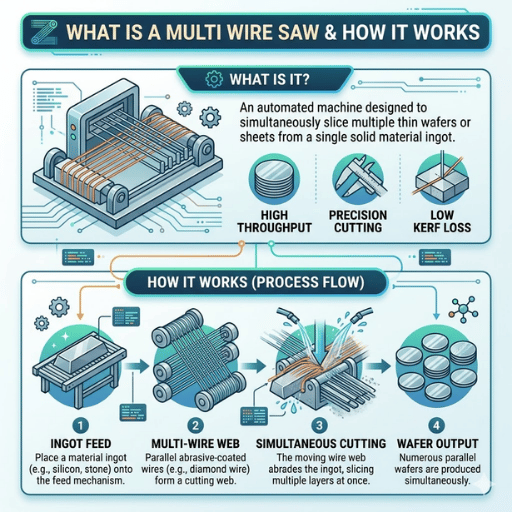
A multi wire saw machine may contain dozens or even hundreds of wires that operate in parallel to slice a single piece into many wafers simultaneously. Individual wires are miniature cutting tools-an array of wires bearing abrasive grit moves together to bring liberated particles into contact with the material. This process produces slices at dramatically increased rates-the 20-wire approach always produces 20 slices in the time required by a single-wire system. For silicon wafers, multi wire saw is the efficient solution for ultra-high-volume, precision cutting of hard materials.
This technique is based on abrasive cutting. In slurry-based systems, a liquid medium loaded with silicon carbide grit creates an abrasive-carrying layer between wire and workpiece, and drives the cutting action. In the latest diamond wire systems, diamond particles are bonded directly on the surface of the wire, eliminating the slurry entirely. The advent of diamond-wire technology for semiconductor industry and photovoltaics was approximately 2016, owing to increases in cutting speed, reductions in kerf loss, and decrease in waste. For more detail, see the diamond wire saw physical principles.
Wire speed in modern multi wire saw machines ranges from 5 to 20 m/s for stone processing, up to 30-40 m/s for semiconductor-grade material. Wires run in a continuous loop around guide rollers. Each guide groove is precisely machined with a form that guarantees even wire spacing: deviations of 10 μm at the roller will produce a measurable thickness inconsistency in the cut batch.
DONGHE has recorded the dependency of this variable across more than 10,000 global cutting sessions, handling multiple silicon-based materials. Results show that machines including servo-controlled wire tension and closed-loop speed regulation outperform open-loop designs in both yield and surface finish.
Engineering Note: In high-volume production multi wire saw, wire speed stability stays within 0.5% at 30-40 m/s. At these speeds, even brief speed variation causes waviness marks on the cut surface, measured as total thickness variation (TTV).
Types of Multi Wire Saw Machines: Diamond Wire vs Slurry Wire
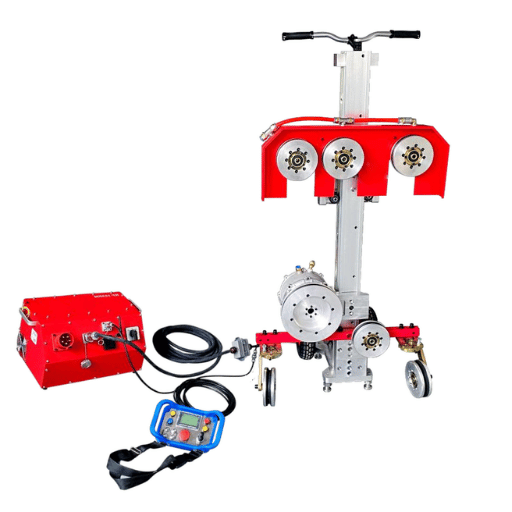
The two main classes of multi wire saw technology vary only in the mode of delivery of the abrasive material to the cutting zone. Your choice will be driven by the specific piece of material to cut, desired surface quality and acceptance of process complexity.
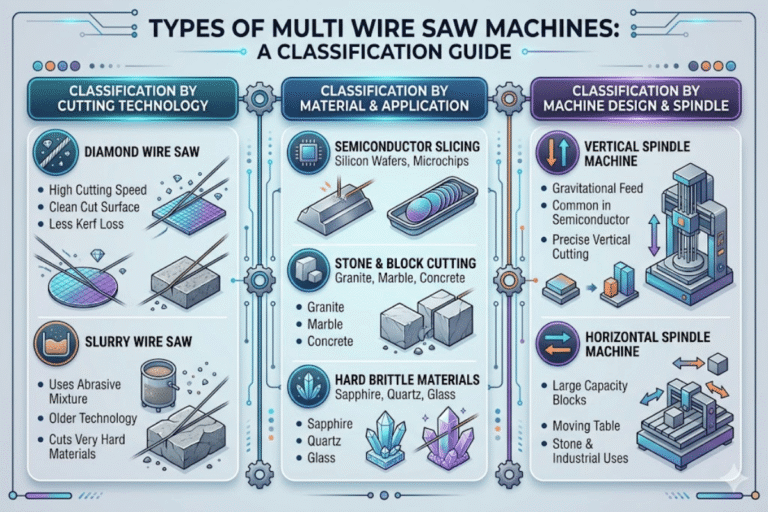
Diamond wire saws employ steel core wire electroplated or resin bonded with diamond grit. Diamond grit is affixed permanently to the wire surface so material removal occurs by direct abrasion. As a result, narrower kerf (80-130 μm), improved surface roughness (around 0.25 μm Ra) and higher speed of feed are achieved. Diamond wire has become standard for silicon ingot slicing and is on the rise when slicing sapphire crystal and SiC.
Slurry wire saws use bare steel wire bathed in an abrasive particle slurry, usually silicon carbide in polyethylene glycol. Loose abrasive is rolled through the gap between wire and workpiece so three-body wear is initiated. An increase in kerf (150-200 μm) and surface roughness (about 0.5 μm Ra) is evident, along with a slower cut rate. However, slurry wire is still employed for fragile semiconductor compounds where three-body interaction will reduce subsurface damage.
| Parameter | Diamond Wire | Slurry Wire |
|---|---|---|
| Kerf Width | 80–130 μm | 150–200 μm |
| Surface Roughness (Ra) | ~0.25 μm | ~0.5 μm |
| Cutting Speed (silicon) | 1.5–3.0 mm/min | 0.3–0.8 mm/min |
| Wire Speed | 30–40 m/s | 8–15 m/s |
| Coolant/Carrier | Water-based coolant | SiC slurry in PEG |
| Environmental Impact | Lower (no slurry disposal) | Higher (slurry recycling required) |
| Diamond Grit Size | 10–20 μm (semiconductor), 40–60 μm (stone) | N/A (loose SiC abrasive) |
| Best Applications | Silicon, SiC, sapphire, stone | Fragile III-V compounds, specialty crystals |
A research article in the journal Materials documented that diamond wire saws of monocrystalline silicon had 30-50% less subsurface damage than slurry (PMC/NIH, 2023). For a deeper look at minimizing subsurface damage in crystalline materials, we have covered the topic separately.
Engineering Note: Grit size selection can be significant. For illustration, stone cutting uses 40-60 μm grit to cut faster. Semiconductor wafer slicing uses 10-20 μm grit to produce lower surface roughness and minimize crack propagation depth.
7 Specifications That Determine Cutting Quality and Throughput
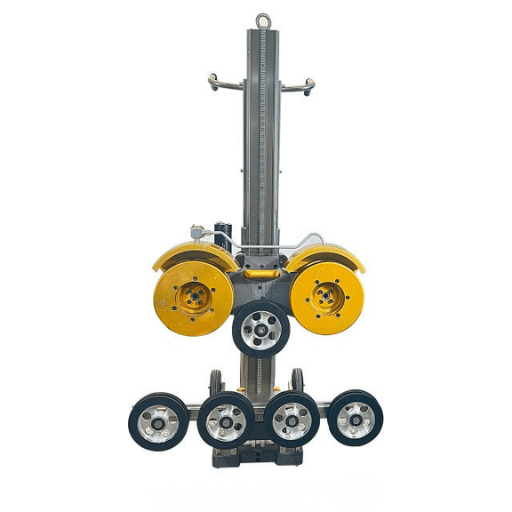
Not all multi wire saw machines are identical in construction, and there is more to your system’s specification sheet than the sales brochure. Read on to find the seven parameters that directly influence your product quality and your production economics.
1. Kerf Width (80–200 μm)
Kerf is waste due to the cut. Each micron of kerf was paid for and can’t be sold. For silicon wafer production, reducing kerf from 180 μm across a 156 mm ingot yields 15-20% more wafers per ingot. Diamond wire will run at 80-130 μm kerfs, whereas slurry systems use 150-200 μm kerfs.
2. Thickness Tolerance (±3–5 μm Standard, Sub-2 μm Premium)
Thickness tolerance measures the consistency of wafer thickness. Industrial average is about ±3-5 μm. Good CNC systems use real-time feedback to reach sub-2 μm TTV. There is a cost to every micron of incoming variation in SiC wafer cutting; it will increase subsequent lapping and polishing processes.
3. Wire Speed (5–20 m/s Stone, 30–40 m/s Semiconductor)
Wire speed affects both cutting rate and surface finish. Higher speed generally improves finish quality but increases wire wear. 5-20 m/s speeds are employed in stone applications because the larger diamond grit removes material efficiently at lower velocities. Semiconductor slicing pushes 30-40 m/s where the fine grit needs higher contact frequency to maintain practical feed rates.
4. Wire Tension Control (100–300 N Range)
Tension governs wire deflection, and deflection governs cut straightness. Systems use hydraulic, pneumatic, or servo-electric tensioning. Servo tension with closed-loop feedback offers the tightest variance-typically within 5% of setpoint. Pneumatic systems drift more during long cuts. Target tension depends on wire diameter: 120 μm core wire typically runs at 20-25 N per wire, while 160 μm wire handles 30-40 N.
5. Maximum Workpiece Dimensions
Values vary from 150 mm travel (laboratory wafer saws) to 4,000 mm+ travel (architectural stone saws). The DONGHE industrial-scale multi wire saw, for example, can handle workpieces up to 4,000 × 4,000 mm. Buy for your largest realistic workpiece, not your average one-retrofitting a larger travel later is usually impossible.
6. Number of Wires per Cycle
This substantially governs throughput per cut cycle. Laboratory machines may run 4-20 wires. Production silicon saws tend to run 500-1,000+ wires simultaneously. Stone cutting machines typically use 20-80 wires. Wire count also governs roller diameter and machine footprint-more wires require longer rollers and a larger frame.
7. Automation Level (Manual / Semi-Auto / Full CNC)
Manual machines require an operator to load and align the workpiece while automating process execution. Semi-automatic machines automate the cut cycle but need manual loading. Full CNC systems automate loading, cut execution, and unload, and include recipe storage for multi-material repeatability. CNC adds 30-50% to machine purchase cost but drops a typical piece’s labor costs by 60-75%. For heavy-duty factory systems running 2-3 shifts, a fully automated system is usually the only way to meet your needs without proportional staff increases.
Engineering Note: Calibrate tension sensors every 200 hours of operation. Variances over 5% of setpoint are associated with measurable increases in TTV and surface waviness in cuts of over 300 mm.
If you are comparing multi wire technology against single-wire technology, the single wire vs multi wire comparison lays out throughput, precision and cost per slice.
Material Compatibility: From Silicon Wafers to Granite Blocks
Multi wire saw machines serve surprisingly broad industries. They reliably operate on many kinds of component, from semiconductor fabrication to quarry operations and construction material processing. They are built for cutting hard materials like silicon carbide, sapphire and granite with equal reliability. Wire type, grit size, tension and feed rate all vary along with cutting material. Below is a matrix of best-practice operating parameters for the most common workpieces.
| Material | Mohs Hardness | Recommended Wire | Typical Kerf | Key Consideration |
|---|---|---|---|---|
| Silicon Ingots | 6.5–7 | Diamond (10–20 μm grit) | 80–120 μm | Minimize TTV for downstream cell efficiency |
| Silicon Carbide (SiC) | 9–9.5 | Diamond (8–15 μm grit) | 100–150 μm | Extreme hardness; wire wear 3–5× faster than Si |
| Sapphire (Al₂O₃) | 9 | Diamond (10–20 μm grit) | 100–140 μm | Crystalline orientation affects fracture risk |
| Granite | 6–7 | Diamond (40–60 μm grit) | 150–200 μm | Heterogeneous grain; adjust tension for quartz veins |
| Marble | 3–4 | Diamond (30–50 μm grit) | 130–170 μm | Soft material; low tension to prevent chipping |
| Technical Ceramics | 7–9 | Diamond (15–30 μm grit) | 90–140 μm | Brittle fracture risk; slow feed rate essential |
| Quartz Crystal | 7 | Diamond (10–25 μm grit) | 90–130 μm | Piezoelectric sensitivity; minimize thermal shock |
Solar industry context: The global photovoltaic wafer market hit 804 GW capacity in 2024, according to the U.S. Department of Energy Quarterly Solar Industry Update. Industry sources estimate the PV wafer market valued $3.2 billion in 2024 at a CAGR of 11.5 percent. Multi wire diamond saws account for the overwhelming volume. The IEA Special Report on Solar PV Supply Chains reinforces the global evolution toward thinner wafers (sub-150 μm), which directly demands tighter kerf control and lower TTV.
Early multi-wire slurry demonstrations by the U.S. Department of Energy showed that multiple wires could produce photovoltaic-grade wafers at scale, a concept documented in OSTI technical reports from that era. Since those early trials, the technology has evolved dramatically, but the core throughput advantage of simultaneous multi-wire cutting remains unchanged.
To discover greater details on DONGHE multi wire saw machines matched to each material types, the product guide provides specifications and application notes for each machine model.
True Cost of Ownership: Beyond the Purchase Price

The published invoice price of a multi wire saw machine shows about 40-60% of the true cost you will encounter during a 5-year ownership cycle: wire consumables, machine maintenance, utilities, and downtime. Wire durability and factory-level productivity gains ultimately determine whether your machine pays for itself. Knowing the true cost of your machine, and what costs matter most, allows you to choose the right machine tier for your anticipated production volumes.
Machine Acquisition Cost
Prices vary significantly by configuration, but the market segments into three broad tiers:
| Tier | Price Range | Typical Application | Wire Count |
|---|---|---|---|
| Entry / Lab | $15,000–$30,000 | R&D sample preparation, prototyping | 4–20 wires |
| Mid-Range Production | $60,000–$120,000 | Stone slabbing, small-batch wafer production | 20–100 wires |
| High-End CNC | $300,000–$500,000+ | High-volume semiconductor wafer manufacturing | 200–1,000+ wires |
Consumable Costs: Wire Is the Biggest Ongoing Expense
Industry sources indicate that diamond wire costs approximately $1,000 per 30,000 meters of wire. A typical spool will last 20-40 hours in active cutting duty, depending upon the hardness of material being cut. SiC cutting consumes wire 3-5 times faster than silicon because of the vastly higher hardness. At high-volume, two-shift utilization levels, annual wire spend can top $30,000-$80,000.
Maintenance Windows
Routine maintenance intervals typically fall at 200-300 operating hours. This includes guide roller inspection and replacement, tension sensor calibration, coolant system flushing, and wire guide groove measurement. Skipping scheduled maintenance does not save money-worn guide rollers are the single most common cause of premature thickness variation drift.
ROI Calculation Framework
💡 Simple ROI Formula for Multi Wire Saw Investment:
Annual Benefit = (pieces/year × value/piece) − (pieces/year × previous cost/piece)
Annual Cost = depreciation + wire + maintenance + utilities + labor
Payback Period = Total Machine Cost ÷ (Annual Benefit − Annual Cost)
For stone processing equipment: payback is generally 14-22 months; in premium semiconductor applications with significantly higher part values payback often is achieved in 10-14 months.
One frequently underestimated cost element is consumable wire quality. Cheaper wire with inconsistent diamond coating density produces more variation in kerf and surface finish, which increases downstream polishing time and rejection rates. The per-meter cost difference between premium and budget wire is typically 15-25%, but the downstream quality cost of using budget wire can erase those savings entirely. Choosing the right wire for your operation means budgeting for wire quality that matches your tolerance requirements.
5 Selection Mistakes That Cost Manufacturers Thousands
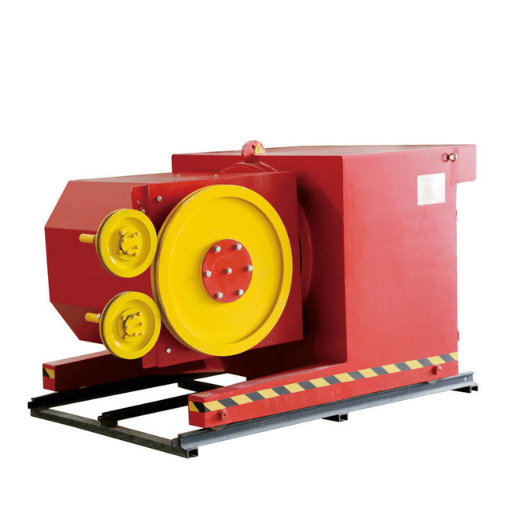
After reviewing purchasing decisions across hundreds of installations, certain errors appear repeatedly. Each one inflates your ownership cost or limits production capability in ways that are expensive to fix after delivery.
1. Over-Specifying Capacity
A manufacturer cutting 20 slabs per day does not need a 1,000-wire machine designed for high-volume wafer fabs. Over-specifying means paying for guide rollers, tensioning systems, and floor space you will never use. It also means higher wire consumption per cycle even when running partial loads. Match the wire count and travel to your actual production plan, not your aspirational one.
2. Ignoring Wire Type Compatibility
There are mechanical design differences between a Diamond wire machine and a slurry wire machine. For example a diamond wire saw employs different guide roller materials, coolant delivery and tension ranges than a slurry system. Buying a diamond wire machine only to find out the intended material requires slurry mode, or vice versa, and this cannot be corrected by repackaging the machine.
Establish wire type compatibility on the purchase order.
3. Skipping Test Cuts Before Purchase
Specification sheets state capability under ideal conditions. Your actual workpiece material, with its grain structure, inclusion concentration and thermal characteristics, will probably react quite differently. Always insist on test cuts using your specific material and the specific machine model you plan to buy; measure kerf, TTV, surface roughness and the depth of subsurface damage, from the test cuts.
If a seller avoids doing test cuts, treat that as a warn off. If you are also considering single-wire options, the single wire saw selection guide establishes a similar decision framework.
4. Underestimating Floor Space and Utilities
A mid-range multi wire saw requires approximately 15-25 m² of floor space with some clearance behind for operators and room at the front and either side for materials staging in and out. Power requirements range from 15 kW (lab units) to 80+ kW (production CNCs). Water-cooled systems require chilled water at 15-20°C with flow rates of 20-40 L/min.
Additional infrastructure will be needed for the extraction of mists. All cutting equipment with exposed moving parts must also comply with OSHA 1910.212 machine guarding requirements. This must be in place before the machine arrives, not after.
5. Neglecting After-Sales Service and Support
A 16-hour per day operation cannot afford to wait three weeks for a component shipped from overseas. Before buying, check: location of spare parts inventory, guaranteed response time in the event of a critical failure, availability of off-line diagnostics, and whether the company provides training on-site. DONGHE, for example, has regional spare parts inventories plus patent protected off-line troubleshooting established over more than 10 years of off-site service with 35 diagnostic systems.
Critical spare parts should be deliverable in hours, not days.
Pre-Purchase Checklist: Before finalizing any multi wire saw purchase, confirm these five items in writing: (1) test cut results on your material, (2) wire type and grit specification compatibility, (3) utility requirements vs your facility capacity, (4) spare parts lead time guarantee, (5) operator training included in purchase scope.
Eager to select the perfect multi wire saw to suit your production requirements?
Frequently Asked Questions
What materials can be cut with a multi wire saw machine?
View Answer
multi wire saws are used for processing all sorts of hard and brittle materials. Typical materials are monocrystalline and polycrystalline silicon ingots for solar (photovoltaic) cells, silicon carbide (SiC) for power electronic devices, sapphire for LED substrates, natural stone (granite, marble) for dimensional stone (architectural slabs), technical ceramics (alumina, zirconia), quartz crystals for frequency control devices, etc. Wire type and grit size are adapted to the hardness and fracture characteristics of the material.
How long do cutting wires last in a multi wire saw?
View Answer
Diamond wire typically lasts 20-40 hours of active cutting. Wire life depends heavily on the material being cut-SiC and sapphire wear wire 3-5 times faster than silicon. Monitoring wire diameter during operation helps predict replacement timing before quality degrades.
What is the typical thickness tolerance when slicing wafers?
View Answer
Standard production multi wire saws achieve thickness tolerance of ±3-5 μm, measured as total thickness variation (TTV) across the surface of the wafer. A superior CNC controlled machine with real time feedback can achieve sub-2 μm TTV. This is critical for leading edge semiconductor and power device substrates where flatness directly influences device yield.
Can multi wire saw machines be fully automated?
View Answer
Yes. Top end modern multi wire saws support complete CNC automation including robotic workpiece loading, automated wire threading, recipe-based parameter adjustment, and real time process monitoring. Complete automation can add 30-50% to the initial purchase cost of the machine but can also reduce per-piece labor costs by 60-75%. Semi-automated systems are an intermediate step, where the cutting operation occurs hands-free but loading and unloading are still operated by a person. How much automation is appropriate depends on how many pieces per day you expect to produce and the availability of labor.
What is the difference between diamond wire saw and slurry wire saw?
View Answer
Diamond wire saws feature abrasive diamond particles directly bonded to the wire surface while slurry wire saws feature plain steel wire bathed in a liquid mixture of free abrasive particles (usually very fine silicon carbide in polyethylene glycol), cutting through three-body rolling contact. Diamond wire produces narrower kerf (80-130 μm vs 150-200 μm), smoother surface finish (0.25 μm Ra vs 0.5 μm Ra), and higher cutting speeds. Slurry wire still finds use in certain fragile compound semiconductors where its gentler cutting action produces less subsurface lattice damage.
How do I calculate the ROI of a multi wire saw investment?
View Answer
Calculate net annual benefit from the increased yield (or material savings) based on additional Pieces produced. Deduct your current annual overhead amortized cost including depreciation, wire-related materials, maintenance, utilities, and labor. Divide total machine cost by net annual benefit to determine payback period. For most medium-sized stone processing operations this is between 14 and 22 months. Higher value per-wafer semiconductor applications tend to achieve payback in only 10-14 months.
Related Articles
References
- PMC/NIH — Recent Advances in Precision Diamond Wire Sawing Monocrystalline Silicon (2023)
- OSHA — 1910.212 General Requirements for All Machines (Machine Guarding)
- U.S. Department of Energy — Quarterly Solar Industry Update
- OSTI — Multi-Wire Slurry Wafering Demonstrations
- IEA — Special Report on Solar PV Global Supply Chains
- Wikipedia — Wire Saw
Our Perspective on This Guide
DONGHE manufactures multi wire saw machines and has a commercial interest in the products discussed. Technical specifications and cost ranges cited in this guide are drawn from published research, government data sources, and field observations from more than 10,000 documented cutting cases. Where exact figures depend on specific configurations, we have used qualifying language and cited ranges rather than single values.
![SiC Wafer Multi Wire Saw Process, Parameters & Selection [Guide]](https://wiresawcutter.com/wp-content/uploads/2026/05/SiC-Wafer-Multi-Wire-Saw-Process-Parameters-Selection-Guide-768x512.webp "SiC Wafer Multi Wire Saw: Process, Parameters & Selection [Guide] 7")

![Polysilicon Material: Properties, Grades & Uses [Guide]](https://wiresawcutter.com/wp-content/uploads/2026/08/polysilicon-material-featured-150x150.webp)